
Digital Watchdog DWC-MF5Wi4TW vs Digital Watchdog MC553WTIR: Specification Comparison
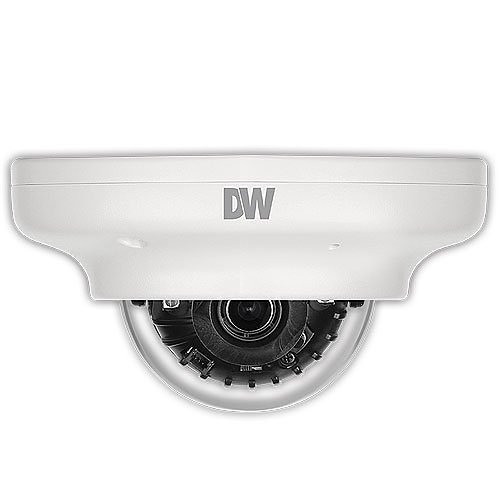
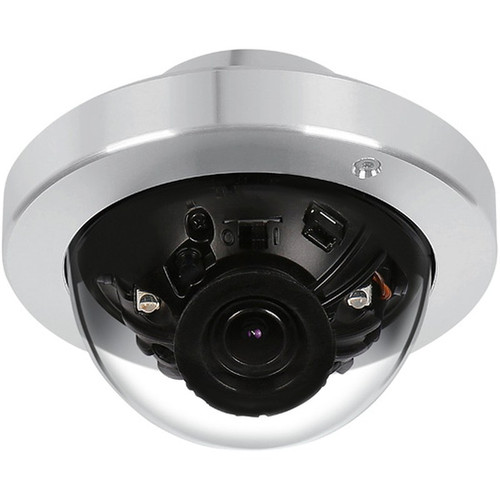
Both the Digital Watchdog DWC-MF5Wi4TW and DWC-MC553WTIR are 5MP fixed-lens outdoor IP dome cameras sharing the same resolution class, sensor size, and general deployment category. The MF5Wi4TW is a full-sized vandal dome with IP/network streaming and onboard analytics, while the MC553WTIR is a micro dome supporting both IP and HD-over-coax analog formats. This comparison helps installers and IT buyers evaluate which unit better fits their low-light requirements, VMS environment, power infrastructure, and physical installation constraints.
In This Guide
How do the imaging specs compare?
Both cameras use a 5MP 1/2.8" CMOS sensor with identical minimum scene illumination ratings: 0.0 lux in B/W and 0.16 lux in color. Both deliver True WDR at 120dB and include Smart DNR 3D digital noise reduction, auto gain control, de-fog, and auto day/night switching. The MF5Wi4TW offers three focal length options — 4.0mm, 6.0mm, and 8.0mm — with corresponding HFOVs of 82.3°, 51.9°, and 37.8°, and VFOVs of 43°, 29°, and 22°. The MC553WTIR is fixed at 4.0mm with an HFOV of 82° and a VFOV of 60°. Active pixel counts differ slightly: 2592×1944 for the MF5Wi4TW versus 2608×1960 for the MC553WTIR.
A meaningful low-light differentiator is the MC553WTIR's Star-Light technology, which provides a configurable sense-up multiplier from x2 to x32, electronically extending sensitivity in near-darkness beyond what standard IR color-to-mono switching alone provides. The MF5Wi4TW does not list a sense-up or Star-Light feature in its specifications. Both cameras share a 50-foot Smart IR range. The MF5Wi4TW specifies shutter speeds from 1/15 to 1/32000 with slow shutter modes (x2 through x7.5), while the MC553WTIR shutter range is 1/30 to 1/30000 with sense-up replacing slow-shutter functionality. The MF5Wi4TW also includes backlight compensation is not explicitly listed in its specs, whereas BLC is explicitly listed for the MC553WTIR.
What about installation and environment?
Both cameras carry an IP66 weatherproof rating and operate across the same temperature range of -4°F to 122°F (-20°C to 50°C) at 10–90% non-condensing humidity. Vandal resistance differs: the MF5Wi4TW is IK10-rated with an aluminum die-cast body and polycarbonate lens cover, while the MC553WTIR achieves IK09 with an all-aluminum die-cast housing. For installations requiring maximum impact resistance — such as exposed corridors or public-access areas — the MF5Wi4TW's IK10 rating provides one additional impact-class of protection.
Form factor and power diverge significantly. The MF5Wi4TW is a standard vandal dome measuring 4.92" × 1.88" and weighing 0.88 lbs, powered exclusively via PoE (Class 3, max 7.2W) or DC12V (max 5.9W). The MC553WTIR is a micro dome at 3.14" × 2.34" and 0.56 lbs, drawing only 1.98W maximum and supporting both PoE Class 2 and DC12V — making it compatible with lower-wattage PoE switches and midspans. Mounting accessories are sold separately for both. Housing colors differ: white for the MF5Wi4TW, ivory for the MC553WTIR.
Which fits your VMS and analytics better?
The DWC-MF5Wi4TW is a network IP camera with full VMS integration capabilities: it is ONVIF-compatible, supports dual-stream H.264/H.265/MJPEG compression, streams at up to 30fps across all resolutions, and includes a web viewer compatible with Chrome, Edge, Firefox, and Safari on Windows, Mac, and Linux. It lists an extensive protocol suite including RTSP, HTTPS, SNMP v1/v2/v3, 802.1x, MAC filtering, Bonjour, UPnP, and Genetec Protocol support. It also carries onboard edge analytics under an IVA license (intrusion, line crossing, counting line, loitering, enter/exit, tamper) and an IVA+ license for extended rules including tailgating and object removal — note that IVA applies to the MF5Wi4TW SKU specifically, and IVA+ applies to the MPF5Wi variant SKUs per the spec sheet.
The MC553WTIR is a hybrid analog/IP camera supporting CVBS, 960H, HD-Analog, HD-CVI, HD-TVI, and HD-over-Coax signal formats in addition to IP, making it suited for mixed or legacy analog infrastructure. However, its specification does not list ONVIF compliance, VMS protocol support, video compression codecs, network streaming capabilities, edge analytics, audio I/O, or onboard SD card storage. The MF5Wi4TW specifies 1 audio input and 1 audio output (G.711 compression), 1 alarm input and 1 alarm output, and a MicroSD/SDHC/SDXC slot supporting up to 1TB. None of these features are listed for the MC553WTIR. Buyers integrating into an IP VMS or requiring edge analytics, audio, or local recording should note these absences.
Which should you choose: the DWC-MF5Wi4TW or the MC553WTIR?
Our take: The DWC-MF5Wi4TW is the stronger choice when deploying into a pure IP/VMS environment with requirements for onboard analytics, audio I/O, alarm I/O, or edge storage. It provides three focal length options (4.0mm, 6.0mm, 8.0mm) versus the MC553WTIR's single 4.0mm fixed lens, adds an IK10 vandal rating versus the MC553WTIR's IK09, and includes a MicroSD slot up to 1TB plus 1-in/1-out audio and alarm I/O — none of which are listed for the MC553WTIR. Conversely, the DWC-MC553WTIR is the stronger choice for legacy or hybrid coax infrastructure (HD-CVI, HD-TVI, HD-over-Coax support), lower-power deployments (1.98W max versus up to 7.2W), and installations where Star-Light x2–x32 sense-up performance in near-zero-light conditions is the primary driver. Buyers on IP-only infrastructure with a Genetec or ONVIF-compliant VMS and a need for analytics should select the MF5Wi4TW; those retrofitting analog systems or prioritizing extreme low-light sensitivity at minimal power draw should evaluate the MC553WTIR.
Side-by-Side Comparison
Spec-for-spec, from manufacturer data.
| Specification | Digital Watchdog DWC-MF5Wi4TW | Digital Watchdog MC553WTIR |
|---|---|---|
| Max Resolution | 5MP (2592 × 1944) | 5MP (2608 × 1960) |
| Image Sensor | 1/2.8" CMOS | 1/2.8" CMOS |
| Focal Length Options | 4.0mm / 6.0mm / 8.0mm (fixed) | 4.0mm (fixed) |
| Horizontal FOV | 82.3° / 51.9° / 37.8° | 82° |
| Min. Illumination (Color / B&W) | 0.16 lux / 0.0 lux | 0.16 lux / 0.0 lux |
| Star-Light / Sense-Up | — | x2 – x32 |
| IR Range | 50 ft (Smart IR) | 50 ft (Smart IR) |
| WDR | True WDR 120dB | True WDR 120dB |
| Shutter Speed Range | 1/15 – 1/32000 | 1/30 – 1/30000 |
| Video Compression | H.264 / H.265 / MJPEG | Not specified |
| Max Frame Rate | 30fps at all resolutions | Not specified |
| Signal Output | IP network only (CVBS test output only) | IP + HD-CVI / HD-TVI / HD-Analog / 960H / CVBS |
| ONVIF Compatible | Yes | Not specified |
| Edge Analytics (IVA) | Yes (intrusion, line crossing, loitering, tamper, etc.) | Not specified |
| Audio I/O | 1 in / 1 out (G.711) | Not specified |
| Alarm I/O | 1 input / 1 output | Not specified |
| Onboard Storage | MicroSD/SDHC/SDXC up to 1TB | Not specified |
| Privacy Zones | 16 programmable | 24 programmable |
| IP Rating | IP66 | IP66 |
| Vandal / Impact Rating | IK10 | IK09 |
| Housing Form Factor | Vandal Dome | Micro Dome |
| Housing Color | White | Ivory |
| Housing Material | Aluminum die-cast + polycarbonate lens cover | Aluminum die-cast |
| Power Input | PoE / DC12V | PoE / DC12V |
| PoE Class | Class 3 | Class 2 |
| Max Power Draw | 7.2W (PoE) / 5.9W (DC12V) | 1.98W |
| Operating Temperature | -4°F to 122°F (-20°C to 50°C) | -4°F to 122°F (-20°C to 50°C) |
| Dimensions (H × Dia.) | 4.92" × 1.88" (125 × 48 mm) | 3.14" × 2.34" (80 × 59.5 mm) |
| Weight | 0.88 lbs (0.4 kg) | 0.56 lbs (0.25 kg) |
| Warranty | 5 Year | 5 Year |
Frequently Asked Questions
Which should you choose: the DWC-MF5Wi4TW or the MC553WTIR?
The DWC-MF5Wi4TW is the stronger choice when deploying into a pure IP/VMS environment with requirements for onboard analytics, audio I/O, alarm I/O, or edge storage. It provides three focal length options (4.0mm, 6.0mm, 8.0mm) versus the MC553WTIR's single 4.0mm fixed lens, adds an IK10 vandal rating versus the MC553WTIR's IK09, and includes a MicroSD slot up to 1TB plus 1-in/1-out audio and alarm I/O — none of which are listed for the MC553WTIR. Conversely, the DWC-MC553WTIR is the stronger choice for legacy or hybrid coax infrastructure (HD-CVI, HD-TVI, HD-over-Coax support), lower-power deployments (1.98W max versus up to 7.2W), and installations where Star-Light x2–x32 sense-up performance in near-zero-light conditions is the primary driver. Buyers on IP-only infrastructure with a Genetec or ONVIF-compliant VMS and a need for analytics should select the MF5Wi4TW; those retrofitting analog systems or prioritizing extreme low-light sensitivity at minimal power draw should evaluate the MC553WTIR.
Is the DWC-MF5Wi4TW or DWC-MC553WTIR better for low-light performance?
Both cameras share identical minimum illumination ratings (0.0 lux B/W, 0.16 lux color) and 50-foot Smart IR range. However, the DWC-MC553WTIR adds Star-Light technology with a configurable x2–x32 sense-up multiplier, which electronically boosts sensitivity in near-darkness beyond standard IR switching. The DWC-MF5Wi4TW offers slow-shutter modes (x2–x7.5) but does not list a Star-Light or sense-up feature. For the most demanding low-light environments, the MC553WTIR's Star-Light specification gives it a documented advantage.
Can the DWC-MC553WTIR be used with an existing analog coax system?
Yes. The DWC-MC553WTIR lists support for CVBS, 960H, HD-Analog, HD-CVI, HD-TVI, and HD-over-Coax signal formats, making it compatible with a range of legacy and hybrid analog infrastructures. The DWC-MF5Wi4TW is a network IP-only camera and does not list any analog or coax output formats beyond a local CVBS test video output (1.0Vp-p, 75Ω) intended for setup use, not continuous recording.
Which camera requires less power and is compatible with lower-wattage PoE switches?
The DWC-MC553WTIR draws a maximum of 1.98W and is classified as PoE Class 2, making it compatible with virtually any PoE switch port. The DWC-MF5Wi4TW draws up to 7.2W via PoE and is classified as PoE Class 3, requiring switch ports rated to deliver at least that wattage. In budget-constrained or high-density PoE deployments where per-port wattage budgets are tight, the MC553WTIR's lower power draw is a practical advantage.
Get a Second Opinion on Your Camera Choice
Share your site layout, coverage goals, and budget. Our team will validate the camera selection, flag anything we would change, and recommend products that match the use case.