
Datalogic PM9100-D910RB vs Datalogic QBT2500-BK: Specification Comparison
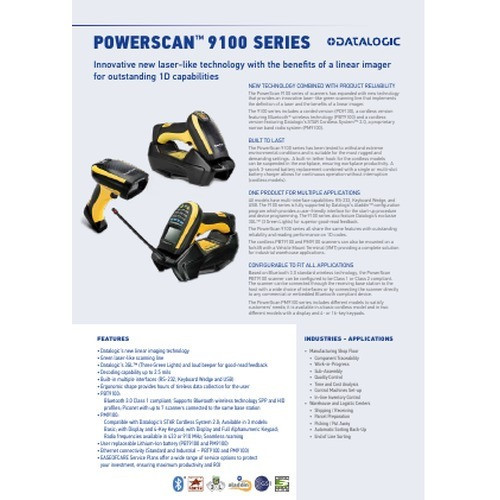
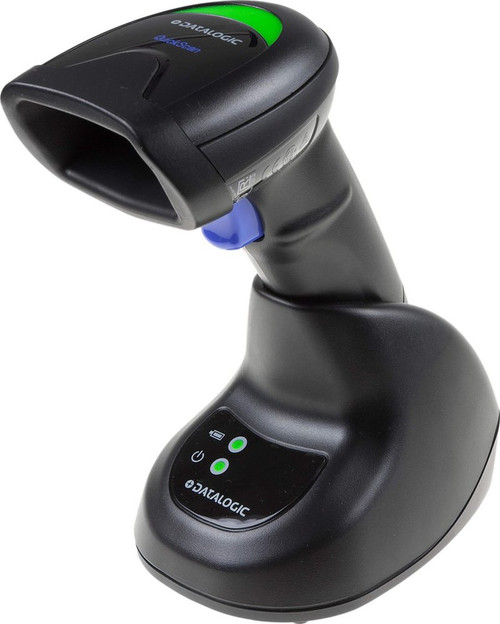
The PM9100-D910RB and QBT2500-BK are both Datalogic wireless 1D handheld barcode scanners intended for mobile scanning workflows, making them genuine cross-shop candidates for buyers evaluating untethered scanning in warehouse, retail, or light industrial environments. The PM9100-D910RB belongs to the ruggedized PowerScan 9100 series, while the QBT2500-BK is positioned under the QuickScan family. This comparison examines durability and ingress protection, physical ergonomics and battery, and connectivity breadth — the three axes most relevant to a deployment decision for handheld wireless scanners.
In This Guide
- Which scanner offers better environmental and drop protection for harsh deployment sites?
- How do the two scanners compare on form factor, weight, and battery for extended shift use?
- Which scanner supports broader interface options and wireless protocols for IT integration?
- Which should you choose: the PM9100-D910RB or the QBT2500-BK?
- Side-by-Side Specs
- FAQ
Which scanner offers better environmental and drop protection for harsh deployment sites?
The PM9100-D910RB carries an IP65 rating, providing full protection against dust ingress and resistance to low-pressure water jets from any direction — a spec that directly supports cold-storage, food-processing, and outdoor loading-dock use cases where moisture and particulate exposure are routine.
The QBT2500-BK is rated IP52, meaning limited dust protection and resistance to vertically dripping water only. This is adequate for dry retail floor or light warehouse picking but excludes environments with direct wash-down, heavy dust, or significant moisture.
On drop resistance, the PM9100-D910RB specifications describe it as industrial-grade rated for rugged use. No equivalent drop-resistance claim appears in the QBT2500-BK specifications. Buyers deploying in manufacturing lines, docks, or outdoor receiving areas should weight IP65 and the industrial drop rating of the PM9100-D910RB heavily.
How do the two scanners compare on form factor, weight, and battery for extended shift use?
The QBT2500-BK weighs 159 g — less than half the PM9100-D910RB's 399 g. For associates scanning continuously across an eight-hour shift, the 240 g difference is ergonomically meaningful and directly reduces hand and wrist fatigue, which the QBT2500-BK card bullets explicitly call out as a design goal.
Dimensionally the PM9100-D910RB is larger at 71 × 193 × 102 mm versus the QBT2500-BK's 69 × 127 × 124 mm. The PM9100-D910RB is notably longer (193 mm vs 127 mm), consistent with a full-size industrial pistol-grip form factor, while the QBT2500-BK has a more compact, roughly cubic profile at 127 × 124 mm.
The QBT2500-BK lists a 3,250 mAh lithium-ion battery. No battery capacity figure is provided in the PM9100-D910RB specifications. The QBT2500-BK's stated battery capacity gives procurement teams a concrete runtime planning data point; the PM9100-D910RB specifications do not supply an equivalent figure for direct comparison.
Which scanner supports broader interface options and wireless protocols for IT integration?
Both scanners include Bluetooth and USB connectivity and provide Datalogic Green Spot visual confirmation feedback. Both support Code 39, UPC, and EAN symbologies as confirmed in their respective specification sets.
The PM9100-D910RB specifications list USB, RS-232, Bluetooth, and STAR 433 MHz radio as interface options, and its card bullets reference STAR 433 MHz radio explicitly — a Datalogic proprietary long-range wireless protocol relevant to large-footprint warehouse deployments where standard Bluetooth range is insufficient.
The QBT2500-BK specifications list USB, RS-232 (via base station), Bluetooth, and Wi-Fi as interfaces. Wi-Fi is not listed in the PM9100-D910RB specifications. The QBT2500-BK also lists a broader symbology set in its spec data — including QR Code, Data Matrix, and PDF417 — although its scan engine field is labeled '2D' in the raw specifications, which conflicts with the '1D Linear Imager' scan-type field; buyers should verify the actual engine capability with Datalogic directly before relying on 2D decode for the QBT2500-BK.
Which should you choose: the PM9100-D910RB or the QBT2500-BK?
Our take: The PM9100-D910RB is the stronger choice when the deployment environment demands rugged sealing and long-range wireless reliability. Its IP65 rating versus the QBT2500-BK's IP52 provides a decisive durability advantage in dusty, wet, or wash-down-adjacent settings. The STAR 433 MHz radio extends usable wireless range beyond standard Bluetooth, which matters in large warehouses or facilities where Bluetooth drop-outs are a risk. However, the QBT2500-BK's 159 g weight versus the PM9100-D910RB's 399 g — a 240 g delta — is a significant ergonomic factor for high-repetition retail or light-warehouse scanning, and its 3,250 mAh battery gives IT planners a concrete runtime figure that the PM9100-D910RB specs do not provide. The QBT2500-BK's Wi-Fi connectivity also suits IT environments standardized on 802.11 infrastructure. Choose the PM9100-D910RB for industrial and harsh-environment deployments; choose the QBT2500-BK for ergonomics-sensitive, Wi-Fi-centric retail or light-distribution operations.
Side-by-Side Comparison
Spec-for-spec, from manufacturer data.
| Specification | Datalogic PM9100-D910RB | Datalogic QBT2500-BK |
|---|---|---|
| Series / Family | PowerScan 9100 | QuickScan QBT2131 |
| Product Type | Industrial Handheld Barcode Scanner | Wireless Handheld Barcode Scanner |
| Scan Type (spec field) | 1D Linear Imager | 1D Linear Imager (scan-type field; scan-engine field states 2D — verify with manufacturer) |
| Ingress Protection Rating | IP65 | IP52 |
| Drop Resistance | Industrial-grade rated (per spec) | — |
| Weight | 399 g (0.88 lb) | 159 g (0.35 lb) |
| Dimensions (mm) | 71 × 193 × 102 | 69 × 127 × 124 |
| Wireless Protocols | Bluetooth; STAR 433 MHz radio | Bluetooth; Wi-Fi |
| Wired Interface | USB; RS-232 | USB; RS-232 (via base station) |
| Battery Capacity | — | 3,250 mAh lithium-ion |
| Input Voltage | — | 5 VDC |
| Symbologies Listed | Code 128; Code 39; UPC; EAN | QR Code; Data Matrix; PDF417; Code 39; UPC; EAN |
| Visual Feedback | Datalogic Green Spot | Datalogic Green Spot |
| Warranty | 1-Year Limited | 3-Year Limited |
| Operating Temperature | Wide range (cold storage to heated environments, per spec) | — |
| Datasheet | /content/product-datasheets/PM9100-D910RB.pdf | /content/product-datasheets/QBT2500-BK.pdf |
Frequently Asked Questions
Which should you choose: the PM9100-D910RB or the QBT2500-BK?
The PM9100-D910RB is the stronger choice when the deployment environment demands rugged sealing and long-range wireless reliability. Its IP65 rating versus the QBT2500-BK's IP52 provides a decisive durability advantage in dusty, wet, or wash-down-adjacent settings. The STAR 433 MHz radio extends usable wireless range beyond standard Bluetooth, which matters in large warehouses or facilities where Bluetooth drop-outs are a risk. However, the QBT2500-BK's 159 g weight versus the PM9100-D910RB's 399 g — a 240 g delta — is a significant ergonomic factor for high-repetition retail or light-warehouse scanning, and its 3,250 mAh battery gives IT planners a concrete runtime figure that the PM9100-D910RB specs do not provide. The QBT2500-BK's Wi-Fi connectivity also suits IT environments standardized on 802.11 infrastructure. Choose the PM9100-D910RB for industrial and harsh-environment deployments; choose the QBT2500-BK for ergonomics-sensitive, Wi-Fi-centric retail or light-distribution operations.
Is the PM9100-D910RB or QBT2500-BK better suited for a cold-storage or food-processing facility?
The PM9100-D910RB is the more appropriate choice for those environments. Its IP65 rating provides full dust sealing and protection against water jets, which aligns with the wash-down and moisture exposure common in cold-storage and food-processing facilities. The QBT2500-BK's IP52 rating only covers limited dust ingress and dripping water, making it unsuitable where direct liquid exposure or heavy particulate is present.
Which scanner is lighter and less fatiguing for associates scanning all day?
The QBT2500-BK is significantly lighter at 159 g compared to the PM9100-D910RB's 399 g — a difference of 240 g, or roughly half a pound. For high-repetition scanning tasks over a full shift, the QBT2500-BK's lighter weight and more compact 69 × 127 × 124 mm form factor will reduce hand and wrist fatigue compared to the larger, heavier PM9100-D910RB.
Do both scanners work over Wi-Fi, or is one limited to Bluetooth only?
Only the QBT2500-BK lists Wi-Fi as a supported interface. The PM9100-D910RB specifications do not include Wi-Fi; it uses Bluetooth and the Datalogic STAR 433 MHz proprietary radio protocol for wireless connectivity. If your facility is standardized on 802.11 Wi-Fi infrastructure for scanner integration, the QBT2500-BK is the compatible choice. If long-range wireless beyond standard Bluetooth is needed and Wi-Fi is not a requirement, the PM9100-D910RB's STAR radio may be advantageous.
More Barcode Scanner Comparisons
- Datalogic PM9100-910RB vs CipherLab A1000ACBU0001
- Datalogic PM9100-910RB vs CipherLab A1000ACWU0001
- Datalogic PM9100-910RB vs Zebra LI2208-SR7U2100AZW
- Datalogic PM9100-910RB vs CipherLab A8001RSC00025
- Datalogic PM9100-910RB vs Datalogic PM9100-D910RB
- Datalogic PM9100-910RB vs Datalogic QBT2500-BK
Barcode Scanner Buying Guides
Get a Second Opinion on Your Camera Choice
Share your site layout, coverage goals, and budget. Our team will validate the camera selection, flag anything we would change, and recommend products that match the use case.