
Datalogic PM9100-D910RB vs CipherLab A1000ACWU0001: Specification Comparison
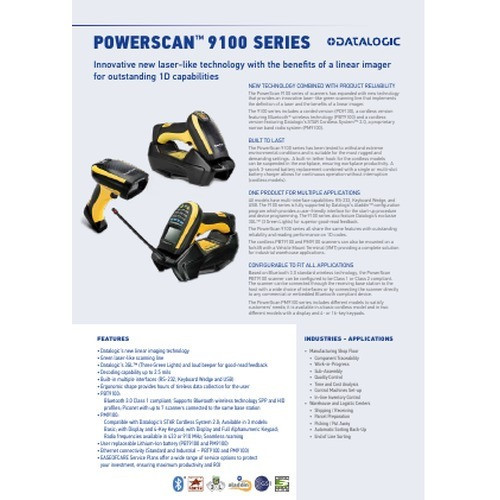
Both the Datalogic PowerScan PM9100-D910RB and the CipherLab A1000ACWU0001 are handheld 1D linear barcode scanners targeting light-industrial and commercial data-capture applications. This comparison examines how each performs across ruggedness and environmental protection, connectivity and deployment flexibility, and symbology breadth and scan performance—the three dimensions that most directly determine which unit fits a given installation environment and workflow.

In This Guide
Which scanner is built for harsher environments and more demanding physical use?
The PM9100-D910RB carries an IP65 ingress-protection rating, meaning it is fully dust-tight and protected against low-pressure water jets—a formally certified level of environmental sealing documented in its spec sheet. It also lists industrial-grade drop resistance, though the specific drop height in meters is not stated in the provided specifications.
The A1000ACWU0001 specifies a 1.0 m (3.3 ft) drop rating to concrete for the primary SKU reviewed, with a secondary environment column listing 2.0 m (6.6 ft) for an alternate configuration. No IP ingress rating is cited in the provided specifications for the CipherLab unit.
For cold-storage, washdown, or dusty manufacturing environments where ingress protection is a procurement requirement, the PM9100-D910RB's IP65 certification is a documented, testable specification the CipherLab unit cannot match based on available data. Buyers prioritizing verified drop height in meters should note that Datalogic's drop figure is absent from the provided spec set.
Which scanner offers greater flexibility in how it connects to host systems?
The PM9100-D910RB supports USB, RS-232, Bluetooth, and—per the card bullet—STAR 433 MHz radio. This multi-interface profile allows the scanner to be deployed in both wired and wireless configurations and to connect to legacy RS-232 hosts, making it suitable for mixed or older infrastructure environments.
The A1000ACWU0001 is specified as a USB wired scanner with plug-and-play USB connectivity. No Bluetooth, RS-232, or radio interface is listed in the provided specifications. The included attached cable is noted as an accessory.
For installations requiring wireless mobility, RS-232 legacy terminal support, or multi-radio flexibility, the PM9100-D910RB's interface set is materially broader. The A1000ACWU0001's USB-only profile is appropriate for fixed counter-mount or tethered point-of-sale positions where cable simplicity and no pairing overhead are priorities.
Which scanner decodes a wider range of barcode formats?
The PM9100-D910RB's documented symbology set in the provided specifications lists Code 128, Code 39, UPC, and EAN. This covers the core retail and logistics formats but is a relatively narrow list as stated.
The A1000ACWU0001 lists 13 or more symbologies by name: Codabar, Code 39, Code 93, Code 128, GS1 DataBar (RSS), Industrial 2 of 5, Interleave 2 of 5, Matrix 2 of 5, MSI, Italian Pharmacode, French Pharmacode, Plessey, Telepen, UPC, EAN, and GS1-128. This is a substantially more detailed and extensive list than what is documented for the Datalogic unit in the provided specifications.
Note: the Datalogic PM9100-D910RB may support additional symbologies not captured in the specifications provided here. Buyers should consult the full Datalogic datasheet before concluding the PM9100-D910RB lacks support for formats such as GS1-128, Code 93, or Interleaved 2 of 5. Based solely on provided specs, the A1000ACWU0001 documents broader symbology coverage.
Which should you choose: the PM9100-D910RB or the A1000ACWU0001?
Our take: The PM9100-D910RB is the stronger choice when the deployment environment demands certified ingress protection, wireless flexibility, or RS-232 legacy compatibility. Its IP65 rating is a formally certified dust-and-water specification the A1000ACWU0001 does not document; it adds Bluetooth and STAR 433 MHz radio where the CipherLab unit is USB-wired only; and at 399 g it is nearly twice the weight of the A1000ACWU0001 (148–203 g depending on configuration), reflecting its heavier industrial construction. Conversely, the A1000ACWU0001 documents 13-plus named symbologies versus four in the Datalogic spec set, a 1.0 m concrete drop rating, a scan rate of 100–200 scans per second, and a 2-year warranty versus the PM9100-D910RB's 1-year limited. Choose the PM9100-D910RB for harsh, mobile, or legacy-interface industrial environments; choose the A1000ACWU0001 for fixed USB counter positions needing broad symbology coverage and a longer documented warranty.
Side-by-Side Comparison
Spec-for-spec, from manufacturer data.
| Specification | Datalogic PM9100-D910RB | CipherLab A1000ACWU0001 |
|---|---|---|
| Product Type | Industrial Handheld Barcode Scanner | Handheld Barcode Scanner |
| Scan Engine | 1D Linear Imager | Red LED (650 nm) 1D Linear |
| Ingress Protection | IP65 (dust-tight, water-jet resistant) | — |
| Drop Resistance | Industrial-grade (height not specified) | 1.0 m (3.3 ft) to concrete |
| Connectivity | USB, RS-232, Bluetooth, STAR 433 MHz | USB wired only |
| Scan Rate | — | 100–200 scans/second |
| Symbologies (documented) | Code 128, Code 39, UPC, EAN | Codabar, Code 39, Code 93, Code 128, GS1-128, GS1 DataBar, I 2of5, ITF, Matrix 2of5, MSI, Plessey, Telepen, UPC, EAN, Pharmacode (IT/FR) |
| GS1-128 Support | Not listed in provided specs | Yes |
| Warranty | 1-Year Limited | 2-Year |
| Weight | 399 g (0.88 lb) | 148–203 g (5.2–7.2 oz) depending on config |
| Dimensions | 71 x 193 x 102 mm (2.8 x 7.6 x 4.0 in) | 18.2 x 10.4 x 6.4 in (per spec; verify units) |
| Visual Scan Feedback | Datalogic Green Spot confirmation | — |
| Min Print Contrast | — | 30% |
| Scan Angles | — | Pitch ±70°, Skew ±40° to ±70° |
| Cable Included | — | Yes (attached cable) |
| Typical Use Environment | Warehouse, manufacturing, cold storage | Retail counter, warehouse, desk-mount |
Frequently Asked Questions
Which should you choose: the PM9100-D910RB or the A1000ACWU0001?
The PM9100-D910RB is the stronger choice when the deployment environment demands certified ingress protection, wireless flexibility, or RS-232 legacy compatibility. Its IP65 rating is a formally certified dust-and-water specification the A1000ACWU0001 does not document; it adds Bluetooth and STAR 433 MHz radio where the CipherLab unit is USB-wired only; and at 399 g it is nearly twice the weight of the A1000ACWU0001 (148–203 g depending on configuration), reflecting its heavier industrial construction. Conversely, the A1000ACWU0001 documents 13-plus named symbologies versus four in the Datalogic spec set, a 1.0 m concrete drop rating, a scan rate of 100–200 scans per second, and a 2-year warranty versus the PM9100-D910RB's 1-year limited. Choose the PM9100-D910RB for harsh, mobile, or legacy-interface industrial environments; choose the A1000ACWU0001 for fixed USB counter positions needing broad symbology coverage and a longer documented warranty.
Is the PM9100-D910RB or A1000ACWU0001 better for a cold-storage warehouse with washdown risk?
The PM9100-D910RB is the documented choice for that environment. It carries an IP65 rating—fully dust-tight and resistant to water jets—which is a formally certified specification. The A1000ACWU0001 does not list an IP ingress rating in its provided specifications, so it cannot be confirmed suitable for washdown or high-dust conditions.
Can either scanner work wirelessly away from a host PC or terminal?
Only the PM9100-D910RB supports wireless operation. Its specifications list Bluetooth and STAR 433 MHz radio connectivity in addition to USB and RS-232. The A1000ACWU0001 is documented as a USB wired scanner only; no wireless interface is listed in its provided specifications.
Which scanner has the longer warranty, and does either support GS1-128 barcodes?
The A1000ACWU0001 carries a 2-year warranty versus the PM9100-D910RB's 1-year limited warranty—an advantage of one full year. On GS1-128: the A1000ACWU0001 explicitly lists GS1-128 in its symbology spec. The PM9100-D910RB's provided specifications list Code 128, Code 39, UPC, and EAN but do not mention GS1-128; buyers should verify against the full Datalogic datasheet before ruling out that format.
More Barcode Scanner Comparisons
- Datalogic PM9100-910RB vs CipherLab A1000ACBU0001
- Datalogic PM9100-910RB vs CipherLab A1000ACWU0001
- Datalogic PM9100-910RB vs Zebra LI2208-SR7U2100AZW
- Datalogic PM9100-910RB vs CipherLab A8001RSC00025
- Datalogic PM9100-910RB vs Datalogic PM9100-D910RB
- Datalogic PM9100-910RB vs Datalogic QBT2500-BK
Barcode Scanner Buying Guides
Get a Second Opinion on Your Camera Choice
Share your site layout, coverage goals, and budget. Our team will validate the camera selection, flag anything we would change, and recommend products that match the use case.