
Datalogic PM9100-910RBK10 vs CipherLab A1000ACBU0001: Specification Comparison
Both the Datalogic PM9100-910RBK10 and the CipherLab A1000ACBU0001 are handheld 1D linear barcode scanners targeted at industrial and warehouse environments, making them legitimate cross-shop candidates for buyers evaluating corded or wireless 1D scanning solutions. The comparison centers on deployment model differences—the PM9100 adds Bluetooth wireless freedom and a rechargeable battery at greater weight and ruggedization, while the A1000 offers a lightweight, USB-powered plug-and-play option. Buyers must weigh mobility needs, drop and ingress protection requirements, symbology breadth, and total cost of ownership.
In This Guide
- Which scanner better fits your wired-versus-wireless deployment and power infrastructure?
- Which unit is rated for harsher physical and environmental conditions on the floor?
- Which scanner reads a broader range of 1D barcode formats and at what scanning performance?
- Which should you choose: the PM9100-910RBK10 or the A1000ACBU0001?
- Side-by-Side Specs
- FAQ
Which scanner better fits your wired-versus-wireless deployment and power infrastructure?
The Datalogic PM9100-910RBK10 supports Bluetooth and USB connectivity alongside a 3,350 mAh Li-Ion rechargeable battery, enabling fully untethered mobile scanning. This suits environments where operators move freely across a floor, dock, or production line without being tethered to a workstation. The battery must be managed through charging cycles, adding infrastructure overhead.
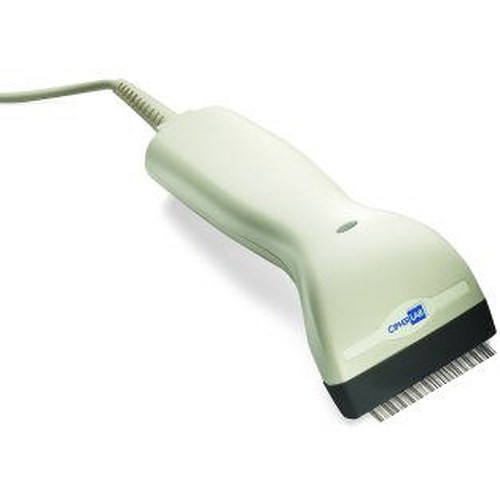
The CipherLab A1000ACBU0001 connects exclusively via USB HID in keyboard-emulation mode and draws power directly from the host USB port—no batteries, no charging stations, no drivers required. Scan rate is specified at up to 200 scans per second in its primary configuration. This plug-and-play profile suits fixed workstations, point-of-sale counters, or receiving desks where the operator remains stationary. No wireless capability is listed in the A1000 spec data provided.
Which unit is rated for harsher physical and environmental conditions on the floor?
The PM9100-910RBK10 carries an IP65 ingress protection rating, meaning it is fully dust-tight and protected against low-pressure water jets—appropriate for food processing, pharmaceutical, and high-humidity warehouse settings. Its industrial-grade drop resistance is noted in the spec data, though a specific drop height in meters is not provided in the supplied specifications.
The A1000ACBU0001 specifies a 1.0 m (3.3 ft) drop rating to concrete in its primary configuration, with an additional 2.0 m (6.6 ft) drop spec listed for other variants in the environmental row. No IP ingress protection rating is listed in the provided A1000 spec data. The PM9100 therefore holds a clear documented advantage for dust and liquid exposure scenarios; the A1000's drop spec is explicit where the PM9100's is qualitative.
The PM9100 weighs 399 g (14 oz). The A1000 weighs 203 g with cable (7.2 oz) in its primary listed configuration, making it notably lighter for prolonged handheld use at a fixed station.
Which scanner reads a broader range of 1D barcode formats and at what scanning performance?
The PM9100-910RBK10 uses a 1D linear imager and is specified to decode standard 1D symbologies including EAN, UPC, and Code 128. The spec data does not enumerate a full symbology list beyond these examples.
The A1000ACBU0001 uses a red LED (650 nm) single-line fixed-pattern scan engine with a minimum print contrast tolerance of 30%. Its documented symbology list is extensive: Codabar, Code 39, Code 93, Code 128, GS1 DataBar (RSS) including all variants, Industrial 2 of 5, Interleaved 2 of 5, Matrix 2 of 5, MSI, Italian and French Pharmacodes, Plessey, Telepen, and UPC/EAN/GS1-128. The A1000 specifies a scan rate of up to 200 scans per second. The PM9100 spec data does not list a scan rate figure. For buyers requiring broad legacy and specialty 1D symbology coverage, the A1000's documented decode list is more comprehensive based on available spec data.
Which should you choose: the PM9100-910RBK10 or the A1000ACBU0001?
Our take: The PM9100-910RBK10 is the stronger choice when operators need untethered mobility and verified environmental protection: it delivers Bluetooth wireless connectivity, a 3,350 mAh rechargeable battery, and an IP65 dust-and-splash rating that the A1000ACBU0001 does not list. The A1000, at 203 g versus the PM9100's 399 g, is substantially lighter, USB-powered with no battery management overhead, and documents a broader 1D symbology list including Plessey, Telepen, Pharmacodes, and all GS1 DataBar variants—specs the PM9100 data does not enumerate. The A1000 also carries a 2-year warranty against the PM9100's 1-year. Deploy the PM9100 where freedom of movement and IP65 protection are mandatory; choose the A1000 for fixed-station, USB-connected workstations prioritizing plug-and-play simplicity, lighter weight, longer warranty, and confirmed broad symbology coverage.
Side-by-Side Comparison
Spec-for-spec, from manufacturer data.
| Specification | Datalogic PM9100-910RBK10 | CipherLab A1000ACBU0001 |
|---|---|---|
| Product Type | Industrial Handheld Barcode Scanner | Handheld Barcode Scanner |
| Scan Engine | 1D Linear Imager | Red LED (650 nm), single-line fixed-pattern |
| Connectivity | Bluetooth, USB | USB HID (keyboard emulation) |
| Power Source | Li-Ion 3,350 mAh rechargeable battery | USB-powered (no battery) |
| IP / Ingress Rating | IP65 | — |
| Drop Resistance | Industrial-grade rated (height not specified) | 1.0 m (3.3 ft) to concrete |
| Scan Rate | — | Up to 200 scans/second |
| Weight | 399 g (14 oz) | 203 g / 7.2 oz (with cable) |
| Dimensions | 71 × 193 × 102 mm (2.8 × 7.6 × 4.0 in) | 18.2 × 10.4 × 6.4 in (per spec; unit appears to be cm — spec as listed) |
| Symbologies (1D) | EAN, UPC, Code 128 (examples; full list not provided) | Codabar, Code 39/93/128, GS1 DataBar, 2of5 variants, MSI, Plessey, Telepen, UPC/EAN, Pharmacodes |
| Min Print Contrast | — | 30% |
| Scan Angles | — | Pitch ±70°, Skew ±40° to ±70° (configuration-dependent) |
| Warranty | 1-Year Limited | 2-Year Warranty |
| Wireless | Bluetooth | None listed |
| Series / Family | PowerScan 9100 | — |
| Brand | Datalogic | CipherLab |
Frequently Asked Questions
Which should you choose: the PM9100-910RBK10 or the A1000ACBU0001?
The PM9100-910RBK10 is the stronger choice when operators need untethered mobility and verified environmental protection: it delivers Bluetooth wireless connectivity, a 3,350 mAh rechargeable battery, and an IP65 dust-and-splash rating that the A1000ACBU0001 does not list. The A1000, at 203 g versus the PM9100's 399 g, is substantially lighter, USB-powered with no battery management overhead, and documents a broader 1D symbology list including Plessey, Telepen, Pharmacodes, and all GS1 DataBar variants—specs the PM9100 data does not enumerate. The A1000 also carries a 2-year warranty against the PM9100's 1-year. Deploy the PM9100 where freedom of movement and IP65 protection are mandatory; choose the A1000 for fixed-station, USB-connected workstations prioritizing plug-and-play simplicity, lighter weight, longer warranty, and confirmed broad symbology coverage.
Is the PM9100-910RBK10 or A1000ACBU0001 better for wet or dusty industrial environments?
Based on the provided specifications, the PM9100-910RBK10 is the documented choice for wet or dusty conditions—it carries an IP65 rating confirming full dust-tightness and protection against low-pressure water jets. No ingress protection rating is listed in the A1000ACBU0001 spec data, so it cannot be verified as suitable for those conditions.
Which scanner works without being plugged into a computer the whole time?
The PM9100-910RBK10 operates wirelessly via Bluetooth and is powered by an onboard 3,350 mAh Li-Ion battery, so it does not need to remain connected to a host during use. The A1000ACBU0001 connects via USB HID and draws its power from the USB host port; no wireless or battery option is listed in the provided specifications.
Does the A1000ACBU0001 read more barcode types than the PM9100-910RBK10?
Based on the spec data provided, yes. The A1000ACBU0001 lists an explicit decode set of 14-plus 1D symbology families including Plessey, Telepen, Italian and French Pharmacodes, all 2-of-5 variants, and the full GS1 DataBar suite. The PM9100-910RBK10 spec data references EAN, UPC, and Code 128 as examples but does not supply a complete symbology list, so a definitive side-by-side count cannot be made from available data.
More Barcode Scanner Comparisons
- Datalogic PM9100-910RB vs CipherLab A1000ACBU0001
- Datalogic PM9100-910RB vs CipherLab A1000ACWU0001
- Datalogic PM9100-910RB vs Zebra LI2208-SR7U2100AZW
- Datalogic PM9100-910RB vs CipherLab A8001RSC00025
- Datalogic PM9100-910RB vs Datalogic PM9100-D910RB
- Datalogic PM9100-910RB vs Datalogic QBT2500-BK
Barcode Scanner Buying Guides
Get a Second Opinion on Your Camera Choice
Share your site layout, coverage goals, and budget. Our team will validate the camera selection, flag anything we would change, and recommend products that match the use case.