
CipherLab A1000ACBU0001 vs CipherLab A8001RSC00025: Specification Comparison
Both the CipherLab A1000ACBU0001 and the CipherLab A8001RSC00025 are handheld 1D barcode scanners from the same manufacturer, but they represent meaningfully different deployment architectures within that class. The A1000ACBU0001 is a tethered, USB-powered corded scanner relying entirely on a host system for power and data transfer, while the A8001RSC00025 is a battery-operated batch scanner with onboard memory, display, and IrDA serial output. Buyers in warehousing, retail, or light manufacturing evaluating a 1D handheld scanner should understand these architectural differences before selecting.
In This Guide
- Which scan engine and connectivity model fits the deployment?
- Does the scanner need onboard memory, a display, or the ability to operate without a live host connection?
- How do the two units compare on drop durability, supported symbologies, and physical footprint?
- Which should you choose: the A1000ACBU0001 or the A8001RSC00025?
- Side-by-Side Specs
- FAQ
Which scan engine and connectivity model fits the deployment?
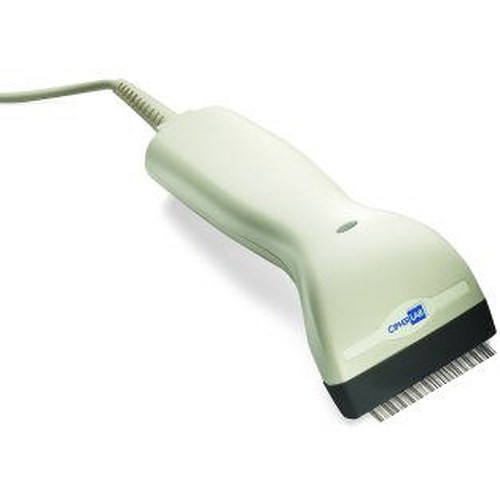
The A1000ACBU0001 uses a Red LED (650 nm) single-line fixed-pattern scan engine operating at up to 200 scans per second on a single-line pass. It connects exclusively via USB HID keyboard emulation, meaning it is plug-and-play with any host that accepts USB keyboard input — no drivers, no middleware. Power is drawn entirely from the USB port; there is no battery.
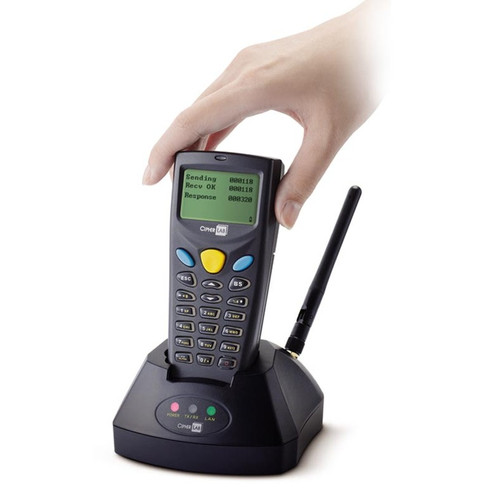
The A8001RSC00025 uses a 1D laser scan engine. Connectivity is dual-mode: USB and IrDA serial at up to 115.2 Kbps. IrDA enables line-of-sight wireless sync to a base or cradle without a physical cable tether during scanning sessions. The laser engine is not further specified (wavelength, scan rate) in the provided specifications.
For always-on, tethered point-of-sale or fixed workstation use, the A1000ACBU0001's USB HID model requires zero configuration. For roaming batch collection away from a host — shop floor, stockroom counts, field inventory — the A8001RSC00025's IrDA sync and untethered operation are structurally necessary.
Does the scanner need onboard memory, a display, or the ability to operate without a live host connection?
The A1000ACBU0001 has no onboard memory, no display, and no battery. Every scan is immediately transmitted to the connected host via USB HID. If the host is unavailable or the cable is disconnected, no data is captured or buffered. This is appropriate only when a live host is always present.
The A8001RSC00025 includes 2 MB of onboard RAM for batch data storage, a 100 × 64 LCD with LED backlight, and a 16-bit CPU running CipherLab's proprietary cOS operating system. Workers can scan hundreds or thousands of barcodes independently and upload the batch later via USB or IrDA. The 100-hour battery life per charge supports multi-shift or multi-day deployments without recharging.
No display, memory, or OS specifications exist for the A1000ACBU0001 because it has none — this is by design for a tethered scanner. Buyers requiring offline capture, operator feedback, or menu-driven workflows must select the A8001RSC00025.
How do the two units compare on drop durability, supported symbologies, and physical footprint?
The A1000ACBU0001 is rated for 1.0 m (3.3 ft) drops to concrete and has a minimum print contrast tolerance of 30%. It supports a broad 1D symbology set including Codabar, Code 39, Code 93, Code 128, GS1 DataBar (RSS), Industrial 2 of 5, Interleave 2 of 5, Matrix 2 of 5, MSI, Italian and French Pharmacodes, Plessey, Telepen, and UPC/EAN/GS1-128. Scan angles are rated at Pitch ±70°, Skew ±40° (or ±70° depending on configuration variant). Weight is 148–203 g depending on cable.
The A8001RSC00025 carries a more demanding drop rating: 1.2 m (4 ft) to concrete tested on all sides (5 drops per side), making it measurably more rugged by the spec. Its specific supported symbologies are not enumerated in the provided specifications beyond '1D.' Physical weight and scan angle data are not provided.
On ruggedness, the A8001RSC00025's 1.2 m / all-sides drop spec edges out the A1000ACBU0001's 1.0 m rating. On symbology transparency, the A1000ACBU0001 provides a fully enumerated list; the A8001RSC00025 does not, which is a gap buyers should resolve with the manufacturer's datasheet before committing.
Which should you choose: the A1000ACBU0001 or the A8001RSC00025?
Our take: The A1000ACBU0001 is the stronger choice when scanners are deployed at fixed, host-connected workstations requiring zero configuration and no battery management. Its USB HID plug-and-play design, detailed 1D symbology support list, and 200 scans-per-second rate suit high-throughput tethered applications. The A8001RSC00025 is the correct selection for any scenario requiring untethered operation: its 100-hour battery, 2 MB batch memory, onboard LCD, and IrDA sync allow workers to capture data freely before uploading — a capability the A1000ACBU0001 structurally cannot provide. The A8001RSC00025 also posts a higher drop rating (1.2 m all-sides vs. 1.0 m). Both carry a 2-year manufacturer warranty. Buyers must note that the A8001RSC00025's specific symbology list is absent from the provided specs and should be confirmed via its datasheet before deployment on non-standard barcode types.
Side-by-Side Comparison
Spec-for-spec, from manufacturer data.
| Specification | CipherLab A1000ACBU0001 | CipherLab A8001RSC00025 |
|---|---|---|
| Product Type | Handheld 1D Barcode Scanner | 1D Laser Barcode Scanner |
| Form Factor | Handheld | Handheld |
| Scan Engine | Red LED (650 nm), single-line fixed-pattern | 1D Laser |
| Scan Rate | 200 scans/sec (primary); 100 scans/sec (alt configs) | — |
| Connectivity | USB HID (keyboard emulation) | USB + IrDA Serial (115.2 Kbps) |
| Power Source | USB-powered (no battery) | Battery (100-hour life) |
| Battery Life | — | 100 hours |
| Onboard Memory | — | 2 MB RAM |
| Display | — | LCD 100 × 64 with LED backlight |
| Processor / OS | — | 16-bit CPU / CipherLab cOS |
| Drop Rating | 1.0 m (3.3 ft) to concrete | 1.2 m (4 ft) to concrete, 5 drops/side |
| Min. Print Contrast | 30% | — |
| Symbologies (1D) | Codabar, Code 39/93/128, GS1 DataBar, 2of5 variants, MSI, Pharmacodes, Plessey, Telepen, UPC/EAN/GS1-128 | 1D (specific formats not specified) |
| Communication Mode | Tethered (corded) | Batch + sync (USB or IrDA) |
| Warranty | 2-Year | 2-Year |
| Weight | 148–203 g (5.2–7.2 oz depending on cable) | — |
Frequently Asked Questions
Which should you choose: the A1000ACBU0001 or the A8001RSC00025?
The A1000ACBU0001 is the stronger choice when scanners are deployed at fixed, host-connected workstations requiring zero configuration and no battery management. Its USB HID plug-and-play design, detailed 1D symbology support list, and 200 scans-per-second rate suit high-throughput tethered applications. The A8001RSC00025 is the correct selection for any scenario requiring untethered operation: its 100-hour battery, 2 MB batch memory, onboard LCD, and IrDA sync allow workers to capture data freely before uploading — a capability the A1000ACBU0001 structurally cannot provide. The A8001RSC00025 also posts a higher drop rating (1.2 m all-sides vs. 1.0 m). Both carry a 2-year manufacturer warranty. Buyers must note that the A8001RSC00025's specific symbology list is absent from the provided specs and should be confirmed via its datasheet before deployment on non-standard barcode types.
Can either scanner work without being plugged into a computer?
Only the A8001RSC00025 can operate without a live host connection. It has a 100-hour battery, 2 MB of onboard storage, and its own operating system, so scans are stored locally and uploaded later via USB or IrDA. The A1000ACBU0001 is USB-powered with no battery and no onboard memory — it cannot capture any data unless connected to an active host.
Is the A1000ACBU0001 or A8001RSC00025 more durable for a warehouse floor?
By the provided drop specifications, the A8001RSC00025 is rated to 1.2 m (4 ft) on all sides with 5 drops per side, compared to the A1000ACBU0001's 1.0 m (3.3 ft) rating. The A8001RSC00025's all-sides test methodology is also more rigorous. For high-drop-risk warehouse environments, the A8001RSC00025 has the stronger documented specification.
Which scanner supports more barcode types out of the box?
The A1000ACBU0001 provides a fully enumerated symbology list — Codabar, Code 39/93/128, GS1 DataBar (RSS), Industrial/Interleave/Matrix 2 of 5, MSI, Italian and French Pharmacodes, Plessey, Telepen, and UPC/EAN/GS1-128. The A8001RSC00025's supported symbologies are listed only as '1D' in the provided specifications; the specific formats are not enumerated. Buyers needing confirmation on non-Code 39/128 symbologies for the A8001RSC00025 should consult its manufacturer datasheet.
More Barcode Scanner Comparisons
- Datalogic PM9100-910RB vs CipherLab A1000ACBU0001
- Datalogic PM9100-910RB vs CipherLab A1000ACWU0001
- Datalogic PM9100-910RB vs Zebra LI2208-SR7U2100AZW
- Datalogic PM9100-910RB vs CipherLab A8001RSC00025
- Datalogic PM9100-910RB vs Datalogic PM9100-D910RB
- Datalogic PM9100-910RB vs Datalogic QBT2500-BK
Barcode Scanner Buying Guides
Get a Second Opinion on Your Camera Choice
Share your site layout, coverage goals, and budget. Our team will validate the camera selection, flag anything we would change, and recommend products that match the use case.