
Aiphone GT-D vs Aiphone IX-SSA: Specification Comparison
Both the Aiphone GT-D and the Aiphone IX-SSA are door stations — units mounted at an entry point to facilitate two-way audio communication with a visitor. The GT-D belongs to Aiphone's GT residential/light-commercial series, operating as an analog audio-only panel powered by the connected master station. The IX-SSA belongs to Aiphone's IX IP-based series, delivering SIP-compatible audio over a standard network infrastructure with PoE power. This comparison evaluates how each unit's connectivity model, environmental durability, and integration capability serve different installer and buyer requirements.
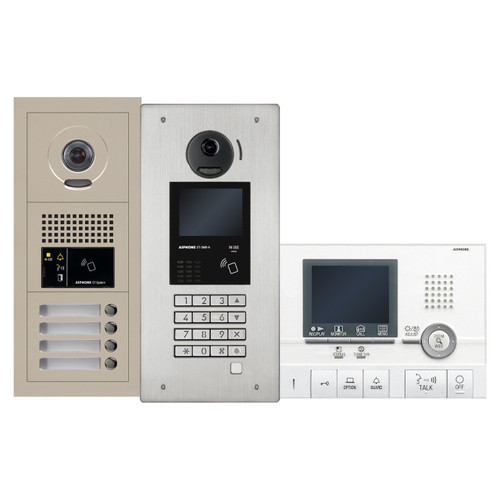

In This Guide
- How does each door station connect, and what communication infrastructure does it require?
- Which door station offers stronger environmental and physical protection for outdoor or demanding installations?
- What integration, expansion, and access-control capabilities does each unit support?
- Which should you choose: the GT-D or the IX-SSA?
- Side-by-Side Specs
- FAQ
How does each door station connect, and what communication infrastructure does it require?
The GT-D uses a 2-conductor PE-insulated wire run and draws all of its power directly from the residential master station — no separate power supply, network switch, or IP infrastructure is needed. Communication is open-voice handsfree, meaning the audio channel is activated without a discrete call-initiation step on the visitor's part. This model is entirely analog and self-contained within the GT wiring ecosystem.
The IX-SSA connects via an RJ45 interface and supports PoE (IEEE 802.3af class 0) at 3.36W, or 24V DC as an alternative power source. It includes an RJ45 pass-through port with PoE passthrough for daisy-chaining downstream devices. Supported protocols span IPv4, IPv6, TCP, UDP, SIP, HTTP, HTTPS, RTSP, RTP, RTCP, IGMP, MLD, SMTP, SFTP, DHCP, NTP, and DNS — a full IP intercom and VoIP-compatible stack. Port security is enforced via IEEE 802.1x. Audio codecs are G.711 and G.722. The GT-D's wiring topology and the IX-SSA's network topology are mutually incompatible; each requires its own ecosystem.
Which door station offers stronger environmental and physical protection for outdoor or demanding installations?
The GT-D is rated for an operating temperature range of 14°F to 140°F (-10°C to 60°C). No ingress-protection (IP) rating, impact-resistance (IK) rating, or vandal-resistance specification is provided in the available spec data.
The IX-SSA carries an IP65 ingress-protection rating (dust-tight, protected against water jets) and an IK08 impact-resistance rating, indicating it withstands significant mechanical impact. Its operating temperature extends down to -40°F (-40°C) — a 26°F (14°C) colder lower limit than the GT-D — while the upper limit is identical at 140°F (60°C). The stainless steel construction contributes to vandal resistance. For exposed outdoor locations, cold climates, or installations subject to deliberate tampering, the IX-SSA's published ratings provide a measurably higher level of protection than the GT-D's spec sheet describes.
What integration, expansion, and access-control capabilities does each unit support?
The GT-D integrates exclusively within the Aiphone GT series. It mounts to a single-gang electrical box, surface-wall-mount style. No trigger inputs, contact outputs, onboard storage, or third-party protocol support are listed in its specifications.
The IX-SSA provides two contact outputs and six trigger inputs, enabling direct integration with electric strikes, magnetic locks, REX devices, or other dry-contact access-control hardware without an intermediate relay module. The SIP protocol support allows registration with SIP-based PBX systems, unified communications platforms, or third-party IP intercom controllers. An onboard microSD card slot enables local audio event logging or firmware storage. Compliance with UL 62368-1 and cUL 62368-1 is documented. The 600Ω audio output and dual-codec support (G.711/G.722) are relevant for VoIP-quality tuning. Flush-mount installation requires a compatible back box; dimensions are 10-7/16" H × 5-7/8" W (depth not specified in available data).
Which should you choose: the GT-D or the IX-SSA?
Our take: The GT-D is the stronger choice when the project is a residential or small light-commercial site already built around the Aiphone GT wired ecosystem, where simplicity, low cost of infrastructure, and two-conductor installation are the design priorities. The IX-SSA is the stronger choice when IP network infrastructure, harsh-environment durability, or access-control integration are required: it operates 26°F colder at the low end (-40°F vs. 14°F), carries IP65 and IK08 ratings versus no published ingress or impact rating for the GT-D, and adds six trigger inputs plus two contact outputs that the GT-D's spec sheet does not list. Buyers integrating with a SIP PBX or requiring IEEE 802.1x port security will find no corresponding capability in the GT-D. The IX-SSA is purpose-built for IP-based commercial and enterprise intercom deployments; the GT-D is appropriate only where the GT series master station is already the chosen platform.
Side-by-Side Comparison
Spec-for-spec, from manufacturer data.
| Specification | Aiphone GT-D | Aiphone IX-SSA |
|---|---|---|
| Product Series | GT (analog) | IX (IP/SIP) |
| Power Source | Supplied from master station | PoE IEEE 802.3af class 0 or 24V DC |
| Power Draw | — | 3.36W |
| Connection Type | 2-conductor PE wire | RJ45 (in/out with PoE passthrough) |
| Communication Mode | Open voice handsfree | SIP-compatible IP audio |
| Audio Codecs | — | G.711, G.722 |
| Network Protocols | — | IPv4/IPv6, SIP, HTTP/HTTPS, RTSP, RTP, RTCP, IGMP, MLD, SMTP, SFTP, DHCP, NTP, DNS |
| Port Security | — | IEEE 802.1x |
| Contact Outputs | — | 2 |
| Trigger Inputs | — | 6 |
| Audio Output Impedance | — | 600Ω |
| Onboard Storage | — | microSD card slot |
| Ingress Protection | — | IP65 |
| Impact Rating | — | IK08 |
| Operating Temperature | 14°F to 140°F (-10°C to 60°C) | -40°F to 140°F (-40°C to 60°C) |
| Mounting Type | Surface wall mount, single-gang box | Flush-mount |
| Dimensions | 5-1/8" H x 3-7/8" W x 1-1/8" D | 10-7/16" H x 5-7/8" W (depth not specified) |
| Weight | 0.44 lbs (200g) | — |
| Compliance | — | UL 62368-1, cUL 62368-1 |
Frequently Asked Questions
Which should you choose: the GT-D or the IX-SSA?
The GT-D is the stronger choice when the project is a residential or small light-commercial site already built around the Aiphone GT wired ecosystem, where simplicity, low cost of infrastructure, and two-conductor installation are the design priorities. The IX-SSA is the stronger choice when IP network infrastructure, harsh-environment durability, or access-control integration are required: it operates 26°F colder at the low end (-40°F vs. 14°F), carries IP65 and IK08 ratings versus no published ingress or impact rating for the GT-D, and adds six trigger inputs plus two contact outputs that the GT-D's spec sheet does not list. Buyers integrating with a SIP PBX or requiring IEEE 802.1x port security will find no corresponding capability in the GT-D. The IX-SSA is purpose-built for IP-based commercial and enterprise intercom deployments; the GT-D is appropriate only where the GT series master station is already the chosen platform.
Can the GT-D and IX-SSA work together on the same intercom system?
No. The GT-D is an analog unit that runs on 2-conductor wiring and is powered by a GT-series master station. The IX-SSA is an IP/SIP device that connects via RJ45 and requires PoE or 24V DC power. The two units use incompatible communication architectures and cannot be paired on the same system without additional bridging hardware, which Aiphone does not document in the provided specifications.
Is the IX-SSA or the GT-D better suited for outdoor installation in cold or coastal climates?
Based on published specifications, the IX-SSA is significantly better suited. It carries an IP65 rating (dust-tight, water-jet resistant) and an IK08 impact rating, and its operating temperature floor is -40°F (-40°C) compared to the GT-D's 14°F (-10°C). No ingress-protection or impact-resistance rating is listed for the GT-D, making the IX-SSA the documentably more durable option for exposed, cold, or high-abuse environments.
Does either door station support direct integration with an electric door strike or access-control panel?
The IX-SSA provides two contact outputs and six trigger inputs per its published specifications, allowing direct wiring to electric strikes, magnetic locks, and access-control inputs without an add-on relay. The GT-D's available specifications do not list any contact outputs or trigger inputs, so no equivalent direct access-control integration can be confirmed for that model.
More Intercom Comparisons
- Ubiquiti UA-G3-INTERCOM vs SDC IPDSE
- Ubiquiti UA-G3-INTERCOM vs Comelit TP6842
- Ubiquiti UA-G3-INTERCOM vs ACTi Q950
- Axis 03448-001 vs Axis 02892-001
- Comelit TP6842 vs ACTi Q950
- Comelit TP6842 vs Comelit 3460HEV
Intercom Buying Guides
Get a Second Opinion on Your Camera Choice
Share your site layout, coverage goals, and budget. Our team will validate the camera selection, flag anything we would change, and recommend products that match the use case.