
ACTi B928 vs Hanwha XNV-8081Z: Specification Comparison
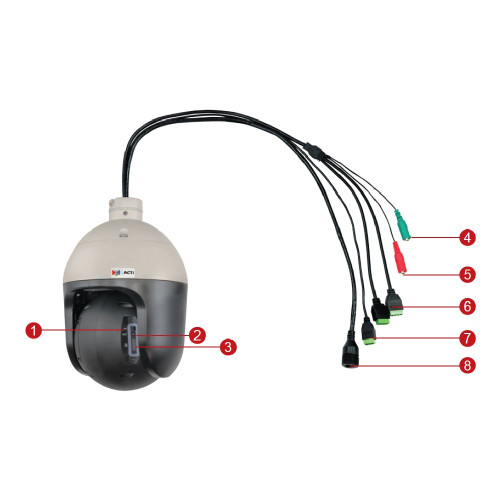
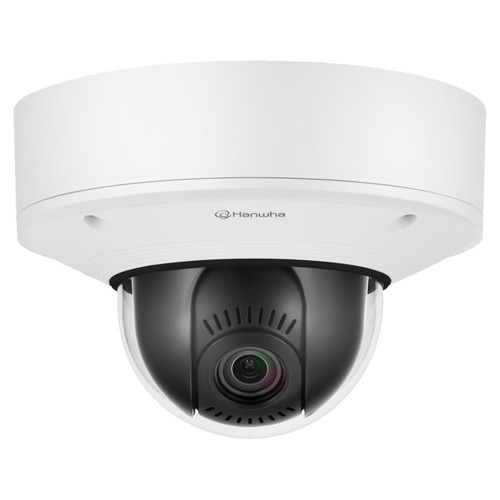
Both the ACTi B928 and Hanwha XNV-8081Z are 5MP outdoor PTZ cameras aimed at perimeter and wide-area surveillance applications. However, they represent fundamentally different PTZ architectures: the B928 is a full-speed-dome with 36x optical zoom on a motorized pan/tilt drive, while the XNV-8081Z is a vandal-resistant dome with remote-adjustable pan/tilt/rotate positioning and only 2.6x motorized varifocal. A buyer choosing between them is weighing long-range tracking performance against hardened close-range coverage.
In This Guide
How do the imaging specs compare?
The ACTi B928 uses a 1/2.9-inch sensor delivering 5MP at up to 30fps, paired with a 4.6–165.6mm varifocal lens providing 36x optical zoom. Its IR illuminators operate at 850nm with a specified working distance of 200m, and minimum illumination is rated at 0.003 lux (color) and 0 lux (B/W with IR active). WDR is rated at 120dB. PTZ movement covers 360° endless pan, tilt from −20° to +200°, with up to 300°/second preset speed and 256 stored presets.
The Hanwha XNV-8081Z uses a larger 1/1.8-inch 6MP CMOS sensor, also outputting 5MP at 30fps (2560×1920). Its lens spans only 3.6–9.4mm (2.6x motorized varifocal), with a maximum aperture of F1.2 at wide end. Minimum illumination is 0.07 lux color / 0.007 lux B/W — materially higher (worse) than the B928 in low light. WDR is also rated at 120dB. Pan/tilt/rotate range is ±175°/0–85°/±175° with a maximum of 200 repositioning cycles noted, and no IR working distance is specified beyond a 0.5m minimum object distance.
What about installation and environment?
The ACTi B928 carries IP66, IK10 (metal casing), and NEMA 4X ratings, with an operating temperature range of −40°C to +55°C. It is a speed-dome form factor weighing 3,146g (6.94 lb). Power requirements are significant: it draws up to 75W and accepts AC 24V or High PoE (802.3at); standard PoE+ (802.3at) is listed but the full 75W load exceeds typical 802.3at budgets, so AC 24V is likely required at full performance. Mounting options include wall, pole, pendant, corner, and rack accessories.
The Hanwha XNV-8081Z is rated IP67, IP66, IP6K9K, IK10+, and NEMA 4X — a stricter ingress and impact certification than the B928 (IP67 vs IP66; IK10+ vs IK10). Operating temperature spans −50°C to +60°C, extending 10°C colder and 5°C warmer than the B928. Power consumption is far lower at 5.4W maximum, accepting PoE IEEE 802.3af Class 3, 12VDC, or 24VAC. The dome weighs 1.75kg (3.86 lb) in a Ø180×125mm housing. The lower power draw makes infrastructure planning straightforward with standard 802.3af switches.
Which fits your VMS and analytics better?
Both cameras support ONVIF (the B928 specifies Profiles S, G, T, and M; the XNV-8081Z specifies Profiles S, G, and T). The B928 lists VMD and People Counting as analytics, with Smoke Detection also referenced in specs. The XNV-8081Z provides a substantially broader analytics suite including defocus detection, directional detection, fog detection, face detection, digital auto tracking, appear/disappear, enter/exit, loitering, tampering, virtual line, audio detection, sound classification, and shock detection, plus business intelligence functions: people counting, queue management, and heatmap. Protocol support on the XNV-8081Z is detailed (IPv4/IPv6, SNMPv3, SRTP, HTTPS/SSL, 802.1X EAP-TLS/EAP-LEAP). The B928's protocol stack is not enumerated in the provided specs.
For audio, the B928 supports two-way audio with line-in and line-out; the XNV-8081Z supports selectable mic-in/line-in and line-out. Edge storage is a meaningful differentiator: the XNV-8081Z provides dual microSD/SDHC/SDXC slots supporting up to 512GB total and 1GB RAM, enabling robust on-camera recording. The B928 does not list edge storage capability in the provided specifications. The XNV-8081Z also includes a Micro USB port (1280×720) for local installation viewing, a feature not referenced in B928 specs.
Which should you choose: the B928 or the XNV-8081Z?
Our take: The B928 is the stronger choice when the application demands long-range identification and continuous PTZ tracking: its 36x optical zoom (4.6–165.6mm vs 3.6–9.4mm / 2.6x) and 200m IR range vastly outperform the XNV-8081Z for perimeter surveillance across open ground. However, the XNV-8081Z holds clear advantages in three other areas: environmental hardening (IP67/IK10+ vs IP66/IK10; operating range −50°C to +60°C vs −40°C to +55°C), power efficiency (5.4W on standard 802.3af vs 75W requiring AC 24V or High PoE infrastructure), and onboard analytics (12+ event-based analytics plus business intelligence vs VMD and people counting). For high-impact, power-constrained installations — building entrances, retail interiors, or vandal-prone exterior domes — the XNV-8081Z's broader feature set and lower infrastructure burden are decisive. Installations requiring rack or wide-area pan/tilt tracking at distance should favor the B928.
Side-by-Side Comparison
Spec-for-spec, from manufacturer data.
| Specification | ACTi B928 | Hanwha XNV-8081Z |
|---|---|---|
| Resolution | 5MP | 5MP (2560×1920) |
| Image Sensor | 1/2.9" CMOS | 1/1.8" 6MP CMOS |
| Lens / Focal Length | 4.6–165.6mm (36x optical zoom) | 3.6–9.4mm (2.6x motorized varifocal) |
| Min. Illumination | 0.003 lux color / 0 lux B/W (IR on) | 0.07 lux color / 0.007 lux B/W |
| IR Range | 200m (850nm) | Not specified (0.5m min. object distance noted) |
| WDR | 120dB | 120dB |
| Max Frame Rate | 30fps @ 5MP | 30fps |
| Pan / Tilt Range | 360° endless pan / −20° to +200° tilt / 256 presets | ±175° pan / 0–85° tilt / ±175° rotate (max 200 cycles) |
| Video Compression | H.265, H.264, MJPEG | H.265, H.264, MJPEG |
| IP Rating | IP66 / NEMA 4X | IP67 / IP66 / IP6K9K / NEMA 4X |
| IK / Impact Rating | IK10 (metal casing) | IK10+ |
| Operating Temperature | −40°C to +55°C | −50°C to +60°C |
| Power Input / PoE Class | AC 24V / High PoE 75W (802.3at listed) | PoE 802.3af Class 3 / 12VDC / 24VAC; max 5.4W |
| Edge Storage | Not specified | Dual microSD/SDHC/SDXC up to 512GB |
| Audio | Two-way; line-in; line-out | Selectable mic-in/line-in; line-out |
| Weight | 3,146g (6.94 lb) | 1,750g (3.86 lb) |
| ONVIF Profiles | S, G, T, M | S, G, T |
| Warranty | Not specified in provided specs | 3 years |
Frequently Asked Questions
Which should you choose: the B928 or the XNV-8081Z?
The B928 is the stronger choice when the application demands long-range identification and continuous PTZ tracking: its 36x optical zoom (4.6–165.6mm vs 3.6–9.4mm / 2.6x) and 200m IR range vastly outperform the XNV-8081Z for perimeter surveillance across open ground. However, the XNV-8081Z holds clear advantages in three other areas: environmental hardening (IP67/IK10+ vs IP66/IK10; operating range −50°C to +60°C vs −40°C to +55°C), power efficiency (5.4W on standard 802.3af vs 75W requiring AC 24V or High PoE infrastructure), and onboard analytics (12+ event-based analytics plus business intelligence vs VMD and people counting). For high-impact, power-constrained installations — building entrances, retail interiors, or vandal-prone exterior domes — the XNV-8081Z's broader feature set and lower infrastructure burden are decisive. Installations requiring rack or wide-area pan/tilt tracking at distance should favor the B928.
Is the B928 or XNV-8081Z better for low-light performance?
The B928 specifies 0.003 lux color and 0 lux B/W (IR on) with IR illumination to 200m. The XNV-8081Z specifies 0.07 lux color and 0.007 lux B/W with no IR working distance stated (0.5m is the minimum object distance, not IR range). On the published specs, the B928 has a lower minimum illumination threshold and a defined long-range IR distance, giving it the edge in low-light and zero-lux conditions at range.
Can I power either camera from a standard PoE switch?
The XNV-8081Z draws a maximum of 5.4W and is rated for PoE IEEE 802.3af Class 3, making it compatible with any standard PoE switch port (budget: up to 15.4W). The B928 lists PoE+ (802.3at) and AC 24V as inputs but has a maximum power draw of 75W — well above the 30W ceiling of 802.3at — so AC 24V or a High PoE injector/switch capable of 75W is required for full operation.
Which camera offers better onboard analytics for retail or building intelligence use cases?
The XNV-8081Z includes people counting, queue management, and heatmap as built-in business intelligence functions, alongside 12+ event-based analytics (loitering, enter/exit, face detection, sound classification, etc.) and dual microSD slots up to 512GB for edge recording. The B928 specifies VMD, People Counting, and Smoke Detection. For retail or occupancy analytics without a separate VMS analytics license, the XNV-8081Z's native suite is significantly broader based on the provided specifications.
Get a Second Opinion on Your Camera Choice
Share your site layout, coverage goals, and budget. Our team will validate the camera selection, flag anything we would change, and recommend products that match the use case.