
ACTi B64 vs ACTi E53: Specification Comparison
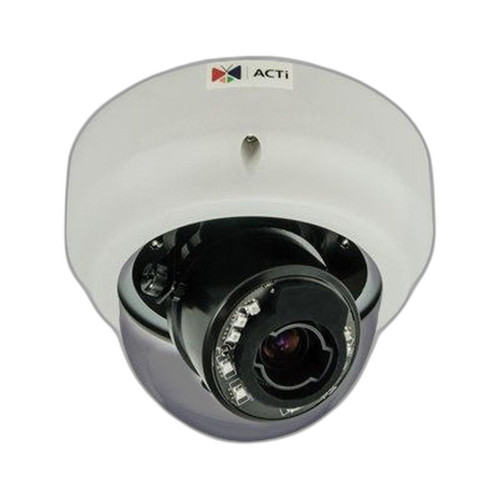
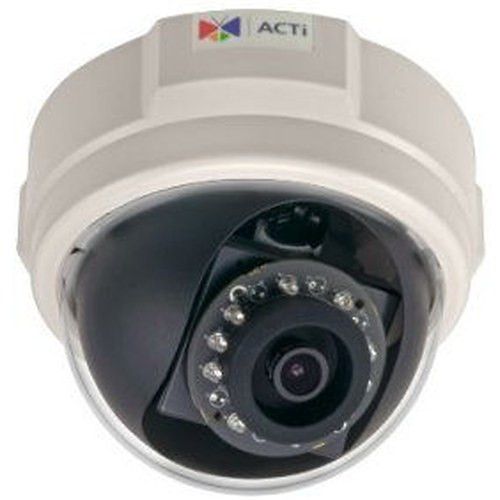
The ACTi B64 and ACTi E53 are both 3MP indoor dome cameras designed for ceiling or wall deployment in commercial and institutional environments. This comparison covers the key specification differences an installer or IT buyer would evaluate when selecting between a motorized-zoom dome and a fixed-lens dome at the same resolution tier. Both are PoE-powered and ONVIF-compatible, making them plausible cross-shop candidates for indoor surveillance projects where lens flexibility, impact resistance, and VMS integration depth are decision factors.
In This Guide
How do the imaging specs compare?
The B64 is specified with a 1/3-inch sensor and a motorized 3.0–9mm varifocal lens delivering 3× optical zoom, with a maximum resolution of 1280×960 at 30 fps or 1280×720 at 60 fps. Its minimum illumination is rated at 0.003 lux in color mode (F1.2) and 0 lux in black-and-white with IR active. The IR illuminators operate at 850nm with a stated range of 40 meters. WDR is described in the specs as both 'Basic WDR (88 dB)' and 'WDR' depending on the spec field—the 88 dB figure is the only numeric WDR value provided. The E53 is specified at 3MP (2048×1536) with a fixed 3.6mm lens. Its WDR is listed as 'WDR' with no dB value provided, and its low-light mode is listed as 'Day/Night' with night vision noted as 'IR'—no minimum illumination lux figure, no IR wavelength, and no IR range are specified for the E53.
In terms of raw pixel count, the E53's 2048×1536 native resolution exceeds the B64's 1280×960 peak resolution, meaning the E53 can capture more spatial detail per frame at a fixed field of view. The B64 compensates with optical zoom: the 3× motorized lens allows an operator or installer to narrow the field of view to recover facial or object detail at longer distances without adding cameras. Frame rate data is available only for the B64 (30 fps at full resolution); no maximum frame rate is specified for the E53. Sensor size for the E53 is not stated in the provided specifications.
What about installation and environment?
The B64 is rated IK09 for impact resistance, meaning it withstands a 5 kg ball-drop impact per IEC 62262—relevant for high-traffic corridors, retail environments, or spaces with collision risk. No IK rating is provided for the E53. Neither camera carries an IP ingress-protection rating in the provided specifications, which is consistent with their indoor-only application classification; installers should verify environmental sealing requirements directly with ACTi documentation before deploying in dusty or humid indoor spaces.
Power requirements differ: the B64 draws up to 10W and is specified as PoE+ (802.3af/802.3at Class 3) in the provided data—note that Class 3 under 802.3af is capped at 15.4W budget, so the 10W draw is within standard PoE range despite the PoE+ label. The E53 is specified as standard 802.3af PoE drawing fewer than 13W, placing it within the 15.4W 802.3af budget. Both cameras require only a single Ethernet run. The B64 operates from −10°C to 50°C; the E53's lower bound is 0°C, making the B64 the wider-range option for unconditioned indoor spaces or cold-storage adjacent installations. Mounting options for the B64 include wall, pole, pendant, corner, and rack; the E53 specifies ceiling and wall only.
Which fits your VMS and analytics better?
The B64 supports ONVIF Profiles S, G, T, and Q, and is listed as compatible with Milestone XProtect, Genetec Security Center, and Axis Camera Station in the provided specifications. The E53 supports ONVIF Profile S only; no named VMS compatibility is provided beyond that. Buyers running Genetec or Milestone enterprise platforms have documented compatibility with the B64; E53 compatibility with those platforms is not confirmed by the provided specifications.
For edge analytics, the B64 specifies VMD (video motion detection), people counting, and smoke detection. No edge analytics are listed for the E53. Audio capability is specified for the B64 as two-way with line-in and line-out; no audio specification is provided for the E53. On-board/edge storage is not specified for either model in the provided data. The B64 also supports PTZ control protocols (Visca, Pelco-D, Pelco-P, ACTi URL command), relevant only if used with a PTZ controller or software integration.
Which should you choose: the B64 or the E53?
Our take: The B64 is the stronger choice when lens flexibility, cold-environment tolerance, or deep VMS integration is required; the E53 is the more straightforward option when maximum native resolution and minimal infrastructure complexity are the priorities. Concretely: the B64 offers a 3× motorized zoom (3.0–9mm vs. the E53's fixed 3.6mm) enabling post-install field-of-view adjustment without physically repositioning the camera; it carries an IK09 impact rating the E53 does not specify; and it supports ONVIF Profiles S, G, T, and Q versus the E53's Profile S alone. The E53's 2048×1536 native resolution exceeds the B64's 1280×960 peak, which matters in wide-area scenes where a fixed lens covers the full target zone. Choose the B64 for varifocal coverage, impact-resistant housings, analytics (people counting, smoke detection), two-way audio, or Milestone/Genetec environments. Choose the E53 where a simpler, lower-power fixed-lens 3MP solution with basic ONVIF integration is sufficient.
Side-by-Side Comparison
Spec-for-spec, from manufacturer data.
| Specification | ACTi B64 | ACTi E53 |
|---|---|---|
| Resolution | 1280×960 (1.3MP native sensor; 3MP stated in some spec fields) | 2048×1536 (3MP) |
| Lens / Focal Length | 3.0–9mm motorized zoom, 3× optical, board mount | 3.6mm fixed |
| Image Sensor Size | 1/3 inch | — |
| Min Illumination | 0.003 lux color (F1.2); 0 lux B/W (IR on) | — |
| IR Illuminators | 850nm; 40m range | IR (wavelength and range not specified) |
| WDR | Basic WDR, 88 dB | WDR (no dB value specified) |
| Max Frame Rate | 30 fps @ 1280×960; 60 fps @ 1280×720 | — |
| Video Compression | H.264 (Baseline/Main/High); MJPEG | — |
| IK / Impact Rating | IK09 | — |
| Operating Temperature | −10°C to 50°C (14°F to 122°F) | 0°C to 50°C (32°F to 122°F) |
| Power Input / PoE Class | PoE+ 802.3at Class 3; 10W typical | 802.3af PoE; <13W |
| ONVIF Profiles | S, G, T, Q | S |
| Named VMS Compatibility | Milestone XProtect; Genetec Security Center; Axis Camera Station | — |
| Edge Analytics | VMD; People Counting; Smoke Detection | — |
| Audio | Two-way; Line-in; Line-out | — |
| Mount Types | Wall; Pole; Pendant; Corner; Rack | Ceiling; Wall |
| Weight | 720g (1.587 lb) | — |
Frequently Asked Questions
Which should you choose: the B64 or the E53?
The B64 is the stronger choice when lens flexibility, cold-environment tolerance, or deep VMS integration is required; the E53 is the more straightforward option when maximum native resolution and minimal infrastructure complexity are the priorities. Concretely: the B64 offers a 3× motorized zoom (3.0–9mm vs. the E53's fixed 3.6mm) enabling post-install field-of-view adjustment without physically repositioning the camera; it carries an IK09 impact rating the E53 does not specify; and it supports ONVIF Profiles S, G, T, and Q versus the E53's Profile S alone. The E53's 2048×1536 native resolution exceeds the B64's 1280×960 peak, which matters in wide-area scenes where a fixed lens covers the full target zone. Choose the B64 for varifocal coverage, impact-resistant housings, analytics (people counting, smoke detection), two-way audio, or Milestone/Genetec environments. Choose the E53 where a simpler, lower-power fixed-lens 3MP solution with basic ONVIF integration is sufficient.
Is the B64 or E53 better for low-light performance?
Based on the provided specifications, the B64 has a documented minimum illumination of 0.003 lux in color mode and 0 lux in black-and-white with IR active, with IR illuminators rated to 40 meters at 850nm. No minimum illumination figure, IR wavelength, or IR range is specified for the E53—only 'Day/Night' and 'IR' are noted. The B64's low-light specifications are therefore more detailed and quantified; the E53's low-light performance cannot be directly compared from the available specs.
Can I use either camera with Milestone XProtect or Genetec Security Center?
The B64 is listed in the provided specifications as compatible with Milestone XProtect and Genetec Security Center, in addition to Axis Camera Station, and supports ONVIF Profiles S, G, T, and Q. The E53 is listed as ONVIF Profile S compliant only; no named VMS compatibility beyond Profile S is stated in its provided specifications. Buyers on Milestone or Genetec platforms should verify E53 compatibility through ACTi's VMS compatibility matrix before specifying it.
Does the B64 or E53 require a higher-wattage PoE switch port?
The E53 specifies standard 802.3af PoE drawing fewer than 13W, compatible with any 802.3af port. The B64 is labeled PoE+ (802.3at) Class 3 in the specifications and draws a typical 10W—Class 3 under 802.3af supports up to 15.4W, so the B64's 10W draw can in practice be supplied by a standard 802.3af port, though ACTi's PoE+ label suggests verifying switch compatibility before deployment. Neither camera should require a high-power 802.3at (30W) port based on the stated wattage figures.
Get a Second Opinion on Your Camera Choice
Share your site layout, coverage goals, and budget. Our team will validate the camera selection, flag anything we would change, and recommend products that match the use case.