
ACTi A952 vs Hanwha C9303RW: Specification Comparison
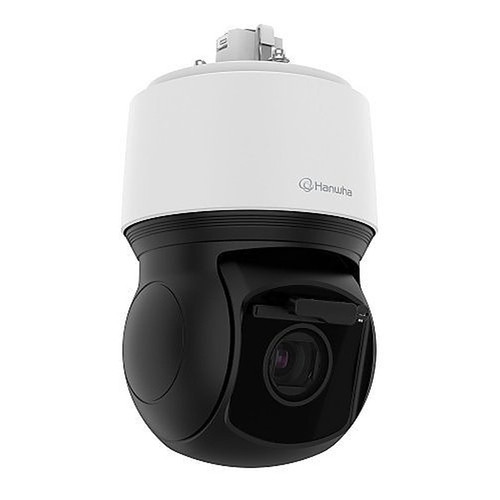
Both the ACTi A952 and Hanwha XNP-C9303RW are 8MP (3840×2160) outdoor PTZ speed domes aimed at wide-area surveillance requiring optical zoom, onboard AI analytics, and all-weather housings. A buyer evaluating either would typically be specifying a perimeter or traffic-monitoring installation where pan/tilt/zoom reach, low-light performance, and edge intelligence are primary decision drivers. This comparison evaluates both units strictly against their published specifications across imaging, installation, and integration dimensions.
In This Guide
How do the imaging specs compare?
The A952 uses a 1/1.8" CMOS sensor delivering 8MP at up to 30 fps across all listed resolutions (3840×2160, 3200×1800, 1920×1080), with a 6.4–138.5 mm lens providing 22x optical zoom and 10x digital zoom. Its minimum illumination is 0.002 lux (color) and 0 lux with IR active, with an IR range of 250 m and adaptive IR LEDs sensitive from 700–1100 nm. WDR is specified at 150 dB. The XNP-C9303RW uses a 1/2.8" CMOS sensor, also 8MP, but specifies a maximum frame rate of 60 fps (the 30 fps figure applies at 8MP per spec), with a 5–150 mm lens delivering 30x optical zoom and 32x digital zoom for a total 960x magnification. Its minimum illumination is 0.1 lux (color) and 0 lux with IR, with a Wise IR range of 200 m. WDR is specified at 120 dB.
On sensor size the A952's 1/1.8" chip is physically larger than the C9303RW's 1/2.8", which generally supports better low-light photon capture; the A952's published minimum color illumination of 0.002 lux versus the C9303RW's 0.1 lux reflects this. The A952 also claims a 30 dB WDR advantage (150 dB vs. 120 dB). The C9303RW counters with a longer zoom range (30x vs. 22x optical) and broader DORI detection reach — tele-end detection at 4,018 m and identification at 401.8 m per published DORI tables — figures not provided by ACTi for the A952. The C9303RW also includes a built-in gyro sensor for digital image stabilization and a wiper/lens heater for active water removal, neither of which is listed in A952 specs.
What about installation and environment?
Both cameras carry IP66 and IK10 ratings and are specified for operation down to -40°C. The A952's upper operating limit is +50°C; the C9303RW extends to +55°C. The A952 requires AC 24V or PoE++ (IEEE 802.3bt, Type 3, Class 6) at up to 60 W and weighs 3,920 g (8.64 lb). The C9303RW is also PoE++ (802.3bt, Class 6, Type 3) but is specified at a typical 26 W and maximum 46 W — meaningfully lower consumption — and weighs 5,600 g (12.34 lb). The C9303RW additionally carries NEMA 4X and NEMA-TS 2 certifications not listed for the A952.
Mounting accessories differ in specificity: ACTi lists compatible mount types (wall, pole, pendant, corner, rack) without model numbers in the provided spec data. Hanwha lists specific SBP-series accessory part numbers for hanging, ceiling, wall, pole, parapet, corner, and cabinet mounts, which simplifies procurement. Both units are aluminum-housings (the C9303RW is aluminum plus polycarbonate per spec). The A952 PTZ range covers 360° endless pan, -20° to +100° tilt, preset speed 300°/s, and manual speed 0.1°–90°/s. The C9303RW covers 360° endless pan at up to 500°/s, tilt 110° (-20° to +90°) at up to 350°/s, and manual speeds down to 0.024°/s — the C9303RW's higher maximum pan speed and finer minimum manual speed give more flexibility in tracking and slow-scan applications.
Which fits your VMS and analytics better?
Both cameras support ONVIF Profile S, G, T, and M, H.265/H.264/MJPEG compression, and unicast streaming. The C9303RW adds WiseStream II and III smart codec support, up to 10 streaming profiles, unicast to 20 users and multicast to 128 users, and an extensive protocol list including SNMPv3, MQTT, SRTP, NTCIP 1205, and IPv6 — none of which are listed in A952 specs. The C9303RW's API surface includes SUNAPI and Wisenet SDK in addition to ONVIF. The A952 lists ONVIF Profile S, G, T, M only.
On analytics, the A952 specifies a dedicated Deep Learning Processing Unit (DLPU) running face detection, ALPR, people counting, and VMD at the edge. The C9303RW specifies AI-engine analytics covering person, face, vehicle, and license plate classification with attribute detection (vehicle type: car/bus/truck/motorcycle/bicycle), virtual line crossing/direction, virtual area detection, object detection, and active auto-tracking of persons and vehicles. A952 specs include two-way audio with line-in and line-out; the C9303RW's alarm events mention audio output capability but audio input/output hardware specs are not explicitly enumerated in the provided data. Edge storage differs significantly: the A952 does not list onboard SD card support in the provided specs; the C9303RW includes two microSD/SDHC/SDXC slots supporting up to 1 TB (512 GB × 2) plus 4 GB RAM and 512 MB flash. The C9303RW also documents a layered cybersecurity stack (TPM with FIPS 140-2 Level 2, secure boot, signed firmware, AES encryption, 802.1X network authentication, device certificates) that is not addressed in the A952 spec set.
Which should you choose: the A952 or the C9303RW?
Our take: The A952 is the stronger choice when low-light performance and WDR headroom are the primary criteria: its 1/1.8" sensor yields a published minimum color illumination of 0.002 lux versus 0.1 lux on the C9303RW, and its 150 dB WDR rating is 30 dB higher than the C9303RW's 120 dB. It also claims a longer IR range (250 m vs. 200 m) and includes confirmed two-way audio with dedicated line I/O. The XNP-C9303RW is the stronger choice for long-range identification missions and systems-integrated deployments: its 30x optical zoom (vs. 22x) and published DORI tables show tele-end identification at 401.8 m, it draws up to 14 W less at maximum power (46 W vs. 60 W), adds dual 512 GB SD card slots, supports MQTT/NTCIP 1205/SRTP/IPv6 for traffic and ITS integration, and carries FIPS 140-2 Level 2 TPM cybersecurity — specs not listed for the A952. Buyers on Hanwha/Wisenet VMS infrastructure or requiring cybersecurity compliance should favor the C9303RW; those prioritizing raw low-light sensitivity should favor the A952.
Side-by-Side Comparison
Spec-for-spec, from manufacturer data.
| Specification | ACTi A952 | Hanwha C9303RW |
|---|---|---|
| Resolution | 8MP (3864×2180) | 8MP (3840×2160) |
| Image Sensor | 1/1.8" CMOS | 1/2.8" CMOS |
| Lens / Focal Length | 6.4–138.5 mm (22x optical, 10x digital) | 5–150 mm (30x optical, 32x digital, 960x total) |
| Min. Illumination (Color) | 0.002 lux | 0.1 lux |
| Min. Illumination (B/W / IR on) | 0 lux | 0 lux |
| IR Range | 250 m | 200 m (Wise IR) |
| WDR | 150 dB (Extreme WDR) | 120 dB (Extreme WDR) |
| Max Frame Rate | 30 fps @ 3840×2160 | 30 fps @ 8MP (60 fps noted in feature spec) |
| Pan Speed (Max / Manual) | 300°/s preset; 0.1°–90°/s manual | 500°/s max; 0.024°–250°/s manual |
| Video Compression | H.265, H.264, MJPEG | H.265, H.264, MJPEG; WiseStream II & III |
| IP / IK Rating | IP66 / IK10 | IP66 / IK10 / NEMA 4X / NEMA-TS 2 |
| Operating Temperature | -40°C to +50°C (heater) | -40°C to +55°C |
| Power Input / PoE Class | PoE++ 802.3bt Type 3 Class 6; AC 24V; max 60 W | PoE++ 802.3bt Type 3 Class 6; typical 26 W, max 46 W |
| Edge Storage | Not listed in provided specs | 2× microSD/SDHC/SDXC up to 512 GB each (1 TB total) |
| Audio | Two-way; Line-in; Line-out | Not explicitly enumerated in provided specs |
| Weight | 3,920 g (8.64 lb) | 5,600 g (12.34 lb) |
| Cybersecurity | Not listed in provided specs | TPM FIPS 140-2 L2, secure boot, signed firmware, AES, 802.1X |
| Warranty | 3 years (1 year continuous motion) | 3 years |
Frequently Asked Questions
Which should you choose: the A952 or the C9303RW?
The A952 is the stronger choice when low-light performance and WDR headroom are the primary criteria: its 1/1.8" sensor yields a published minimum color illumination of 0.002 lux versus 0.1 lux on the C9303RW, and its 150 dB WDR rating is 30 dB higher than the C9303RW's 120 dB. It also claims a longer IR range (250 m vs. 200 m) and includes confirmed two-way audio with dedicated line I/O. The XNP-C9303RW is the stronger choice for long-range identification missions and systems-integrated deployments: its 30x optical zoom (vs. 22x) and published DORI tables show tele-end identification at 401.8 m, it draws up to 14 W less at maximum power (46 W vs. 60 W), adds dual 512 GB SD card slots, supports MQTT/NTCIP 1205/SRTP/IPv6 for traffic and ITS integration, and carries FIPS 140-2 Level 2 TPM cybersecurity — specs not listed for the A952. Buyers on Hanwha/Wisenet VMS infrastructure or requiring cybersecurity compliance should favor the C9303RW; those prioritizing raw low-light sensitivity should favor the A952.
Is the A952 or C9303RW better for low-light and high-contrast scenes?
Based on published specs, the A952 has a lower minimum color illumination (0.002 lux vs. 0.1 lux) and a higher WDR rating (150 dB vs. 120 dB), giving it the specified edge in both low-light and backlit conditions. The A952 also lists a longer IR range (250 m vs. 200 m). The C9303RW does not publish a minimum color illumination figure below 0.1 lux in the provided spec data.
Which camera has better zoom reach and target identification at distance?
The C9303RW specifies 30x optical zoom (5–150 mm, F1.6 wide) versus the A952's 22x optical zoom (6.4–138.5 mm). Hanwha publishes full DORI tables: tele-end detection at 4,018 m, observation at 1,607 m, recognition at 803 m, and identification at 401 m. ACTi does not provide equivalent DORI distance figures in the supplied A952 spec data, so a direct numerical comparison of identification range is not possible.
Does either camera support onboard SD card storage, and which has stronger cybersecurity specs?
The C9303RW includes two microSD/SDHC/SDXC card slots supporting up to 1 TB total (512 GB per slot) with SD card encryption. Onboard SD storage is not listed in the A952 spec data provided. On cybersecurity, the C9303RW documents TPM with FIPS 140-2 Level 2, secure boot, signed firmware, firmware encryption, AES data encryption, 802.1X network authentication, device certificates, and brute-force attack prevention. Equivalent cybersecurity certifications are not enumerated in the A952 spec set.
Get a Second Opinion on Your Camera Choice
Share your site layout, coverage goals, and budget. Our team will validate the camera selection, flag anything we would change, and recommend products that match the use case.