
ACTi A818 vs Hanwha PNM-12082RVD: Specification Comparison
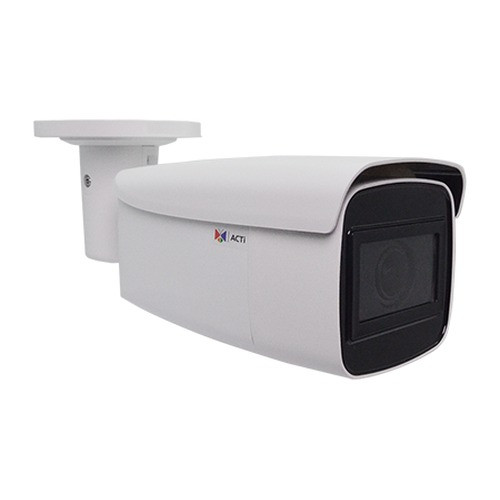
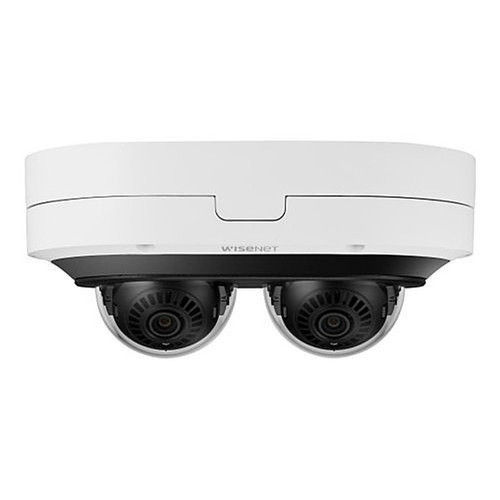
Both the ACTi A818 and Hanwha PNM-12082RVD are 6MP outdoor IP dome cameras targeting perimeter and general-surveillance applications where vandal resistance and all-weather performance are required. The A818 is a single-channel zoom dome with a 5x optical varifocal lens, while the PNM-12082RVD is a dual-channel fixed varifocal dome that delivers two independent 6MP video streams from one housing. Buyers cross-shopping these models are typically weighing optical zoom range and IR throw against dual-channel density and advanced cybersecurity features within the same resolution tier.
In This Guide
How do the imaging specs compare?
The A818 uses a 1/2.7-inch sensor and a motorized 2.7–13.5mm lens providing 5x optical zoom, achieving a maximum resolution of 2688×1520 at 25 fps or 2592×1944 at 20 fps. Its IR illuminators operate at 850nm with a rated throw of 85 metres at 1.0 lux, and minimum illumination is 0.01 lux in colour mode, dropping to 0 lux with IR active. WDR is specified at 150dB. The PNM-12082RVD uses a 1/2.8-inch sensor with a narrower motorized varifocal lens spanning 3.54–6.69mm (approximately 1.9x zoom), delivering dual 6MP streams at a maximum of 15 fps per channel. Its 850nm IR is rated to 25 metres, and minimum illumination is 0.16 lux in colour, 0.016 lux in B/W, and 0 lux with IR on. WDR is specified at 120dB.
On raw imaging metrics the A818 holds clear advantages in IR range (85m vs 25m), WDR depth (150dB vs 120dB), colour low-light sensitivity (0.01 lux vs 0.16 lux), and optical zoom reach (5x vs 1.9x). The PNM-12082RVD's differentiator is dual-channel output — two independent 6MP streams from a single unit — useful for covering two lanes or angles without a second camera, though each channel is capped at 15 fps versus the A818's 30 fps at 1080p.
What about installation and environment?
The A818 carries IP68 and NEMA 4X ratings, indicating full submersion protection, compared with the PNM-12082RVD's IP66/IP67 and NEMA 4X ratings. Both carry IK10 vandal resistance. The A818 operates across -30°C to 60°C (-22°F to 140°F), a significantly wider thermal envelope than the PNM-12082RVD's -10°C to 50°C (14°F to 122°F), making it more suitable for cold-climate deployments. The A818 is powered via DC 12V or PoE Class 3 (802.3af/at, 13W max). The PNM-12082RVD requires PoE+ Class 4 (802.3at), drawing more power to support its dual-channel architecture.
Mount options differ: the A818 supports wall, pole, corner, and rack mounting via accessories, and connects via a 2m pigtail cable with RJ-45 termination. The PNM-12082RVD supports ceiling, wall, and pendant mounting and terminates in a metal-shielded RJ-45 supporting 10/100/1000BASE-T gigabit Ethernet, versus the A818's 10/100BASE-T. The PNM-12082RVD housing is aluminum; the A818's housing material is not specified in the provided data. The PNM-12082RVD also includes onboard microSD storage support; the A818's spec data does not list a microSD slot.
Which fits your VMS and analytics better?
The A818 supports ONVIF Profile S, G, T, and M, offering broader profile coverage than the PNM-12082RVD, which is listed as Profile S and T only. Profile G (recording) and Profile M (metadata/analytics) compliance on the A818 may simplify integration with VMS platforms that leverage those profiles for edge recording and analytics metadata. The A818 includes onboard analytics for VMD, people counting, smoke detection, face detection, and tampering detection. The PNM-12082RVD's analytics field is not populated in the provided specifications.
For audio, the A818 provides 2-way audio with mic-in, line-in, and line-out connections. The PNM-12082RVD supports audio input only via an optional external I/O box, adding cost and installation complexity if audio is required. On cybersecurity, the PNM-12082RVD specifies TPM 2.0 (FIPS 140-2), encrypted firmware, secure boot, and signed firmware; the A818 holds Taiwan IoT Cybersecurity Certification Level 1. The PNM-12082RVD also lists 4GB RAM and 512MB onboard storage; equivalent memory figures are not provided for the A818. Edge storage via microSD is confirmed for the PNM-12082RVD; it is not confirmed for the A818 in the provided data.
Which should you choose: the A818 or the PNM-12082RVD?
Our take: The A818 is the stronger choice when long-range identification, wide-temperature operation, or onboard analytics are the primary requirements. Its 85m IR throw is 3.4× the PNM-12082RVD's 25m, its 150dB WDR exceeds the Hanwha's 120dB by 30dB, and its -30°C lower operating limit makes it viable in cold climates where the PNM-12082RVD's -10°C floor is a disqualifier. The PNM-12082RVD is the stronger choice when site density matters: two independent 6MP streams from one housing can replace two discrete cameras on a junction or entrance lane, and its TPM 2.0 / FIPS 140-2 cybersecurity stack, gigabit Ethernet port, and five-year warranty (vs the A818's three-year) favour enterprise IT environments with strict security-compliance requirements. Analytics for the PNM-12082RVD are not confirmed in the provided specifications, which is a gap buyers should resolve with Hanwha before selecting it for analytics-driven deployments.
Side-by-Side Comparison
Spec-for-spec, from manufacturer data.
| Specification | ACTi A818 | Hanwha PNM-12082RVD |
|---|---|---|
| Resolution | 6MP (2688×1520 max) | 6MP (3328×1872) per channel, dual-channel |
| Image Sensor | 1/2.7 inch | 1/2.8 inch |
| Lens / Focal Length | 2.7–13.5mm (5x optical zoom) | 3.54–6.69mm (1.9x optical zoom, motorized varifocal) |
| Min Illumination (Color) | 0.01 lux | 0.16 lux (F1.67, 1/30s) |
| Min Illumination (B/W) | 0 lux (IR on) | 0.016 lux; 0 lux (IR on) |
| IR Range | 85m @ 1.0 lux | 25m (82 ft) |
| WDR | 150dB | 120dB |
| Max Frame Rate | 30 fps @ 1080p; 25 fps @ 2688×1520 | 15 fps @ 6MP per channel |
| Video Compression | H.265; H.264; MJPEG | H.265; H.264; MJPEG |
| IP Rating | IP68 / NEMA 4X | IP66 / IP67 / NEMA 4X |
| IK / Impact Rating | IK10 | IK10 |
| Operating Temperature | -30°C to 60°C (-22°F to 140°F) | -10°C to 50°C (14°F to 122°F) |
| Power Input / PoE Class | DC 12V or PoE Class 3 (802.3af/at); 13W max | PoE+ Class 4 (802.3at) |
| ONVIF Profiles | Profile S, G, T, M | Profile S, T |
| Edge Storage | Not specified in provided data | microSD supported |
| Audio | 2-way (mic-in, line-in, line-out) | Audio input via optional external I/O box |
| Cybersecurity | Taiwan IoT Cybersecurity Certification Level 1 | TPM 2.0 (FIPS 140-2); encrypted firmware; secure boot; signed firmware |
| Warranty | 3 years | 5 years |
Frequently Asked Questions
Which should you choose: the A818 or the PNM-12082RVD?
The A818 is the stronger choice when long-range identification, wide-temperature operation, or onboard analytics are the primary requirements. Its 85m IR throw is 3.4× the PNM-12082RVD's 25m, its 150dB WDR exceeds the Hanwha's 120dB by 30dB, and its -30°C lower operating limit makes it viable in cold climates where the PNM-12082RVD's -10°C floor is a disqualifier. The PNM-12082RVD is the stronger choice when site density matters: two independent 6MP streams from one housing can replace two discrete cameras on a junction or entrance lane, and its TPM 2.0 / FIPS 140-2 cybersecurity stack, gigabit Ethernet port, and five-year warranty (vs the A818's three-year) favour enterprise IT environments with strict security-compliance requirements. Analytics for the PNM-12082RVD are not confirmed in the provided specifications, which is a gap buyers should resolve with Hanwha before selecting it for analytics-driven deployments.
Is the A818 or PNM-12082RVD better for low-light performance?
Based on the provided specifications, the A818 has an advantage: its colour minimum illumination is 0.01 lux versus the PNM-12082RVD's 0.16 lux, and its IR throw reaches 85 metres compared with 25 metres on the PNM-12082RVD. Both cameras reach 0 lux operation with IR active.
Can I use either camera in sub-zero temperatures?
The A818 is rated to -30°C (-22°F), making it suitable for cold-climate outdoor installations. The PNM-12082RVD's lower operating limit is -10°C (14°F) per the provided specifications, which may be insufficient for northern or high-altitude deployments without supplemental heating.
Does the PNM-12082RVD really replace two cameras?
Per the provided specifications, the PNM-12082RVD outputs two independent 6MP video channels from a single housing, each with its own motorized varifocal lens view. This can reduce conduit runs, junction boxes, and licensing slots in VMS environments that count channels per device. However, both channels share the same physical mounting point, so they cannot cover widely separated angles the way two independently mounted cameras can.
Get a Second Opinion on Your Camera Choice
Share your site layout, coverage goals, and budget. Our team will validate the camera selection, flag anything we would change, and recommend products that match the use case.