
ACTi A76 vs ACTi Z86: Specification Comparison
Both the ACTi A76 and ACTi Z86 are 4MP outdoor dome cameras designed for perimeter and general surveillance deployments. They share the same resolution class, dome form factor, IK10 vandal resistance, and PoE 802.3af power input — making them genuine cross-shop candidates. The key differentiators are lens type (fixed 2.8mm vs. motorized varifocal 2.8–12mm), ingress protection level, WDR capability, edge analytics depth, and audio I/O configuration. This comparison is grounded solely in the published specifications for each model.
In This Guide
How do the imaging specs compare?
Both cameras deliver 4MP resolution at 30 fps, but their imaging configurations diverge significantly at the lens. The A76 uses a fixed 2.8mm board-mount lens on a 1/2.7" sensor, yielding a wide, static field of view with no remote adjustment capability. The Z86 uses a motorized varifocal 2.8–12mm lens (f/1.6, 4.3× optical zoom), enabling remote reframing across a 4:1 focal-length range without physical access to the camera — a material advantage in applications where scene coverage requirements may shift after installation. The A76 specifies a maximum frame rate at 2688×1520; the Z86 specifies 30 fps at 1440p. Resolution output is stated differently across the two datasheets, so direct pixel-count comparison at identical resolutions is not confirmed by the supplied specs.
On low-light and dynamic-range performance, the A76 holds a clear quantified advantage. Its Extreme WDR is rated at 150 dB, and minimum illumination is specified at 0.003 lux in color mode and 0 lux in black-and-white with IR active, with an 850nm IR illuminator rated to 65m range. The Z86 lists WDR without a decibel rating and IR without a wavelength, range, or lux figure — so no direct numeric comparison is possible for those parameters. Buyers who need documented low-light or WDR performance benchmarks will find the A76's specs more auditable.
What about installation and environment?
Both cameras are rated IK10 for vandal resistance and share an operating temperature range of -40°C to 60°C (-40°F to 140°F), making either suitable for harsh outdoor environments. The primary environmental distinction is ingress protection: the A76 carries an IP68 rating (continuous submersion beyond 1m, per IEC 60529), while the Z86 is rated IP67 (temporary submersion to 1m). For installations exposed to sustained water ingress — drainage channels, wash-down areas, or flood-prone zones — the A76's IP68 rating provides a documented margin the Z86 does not.
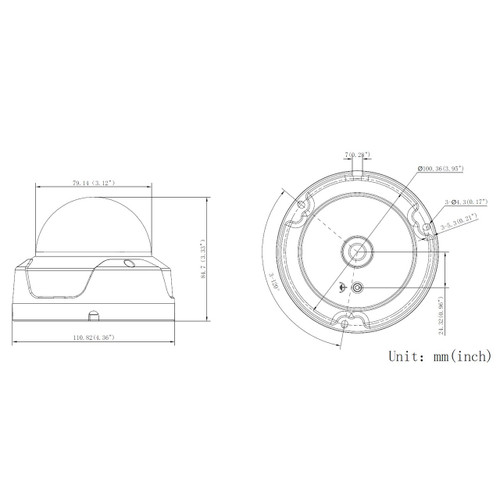
Both cameras are powered by PoE 802.3af; the Z86 further specifies consumption under 13W, while the A76 does not publish a wattage figure. The A76 also accepts DC 12V as an alternate power input, which the Z86 spec does not mention. Mounting options differ: the A76 supports wall, pole, pendant, and corner mounts; the Z86 supports ceiling, wall, and pendant. The A76 includes an RJ-45 pigtail connector; the Z86 connector type is not specified. The A76 dimensions are published (Ø110.82mm × H84.7mm); Z86 physical dimensions and weight are not provided in the supplied specs.
Which fits your VMS and analytics better?
The A76 carries explicit ONVIF Profile S, G, T, and M certifications, providing a documented compliance baseline for VMS integration. The Z86 is described as 'ONVIF-compatible' with vendor-specific integrations noted, but no specific ONVIF profile certifications are listed in the supplied specs — a distinction that matters when a VMS vendor requires a specific profile for full feature support. On edge analytics, the A76 includes Deep Learning-based Face Detection and People Detection alongside VMD; the Z86 lists no analytics capabilities in the supplied specs.
Audio also differentiates the two models. The A76 provides a dedicated audio input and a line-level 2-way audio interface (line-in and line-out), supporting external microphone or speaker attachment. The Z86 includes a built-in microphone only, with no line-out or 2-way audio specified. For on-board storage, the Z86 includes a MicroSDHC card slot; the A76 does not list local storage capability in the supplied specs. Buyers requiring edge recording redundancy will find the Z86 advantageous on that dimension alone.
Which should you choose: the A76 or the Z86?
Our take: The A76 is the stronger choice when documented imaging performance, deep analytics, and multi-profile ONVIF compliance are the primary requirements. Its 150 dB Extreme WDR (vs. an unquantified WDR on the Z86), 0.003 lux minimum illumination with a 65m/850nm IR illuminator (vs. no numeric IR or lux spec on the Z86), and certified ONVIF Profiles S/G/T/M (vs. 'ONVIF-compatible' on the Z86) give integrators auditable benchmarks. It also adds Deep Learning analytics — Face and People Detection — absent from the Z86 spec sheet, plus IP68 vs. IP67 ingress protection and 2-way line-level audio vs. a built-in mic only. The Z86 is the better fit when post-install scene flexibility is essential: its motorized 2.8–12mm varifocal lens allows remote reframing across a 4.3× zoom range without physical access, and its MicroSDHC slot provides on-board storage redundancy the A76 does not specify. Choose the Z86 for adjustable-coverage or edge-recording deployments; choose the A76 for fixed wide-angle positions where low-light depth, analytics, and verified VMS interoperability take priority.
Side-by-Side Comparison
Spec-for-spec, from manufacturer data.
| Specification | ACTi A76 | ACTi Z86 |
|---|---|---|
| Resolution | 4MP | 4MP |
| Max Frame Rate | 30 fps @ 2688×1520 | 30 fps @ 1440p |
| Image Sensor Size | 1/2.7" | — |
| Lens / Focal Length | 2.8mm fixed, board mount | 2.8–12mm motorized varifocal (f/1.6, 4.3× zoom) |
| Min Illumination | 0.003 lux (color); 0 lux (B/W with IR) | — |
| IR Illuminator | 850nm; 65m range | IR (wavelength and range not specified) |
| WDR | Extreme WDR, 150 dB | WDR (dB rating not specified) |
| Video Compression | H.265; H.264; MJPEG | H.265; H.264 |
| IP Rating | IP68 | IP67 |
| IK / Impact Rating | IK10 | IK10 |
| Operating Temperature | -40°C to 60°C | -40°C to 60°C |
| Power Input | PoE 802.3af Class 3; DC 12V | PoE 802.3af (under 13W) |
| ONVIF Profiles | Profile S, G, T, M (certified) | ONVIF-compatible (specific profiles not specified) |
| Edge Analytics | Deep Learning: Face Detection, People Detection; VMD | — |
| Audio | 2-way line-level (line-in, line-out) | Built-in microphone only |
| On-Board Storage | — | MicroSDHC card slot |
| Mount Types | Wall; Pole; Pendant; Corner | Ceiling; Wall; Pendant |
| Dimensions | Ø110.82mm × H84.7mm (4.36" × 3.33") | — |
| Warranty | 3 years | — |
Frequently Asked Questions
Which should you choose: the A76 or the Z86?
The A76 is the stronger choice when documented imaging performance, deep analytics, and multi-profile ONVIF compliance are the primary requirements. Its 150 dB Extreme WDR (vs. an unquantified WDR on the Z86), 0.003 lux minimum illumination with a 65m/850nm IR illuminator (vs. no numeric IR or lux spec on the Z86), and certified ONVIF Profiles S/G/T/M (vs. 'ONVIF-compatible' on the Z86) give integrators auditable benchmarks. It also adds Deep Learning analytics — Face and People Detection — absent from the Z86 spec sheet, plus IP68 vs. IP67 ingress protection and 2-way line-level audio vs. a built-in mic only. The Z86 is the better fit when post-install scene flexibility is essential: its motorized 2.8–12mm varifocal lens allows remote reframing across a 4.3× zoom range without physical access, and its MicroSDHC slot provides on-board storage redundancy the A76 does not specify. Choose the Z86 for adjustable-coverage or edge-recording deployments; choose the A76 for fixed wide-angle positions where low-light depth, analytics, and verified VMS interoperability take priority.
Is the A76 or Z86 better for low-light performance?
Based on the supplied specs, the A76 is more fully documented for low-light use. It specifies 0.003 lux minimum illumination in color, 0 lux in B/W with IR active, an 850nm IR illuminator with a 65m range, and 150 dB Extreme WDR. The Z86 lists IR and WDR as features but provides no lux figure, IR wavelength, IR range, or WDR decibel rating in the supplied specifications — so a numeric comparison cannot be made for that camera.
Can I adjust the Z86's field of view remotely after installation?
Yes. The Z86 uses a motorized varifocal 2.8–12mm lens with 4.3× optical zoom, which supports remote focal-length adjustment without physical access to the camera. The A76 has a fixed 2.8mm lens; its field of view is set at installation and cannot be changed remotely.
Does either camera support on-board storage or 2-way audio?
The Z86 includes a MicroSDHC card slot for local edge recording; the A76 does not list on-board storage in the supplied specs. For audio, the A76 provides 2-way line-level audio (line-in and line-out) for external microphone and speaker connection. The Z86 includes a built-in microphone only, with no line-out or 2-way audio specified.
Get a Second Opinion on Your Camera Choice
Share your site layout, coverage goals, and budget. Our team will validate the camera selection, flag anything we would change, and recommend products that match the use case.