
ACTi A76 vs ACTi Z82: Specification Comparison
Both the ACTi A76 and ACTi Z82 are 4MP outdoor dome cameras sharing the same resolution class and fixed-dome form factor, making them genuine cross-shop candidates for perimeter and general surveillance installations. The core trade-off centers on lens flexibility versus environmental hardening: the A76 offers a fixed wide-angle lens with superior ingress protection and vandal resistance, while the Z82 brings a motorized varifocal zoom lens and on-board storage at the cost of a lighter IP rating and fewer analytics capabilities.
In This Guide
How do the imaging specs compare?
Both cameras deliver 4MP resolution at 30 fps, but the maximum output resolutions differ: the A76 is specified at 2688×1520 while the Z82's 30 fps figure is noted only at 1080p, leaving its peak 4MP frame rate unspecified in the provided data. The A76 uses a 1/2.7" sensor with a fixed 2.8mm lens, yielding a single wide field of view, whereas the Z82 employs a 2.7–12mm motorized zoom lens providing a 4.4× optical range that adjusts the field of view remotely from approximately 91° to 27°—a meaningful operational advantage where post-install framing adjustments are anticipated.
In low-light performance, the A76 is more precisely specified: minimum illumination is 0.003 lux in color mode, 0 lux in B/W with IR, with 850nm IR LEDs rated to 65m. The Z82 lists IR and Day/Night capability but provides no lux figure, no IR wavelength, and no IR range in the supplied specs—buyers requiring quantified low-light performance cannot compare those figures directly from available data. Both cameras claim Extreme WDR; the A76 quantifies this at 150 dB, while the Z82's WDR value is unspecified numerically.
What about installation and environment?
The A76 carries IP68 and IK10 ratings, meaning it is rated for continuous submersion beyond IP67 limits and withstands 20-joule vandal impacts per IK10. Its operating temperature range spans -40°C to 60°C (-40°F to 140°F). The Z82 is rated IP67—dust-tight and protected against temporary water immersion—but no IK impact rating is listed in the provided specs, and no operating temperature range is supplied, leaving cold- or heat-environment suitability unverifiable from available data.
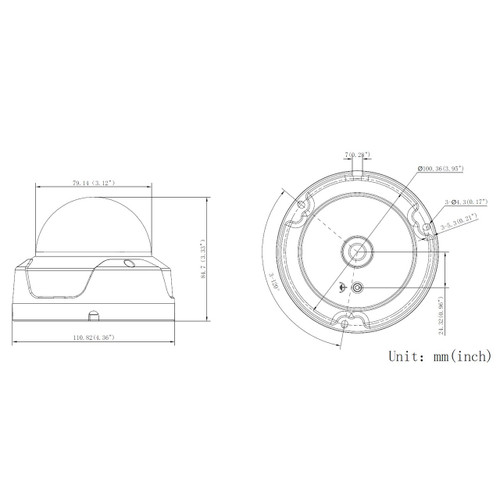
Power input for the A76 is PoE 802.3af Class 3 or DC 12V, with connection via RJ-45 pigtail. The Z82 is also PoE 802.3af but draws 15W—which exceeds the 802.3af standard maximum of 15.4W at the PSE and is at the ceiling of Class 3 budget; installers should verify switch port capacity. The A76 supports wall, pole, pendant, and corner mounts per spec; the Z82 lists ceiling and wall mounts only. The A76 dimensions are 110.82mm × 84.7mm (Ø × H); Z82 dimensions are not provided in the supplied specs.
Which fits your VMS and analytics better?
The A76 supports ONVIF Profile S, G, T, and M, offering broader VMS compatibility including Profile G for edge recording and Profile M for metadata/analytics streams. The Z82 supports ONVIF Profile S and T only—Profile G and M are not listed, which may limit integration with VMS platforms that rely on those profiles for advanced features. Both cameras confirm ONVIF compliance.
The A76 includes deep-learning analytics covering Face Detection and People Detection, plus VMD, all specified in the provided data. The Z82 lists no edge analytics in its supplied specs. For audio, the A76 provides a dedicated audio input and 2-way audio (line-in, line-out), while the Z82 includes only a built-in microphone with no line-out or 2-way audio capability noted. On-board storage is available on the Z82 via MicroSD/MicroSDXC; the A76 lists no local storage option in the provided specs. The A76 also carries a Taiwan IoT Cybersecurity Certification Level 1 (TAICS, CNS-16120); no cybersecurity certification is listed for the Z82.
Which should you choose: the A76 or the Z82?
Our take: The A76 is the stronger choice when the installation demands maximum environmental hardening, quantified low-light performance, richer analytics, or broader VMS integration. Concretely: it exceeds the Z82 on ingress protection (IP68 vs IP67) and adds a rated IK10 vandal resistance not listed for the Z82; its IR illuminators are specified at 65m range with a 0.003 lux color threshold versus no lux figure or range provided for the Z82; and it supports ONVIF Profile G and M plus deep-learning Face and People Detection absent from the Z82's spec sheet. The Z82 is the appropriate selection when post-installation lens adjustment is operationally necessary—its 2.7–12mm motorized zoom covers 91° to 27° remotely—or when local MicroSD storage is required, a feature the A76 does not list. Buyers in extreme-cold environments should note the Z82's operating temperature range is unspecified and cannot be confirmed from supplied data.
Side-by-Side Comparison
Spec-for-spec, from manufacturer data.
| Specification | ACTi A76 | ACTi Z82 |
|---|---|---|
| Resolution | 4MP | 4MP |
| Max Frame Rate | 30 fps @ 2688×1520 | 30 fps @ 1080p (4MP frame rate not specified) |
| Image Sensor Size | 1/2.7" | — |
| Lens / Focal Length | 2.8mm fixed, board mount | 2.7–12mm motorized zoom (4.4×) |
| Min Illumination | 0.003 lux (color); 0 lux (B/W with IR) | — |
| IR Range | 65m (850nm LEDs) | — |
| WDR | Extreme WDR, 150 dB | Extreme WDR (dB value not specified) |
| Video Compression | H.265; H.264; MJPEG | H.265; H.264 |
| IP Rating | IP68 | IP67 |
| IK / Impact Rating | IK10 | — |
| Operating Temperature | -40°C to 60°C (-40°F to 140°F) | — |
| Power Input / PoE Class | PoE 802.3af Class 3; DC 12V | PoE 802.3af; 15W |
| Mount Types | Wall; Pole; Pendant; Corner | Ceiling; Wall |
| Edge Storage | — | MicroSD / MicroSDXC |
| Audio | 2-way (Line-in, Line-out) | Built-in microphone only |
| ONVIF Profiles | Profile S, G, T, M | Profile S, T |
| Edge Analytics | Face Detection; People Detection; VMD (Deep Learning) | — |
| Cybersecurity Certification | Taiwan IoT Cybersecurity Level 1 (TAICS, CNS-16120) | — |
| Dimensions (Ø × H) | 110.82mm × 84.7mm (4.36" × 3.33") | — |
| Warranty | 3 Years | — |
Frequently Asked Questions
Which should you choose: the A76 or the Z82?
The A76 is the stronger choice when the installation demands maximum environmental hardening, quantified low-light performance, richer analytics, or broader VMS integration. Concretely: it exceeds the Z82 on ingress protection (IP68 vs IP67) and adds a rated IK10 vandal resistance not listed for the Z82; its IR illuminators are specified at 65m range with a 0.003 lux color threshold versus no lux figure or range provided for the Z82; and it supports ONVIF Profile G and M plus deep-learning Face and People Detection absent from the Z82's spec sheet. The Z82 is the appropriate selection when post-installation lens adjustment is operationally necessary—its 2.7–12mm motorized zoom covers 91° to 27° remotely—or when local MicroSD storage is required, a feature the A76 does not list. Buyers in extreme-cold environments should note the Z82's operating temperature range is unspecified and cannot be confirmed from supplied data.
Is the A76 or Z82 better for low-light performance?
Based on supplied specs, the A76 is better documented for low light: it is rated to 0.003 lux in color and 0 lux in B/W with IR, with 850nm IR LEDs specified at a 65m range. The Z82 lists IR and Day/Night capability but provides no minimum illumination figure, no IR wavelength, and no IR range—so a direct numeric comparison cannot be made from available data.
Which camera is tougher for outdoor or vandal-prone locations?
The A76 carries both IP68 (continuous submersion) and IK10 (20-joule impact resistance) ratings along with a confirmed operating range of -40°C to 60°C. The Z82 is rated IP67 (temporary immersion) with no IK impact rating or operating temperature range listed in its specs, making the A76 the clearly documented choice for harsh or vandal-risk environments.
Do I need the Z82's zoom lens, or is the A76's fixed lens sufficient?
If the camera's field of view may need to be adjusted after installation—or if a single unit must cover varying distances—the Z82's 2.7–12mm motorized zoom (4.4× optical) provides remote reframing from roughly 91° down to 27° without physical access. The A76's fixed 2.8mm lens sets a wide, unchangeable field of view at installation. For fixed, wide-area coverage where framing is determined at mount time, the A76's fixed lens is operationally simpler; for flexible or variable-distance applications, the Z82's zoom is the differentiating feature.
Get a Second Opinion on Your Camera Choice
Share your site layout, coverage goals, and budget. Our team will validate the camera selection, flag anything we would change, and recommend products that match the use case.