
ACTi A31 vs ACTi A415: Specification Comparison
The ACTi A31 and ACTi A415 are both 3MP outdoor-rated fixed bullet IP cameras from the same manufacturer, sharing identical resolution, IP66/IK10 enclosures, and 30m IR range. A buyer comparing them is typically choosing between a cost-optimized fixed-focal installation camera and a motorized-zoom variant with higher WDR performance and audio I/O. The comparison focuses on lens flexibility, low-light sensitivity, WDR headroom, PoE power class, and integration features such as ONVIF profile coverage and audio support.
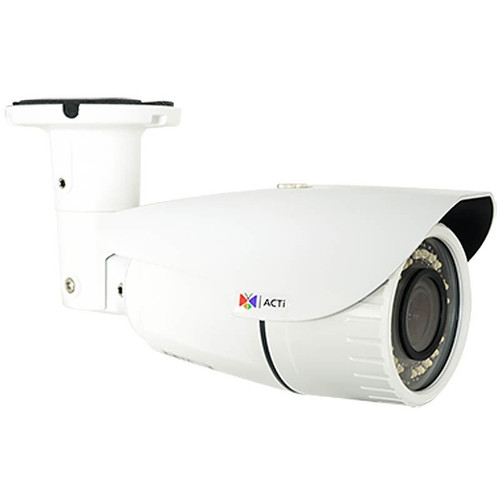
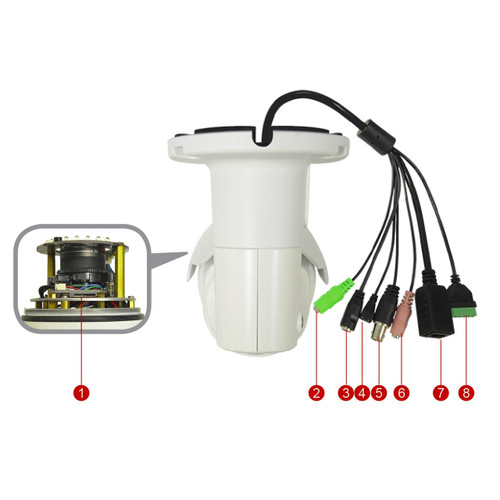
In This Guide
How do the imaging specs compare?
Both cameras deliver 3MP resolution at 30 fps, but their imaging chains diverge in several measurable ways. The A31 uses a 1/2.8-inch sensor with a fixed 2.8mm lens (approximately 90° horizontal FOV, fixed), while the A415 uses a 1/2.7-inch sensor paired with a motorized 2.8–12mm varifocal lens providing 4.3× optical zoom (90.6°–32.7° FOV). This gives the A415 genuine optical reach adjustment without digital resolution loss; the A31 offers no field-of-view flexibility once mounted.
Low-light performance also differs significantly. The A31 specifies minimum illumination of 0.1 lux (color) and 0.01 lux (B/W) at F1.85. The A415 specifies 0.05 lux (color) and 0.005 lux (B/W) at F1.4—a full stop lower in both color and monochrome modes, indicating a more sensitive imaging path. WDR headroom is similarly offset: the A31 is rated at 120dB (Advanced WDR), while the A415 is rated at 142dB (Extreme WDR). Both use 850nm IR LEDs with a 30m working distance, but the A415 spec describes the IR as 'Adaptive IR' with a mechanical IR-cut filter, whereas the A31 spec lists '22 × LED' without noting adaptive intensity control.
What about installation and environment?
Both cameras carry IP66 and IK10 ratings in metal casings and share an identical operating temperature range of -30°C to +50°C (-22°F to 122°F), so neither offers an environmental durability advantage over the other. Both support pole and rack mounting per the provided specs.
Power class is one installation differentiator. The A31 is specified as PoE+ (802.3at) Class 3, while the A415 is specified as PoE++ (802.3bt) Class 3. Both accept DC 12V as an alternative. Importantly, both list 'PoE Class 3 (IEEE 802.3af)' in their Power Supply field, which is consistent with the Class 3 designation but conflicts with the higher 802.3bt label on the A415—installers should verify switch port compatibility with ACTi's datasheet. The A31 weighs 771g versus the A415 at 834g; both use an RJ-45 pigtail connector. The A415 additionally lists EAC certification; the A31 additionally lists NEMA 4X. The A31 carries a stated 3-year warranty; no warranty term is listed in the A415 spec data provided.
Which fits your VMS and analytics better?
ONVIF coverage differs by one profile. The A31 supports ONVIF Profile S, Profile T, and Profile Q. The A415 adds Profile G, which enables edge-recorded stream retrieval directly from the camera—relevant where NVR redundancy or local buffering is required by the VMS.
Audio is exclusive to the A415: it includes an audio input and 2-way audio capability (mic-in, line-in, line-out), enabling intercom integration or on-site announcement without an external audio module. The A31 spec lists no audio. Both cameras provide the same edge analytics—Video Motion Detection (VMD) and People Counting—so analytics capability is equal. The A415 spec also references Pelco-D, Pelco-P, and ACTi URL command PTZ protocols for zoom control; the A31 has no such protocols given its fixed lens. Neither spec lists an onboard SD card slot or edge storage capability.
Which should you choose: the A31 or the A415?
Our take: The A415 is the stronger choice when scene coverage must be adjusted post-installation, low-light performance is critical, or audio I/O is required. Its 4.3× motorized optical zoom (2.8–12mm) versus the A31's fixed 2.8mm lens is the most operationally significant delta, enabling field-of-view tuning without remounting. The A415 also outperforms in low-light sensitivity—0.05 lux color versus 0.1 lux, and 0.005 lux B/W versus 0.01 lux—and delivers 142dB Extreme WDR against the A31's 120dB, a 22dB headroom advantage in high-contrast scenes. The A415 adds ONVIF Profile G for edge-recording retrieval and onboard 2-way audio, neither of which the A31 provides. Choose the A31 when the mount location is fixed and FOV is predetermined, the VMS does not require Profile G, audio integration is not needed, and budget or PoE switch constraints favor a simpler installation.
Side-by-Side Comparison
Spec-for-spec, from manufacturer data.
| Specification | ACTi A31 | ACTi A415 |
|---|---|---|
| Resolution | 3 MP | 3 MP |
| Image Sensor | 1/2.8 inch | 1/2.7 inch |
| Lens / Focal Length | 2.8mm fixed | 2.8–12mm motorized varifocal (4.3× optical zoom) |
| Min Illumination (Color / B/W) | 0.1 lux / 0.01 lux @ F1.85 | 0.05 lux / 0.005 lux @ F1.4 |
| WDR | 120dB (Advanced WDR) | 142dB (Extreme WDR) |
| IR Range | 30m (850nm, 22 × LED) | 30m (850nm, Adaptive IR) |
| Max Frame Rate | 30 fps | 30 fps |
| Video Compression | H.265; H.264; MJPEG | H.265 Adaptive Stream; H.264 (Baseline/Main/High); MJPEG |
| IP Rating | IP66 | IP66 |
| IK / Impact Rating | IK10 | IK10 |
| Operating Temperature | -30°C to +50°C | -30°C to +50°C |
| Power Input / PoE Class | PoE+ (802.3at) Class 3; DC 12V | PoE++ (802.3bt) Class 3; DC 12V |
| ONVIF Profiles | Profile S, T, Q | Profile S, G, T, Q |
| Audio | — | 2-way (Mic-in, Line-in, Line-out) |
| Certifications | CE; FCC; IP66; NEMA 4X; IK10 | CE Class A; FCC Class A; EAC; IP66; IK10 |
| Weight | 771g (1.70 lb) | 834g (1.84 lb) |
| Warranty | 3 years | — |
Frequently Asked Questions
Which should you choose: the A31 or the A415?
The A415 is the stronger choice when scene coverage must be adjusted post-installation, low-light performance is critical, or audio I/O is required. Its 4.3× motorized optical zoom (2.8–12mm) versus the A31's fixed 2.8mm lens is the most operationally significant delta, enabling field-of-view tuning without remounting. The A415 also outperforms in low-light sensitivity—0.05 lux color versus 0.1 lux, and 0.005 lux B/W versus 0.01 lux—and delivers 142dB Extreme WDR against the A31's 120dB, a 22dB headroom advantage in high-contrast scenes. The A415 adds ONVIF Profile G for edge-recording retrieval and onboard 2-way audio, neither of which the A31 provides. Choose the A31 when the mount location is fixed and FOV is predetermined, the VMS does not require Profile G, audio integration is not needed, and budget or PoE switch constraints favor a simpler installation.
Is the A31 or A415 better for low-light performance?
The A415 specifies lower minimum illumination—0.05 lux color and 0.005 lux B/W at F1.4—compared to the A31's 0.1 lux color and 0.01 lux B/W at F1.85. The A415 is the stronger performer in low-light conditions based on the provided specs.
Can either camera adjust its field of view after installation?
Only the A415 supports post-installation FOV adjustment. It uses a motorized 2.8–12mm varifocal lens with 4.3× optical zoom, covering 90.6° to 32.7° horizontal FOV. The A31 has a fixed 2.8mm lens with no optical zoom capability.
Does either camera support audio or edge recording?
The A415 includes audio input and 2-way audio (mic-in, line-in, line-out) and supports ONVIF Profile G, which enables edge-recorded stream retrieval on compatible VMS platforms. The A31 has no audio capability and does not list ONVIF Profile G. Neither camera lists an onboard SD storage slot in the provided specifications.
Get a Second Opinion on Your Camera Choice
Share your site layout, coverage goals, and budget. Our team will validate the camera selection, flag anything we would change, and recommend products that match the use case.