
ACTi A49 vs ACTi B412: Specification Comparison
Both the ACTi A49 and ACTi B412 are outdoor-rated 3MP zoom bullet cameras from the same manufacturer, targeting perimeter and area-surveillance applications where optical zoom eliminates the need for PTZ repositioning. The comparison covers the key specification deltas a B2B installer or IT buyer would weigh: zoom range and low-light performance, environmental and power requirements, and VMS/analytics integration depth. Neither model includes on-board storage per the provided specs; both share the same resolution class and bullet form factor.
In This Guide
How do the imaging specs compare?
Both cameras use a 1/2.8-inch sensor and deliver 3MP output at up to 30 fps, but their optical zoom ranges differ significantly. The A49 covers 2.8–12mm at 4.3x optical zoom, while the B412 spans 4.7–47mm at 10x optical zoom—more than twice the reach. The B412's longer telephoto end suits wider perimeters or stand-off distances where the A49's narrower zoom range would fall short. The A49 specifies a maximum resolution of 3MP without a named pixel grid in the provided data; the B412 explicitly lists 2065×1553 as its native resolution with additional stream options at 2048×1536, 1920×1080, and 1280×960 at 30 fps.
In WDR, the B412 edges the A49 by 3dB—145dB versus 142dB Extreme WDR—a marginal but spec-confirmed difference in dynamic range handling. Low-light performance diverges more sharply: the A49 achieves 0.05 lux color / 0.005 lux B/W at F1.4 with a visible IR LED rated to 30m. The B412 reaches 0.003 lux color at F1.6 and 0 lux in B/W with IR active, using 940nm invisible IR at a 60m range. The B412's invisible IR eliminates the red-glow signature that can attract attention or cause subject awareness, and its doubled IR range covers larger scenes without supplemental lighting.
What about installation and environment?
Both cameras carry IP66 and IK10 ratings, providing equivalent ingress protection against dust and water jets and identical impact resistance. The A49 adds NEMA 4X certification, which may be relevant for installations requiring that specific enclosure standard—the B412's provided specs do not list NEMA 4X. The A49 supports Wall, Pole, and Rack mount points per its spec data (with Board mount also noted); the B412 lists Wall, Ceiling, Pole, and Rack, adding ceiling as an explicitly supported orientation.
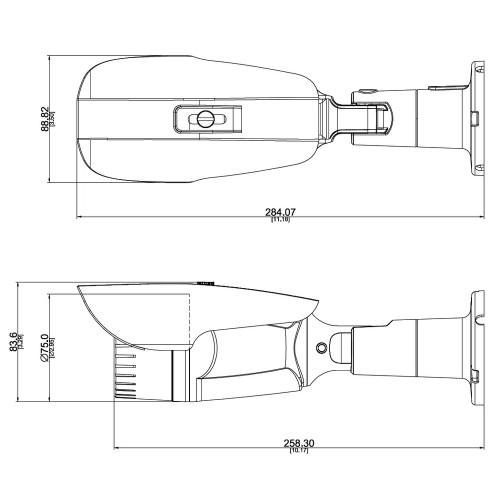
Power requirements differ meaningfully. The A49 draws 13W and is powered by PoE Class 3 (IEEE 802.3af), compatible with standard PoE switches without budget concerns. The B412 specifies PoE++ (802.3bt) as its primary power designation, though its power supply field also references 'High PoE (IEEE 802.3at)'—installers should confirm exact wattage from the B412 datasheet before switch selection, as 802.3bt infrastructure is not universally deployed. Operating temperature range also favors the B412: −40°C to 60°C versus the A49's −30°C to 50°C, a 10°C advantage at both extremes relevant to extreme-climate deployments. The B412 weighs 2098g (4.625 lb) versus the A49's 694g (1.53 lb)—a 3× weight difference that affects bracket and pole-mount load ratings.
Which fits your VMS and analytics better?
The B412 supports ONVIF Profile S, G, T, and M; the A49 is limited to Profile S and Profile T per the provided specs. Profile G adds on-board storage and recording management interoperability; Profile M extends metadata and analytics event handling. Neither camera lists on-board storage (SD card) in the provided specifications, so Profile G compatibility on the B412 may be contingent on an accessory or future firmware. Installers targeting VMS platforms that mandate Profile G or M should verify B412 firmware support before deployment.
Analytics parity is close but not identical: both models include VMD and People Counting. The B412 additionally lists Smoke Detection in its analytics spec. The B412 also specifies audio capabilities—built-in microphone, mic-in, line-in, and line-out—enabling two-way audio or audio event recording integrations. The A49's provided specs list no audio input or output. PTZ control protocol support on the B412 (Visca, Pelco-D, Pelco-P, ACTi URL command for zoom control) is not listed for the A49, which matters for VMS operators using those control buses. Certifications differ: the A49 carries CE, FCC, and EAC; the B412 lists NEMA Taiwan IoT Cybersecurity Certification—neither carries the other's marks per provided data.
Which should you choose: the A49 or the B412?
Our take: The A49 is the stronger choice when infrastructure is limited to standard 802.3af PoE switches, mounting loads are restricted, and a 30m IR range with 4.3x zoom covers the target scene. Its 694g weight, 13W draw, and NEMA 4X certification lower installation overhead in standard outdoor enclosures. The B412 is the stronger choice for demanding long-range or low-light scenarios: its 10x zoom (4.7–47mm vs. 2.8–12mm) doubles the optical reach, its 60m 940nm invisible IR eliminates glow signature, and its minimum illumination of 0.003 lux color vs. the A49's 0.05 lux is a 16× sensitivity advantage. The B412 also extends operational temperature to −40°C vs. −30°C and adds audio I/O, Smoke Detection analytics, and ONVIF Profile G/M—capabilities the A49 lacks per spec. Choose the A49 for cost-efficient PoE-constrained installs; specify the B412 where zoom depth, low-light sensitivity, audio, and broader ONVIF profile support justify the heavier power and mounting requirements.
Side-by-Side Comparison
Spec-for-spec, from manufacturer data.
| Specification | ACTi A49 | ACTi B412 |
|---|---|---|
| Resolution | 3MP | 3MP (2065×1553) |
| Image Sensor | 1/2.8 inch | 1/2.8 inch |
| Lens / Focal Length | 2.8–12mm (4.3x optical zoom) | 4.7–47mm (10x optical zoom) |
| Min. Illumination (Color) | 0.05 lux @ F1.4 | 0.003 lux @ F1.6 |
| Min. Illumination (B/W) | 0.005 lux @ F1.4 | 0 lux (IR on) |
| IR Range | 30m (visible IR) | 60m (940nm invisible IR) |
| WDR | Extreme WDR 142dB | Extreme WDR 145dB |
| Max Frame Rate | 30 fps | 30 fps |
| Video Compression | H.265; H.264 (B/M/H); MJPEG | H.265; H.264 (B/M/H); MJPEG |
| IP Rating | IP66 / NEMA 4X | IP66 |
| IK / Impact Rating | IK10 | IK10 |
| Operating Temperature | −30°C to 50°C | −40°C to 60°C |
| Power / PoE Class | PoE Class 3 (802.3af), 13W; DC 12V | PoE++ (802.3bt); DC 12V |
| ONVIF Profiles | Profile S, Profile T | Profile S, Profile G, Profile T, Profile M |
| Edge Analytics | VMD; People Counting | VMD; People Counting; Smoke Detection |
| Audio | — | Built-in mic; Mic-in; Line-in; Line-out |
| Weight | 694g (1.53 lb) | 2098g (4.63 lb) |
| Mount Options | Wall; Pole; Rack | Wall; Ceiling; Pole; Rack |
Frequently Asked Questions
Which should you choose: the A49 or the B412?
The A49 is the stronger choice when infrastructure is limited to standard 802.3af PoE switches, mounting loads are restricted, and a 30m IR range with 4.3x zoom covers the target scene. Its 694g weight, 13W draw, and NEMA 4X certification lower installation overhead in standard outdoor enclosures. The B412 is the stronger choice for demanding long-range or low-light scenarios: its 10x zoom (4.7–47mm vs. 2.8–12mm) doubles the optical reach, its 60m 940nm invisible IR eliminates glow signature, and its minimum illumination of 0.003 lux color vs. the A49's 0.05 lux is a 16× sensitivity advantage. The B412 also extends operational temperature to −40°C vs. −30°C and adds audio I/O, Smoke Detection analytics, and ONVIF Profile G/M—capabilities the A49 lacks per spec. Choose the A49 for cost-efficient PoE-constrained installs; specify the B412 where zoom depth, low-light sensitivity, audio, and broader ONVIF profile support justify the heavier power and mounting requirements.
Is the A49 or B412 better for low-light performance?
The B412 is substantially better in low light per the provided specs. It achieves 0.003 lux color (F1.6) and 0 lux in B/W with IR active, versus the A49's 0.05 lux color and 0.005 lux B/W at F1.4. The B412 also uses 940nm invisible IR at a 60m range, compared to the A49's visible IR at 30m—meaning the B412 covers twice the distance in darkness without a detectable red glow.
Can I power the A49 and B412 from the same PoE switch?
Not necessarily. The A49 draws 13W and runs on standard PoE Class 3 (IEEE 802.3af), which any 802.3af-capable switch port can supply. The B412 is specified as PoE++ (802.3bt), which requires a higher-budget switch port. Its power supply field also references IEEE 802.3at (High PoE), so the actual wattage draw should be confirmed from the B412 datasheet before switch selection to avoid underpowering the unit.
Which camera is easier to integrate with a VMS that uses ONVIF Profile G for edge recording?
The B412 supports ONVIF Profile S, G, T, and M per its provided specs, making it the compatible choice for VMS platforms requiring Profile G or Profile M. The A49 is listed as Profile S and Profile T only—Profile G is absent from its spec data. Note that neither camera lists on-board storage (SD card) in the provided specifications, so Profile G functionality on the B412 should be verified against current firmware before relying on it for edge recording workflows.
Get a Second Opinion on Your Camera Choice
Share your site layout, coverage goals, and budget. Our team will validate the camera selection, flag anything we would change, and recommend products that match the use case.