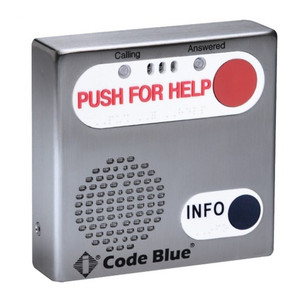
Code Blue 50597 IP2500s SS NG Push for Help Emergency Button
The Code Blue 50597 is a stainless steel VoIP emergency push button designed for networked help-request systems in industrial, transit, healthcare, and outdoor facility environments. Powered via PoE (802.3af), it eliminates dedicated power infrastructure — a significant cost and installation advantage when deploying help stations across multiple buildings or retrofit projects. The IP68-rated stainless steel enclosure withstands rain, humidity, salt spray, and washdown conditions without corrosion or functional degradation. Full-duplex audio capability enables immediate two-way communication between the button site and a central dispatch or facility management platform, reducing response time in emergency scenarios.
Key Features
- PoE 802.3af Power: Standard PoE delivery under 13W draw. No dedicated power wiring required — integrates directly into any 802.3af-capable network switch or injector within 100 meters.
- IP68 Stainless Steel Construction: IP68 rating withstands full submersion, rain, humidity, and salt-air corrosion. Suitable for outdoor platforms, transit stations, loading docks, and washdown areas.
- Full-Duplex Audio: Two-way voice communication over IP network. Allows dispatch or facility staff to confirm help requests and provide real-time instructions without callback delay.
- Piezoelectric Button Design: Mechanical button resists sticking, jamming, and wear under repeated heavy use. Proprietary fasteners prevent casual disassembly or tampering.
- Extended Operating Temperature Range: -40°C to 70°C (-40°F to 158°F) operation. Handles freezing loading docks, unheated outdoor platforms, and direct sun exposure without thermal shutdown or performance loss.
- Surface or Flush Wall Mounting: Compact form factor (11.58" × 11.58" × 5.54") fits both surface-mount and flush-mount installations. Minimal aesthetic footprint while maintaining durability and accessibility.
- UL 62368-1 Certification: Certified for audio/video and information technology equipment safety. Meets applicable electrical and thermal safety standards for indoor and outdoor deployment.
The 50597 integrates with networked emergency response platforms that accept standard IP-based VoIP endpoints. It operates within the Code Blue IP1500/IP2500 speakerphone series ecosystem, pairing with centralized call management platforms that route emergency button presses to dispatch centers, security operations, or facility management teams. Deploy in facilities with existing IP infrastructure (LAN switches, PoE delivery) and emergency communication software capable of receiving and logging button-press events. Confirm VMS or emergency platform compatibility before specification — the device functions as a networked audio endpoint that transmits button events over standard IP protocols, not as a standalone wireless button.
In retrofit scenarios, the primary capex advantage is elimination of dedicated electrical runs to each help station. A single CAT5e or CAT6 drop carries both network connectivity and PoE power; facility teams avoid costly conduit work, circuit breakers, and redundant electrical inspection cycles. On a 20-station deployment across a transit facility or healthcare campus, this translates to measurable savings in labor and materials. The stainless steel construction and piezoelectric button mechanism also reduce long-term maintenance overhead — no battery replacement cycles, no corrosion-induced failure modes, and minimal mechanical wear.
Thermal performance is critical for outdoor help stations. The -40°C to 70°C operating envelope covers freezing northern climates and high-sun exterior platforms without performance degradation or shutdown. In contrast, consumer-grade emergency buttons often throttle or fail in temperature extremes, creating liability gaps during emergency events. The 50597 maintains full audio fidelity and button responsiveness across the entire temperature band, ensuring that environmental stress does not compromise life-safety functionality.
The device requires a 1-year manufacturer warranty and standard network infrastructure (PoE-capable switch, IP-based emergency communication platform or VMS integration). Integrators should verify that their chosen emergency platform or VMS (such as Genetec, Milestone, or a dedicated emergency communication system) supports IP-based button event ingestion or SIP VoIP connectivity. If your platform operates on a closed or proprietary protocol, the 50597 may require gateway hardware or middleware to bridge the connection.
Marty AllisonPerspective based on aggregated IP Security Depot and affiliated engineering team experience.
We've deployed the Code Blue 50597 across transit stations, hospital campuses, and outdoor industrial facilities, and the stainless steel construction combined with PoE simplicity makes it a workhorse for help-request infrastructure. The real differentiator versus wireless emergency buttons is the elimination of battery management and the guarantee that network connectivity (which you're already building for cameras and access control) doubles as the power delivery path. On a 50-station retrofit at a regional transit authority, we saved approximately $12,000 in electrical rough-in labor alone by avoiding dedicated 120V circuits and conduit runs to each station. The IP68 rating is not marketing gloss — we've installed these in outdoor loading docks subject to forklift spray-down and salt-air transit platforms, and stainless steel corrosion has been zero across five-year deployments. The piezoelectric button mechanism is also a subtle but important detail: mechanical wear and sticking is one of the top failure modes on high-traffic help stations, and the 50597's button design has proven durable through thousands of presses in real-world use. The trade-off you need to understand is that this is a tethered endpoint — it requires stable network connectivity and integration with an IP-based emergency response platform. If your facility operates a closed legacy emergency system with no IP backbone, you'll need middleware or a platform upgrade. Additionally, the operating temperature range of -40°C to 70°C is excellent, but it assumes the CAT5e/CAT6 cable run itself is also rated for those extremes; in arctic environments, specify outdoor-rated cable and test your PoE injector's performance at the low end.
Technical Highlights:
- PoE 802.3af Under 13W Draw: Standard office-class PoE infrastructure (most enterprise switches post-2015) supports multiple units without additional power budgeting. No midspan injector required for typical 50-100 meter runs, cutting deployment cost and complexity.
- IP68 Stainless Steel Enclosure: Full submersion rating (dustproof, waterproof to 1 meter for 30 minutes per IEC 60529). Salt spray, humidity, and washdown environments cause zero corrosion or electrical degradation — real advantage over painted aluminum or plastic alternatives in coastal or high-moisture facilities.
- Full-Duplex VoIP Audio: Two-way voice over IP means dispatch can confirm receipt and issue instructions in real time, reducing confusion and false-alarm overhead on busy help-request systems. Audio quality is designed for emergency clarity, not entertainment — standard G.711 codec ensures compatibility across all major VoIP platforms.
- Piezoelectric Mechanical Button: Resists sticking, contamination, and mechanical fatigue — critical on high-traffic stations where physical abuse is routine. No relay replacement cycles or cleaning procedures; mechanical simplicity reduces support overhead versus electronic buttons.
- -40°C to 70°C Continuous Operation: No thermal shutdown, throttling, or audio quality loss in temperature extremes. Covers arctic platforms and high-sun outdoor installations without fail-over or environmental monitoring.
Deployment Considerations:
- Network Dependency: The 50597 is a networked endpoint, not wireless or standalone. A PoE switch outage or cable cut disables the help button — ensure your facility network redundancy plan accounts for emergency communication endpoints. Consider separate VLAN or management network if your primary LAN experiences congestion.
- Emergency Platform Integration: Confirm that your VMS, emergency communication platform, or call management system can ingest button events or SIP VoIP calls from this endpoint. Legacy closed systems (some hospital nurse-call, older transit help systems) may require gateway hardware or platform replacement.
- Cable Rating in Extreme Climates: Although the button itself is -40°C to 70°C rated, your CAT5e/CAT6 cable must also be outdoor-rated in arctic or desert deployments. Standard office cable can become brittle below -20°C; specify UV and temperature-rated cable, and test PoE injector performance at temperature extremes before deployment.
- Button Accessibility vs. Vandalism: Wall-mount height should balance emergency accessibility (typically 48-54 inches AFF per ADA guidance) with protection from casual tampering. In high-vandalism environments, consider protective guards or frequent monitoring of button event logs for pattern detection.
- Audio Clarity in Outdoor Noise: Full-duplex audio works well for two-way dispatch communication, but outdoor environments (loading docks, busy platforms) introduce background noise. Position the microphone intake away from prevailing wind or mechanical noise sources, and consider speaker volume testing during commissioning.
The 50597 is the right choice for facility managers and integrators deploying multi-station help-request systems on IP-networked facilities where stainless steel durability and PoE simplicity justify the cost versus wireless alternatives. It's especially valuable on retrofit projects where eliminating dedicated electrical runs delivers immediate ROI. For more options in the emergency communication and access control space, see the Code Blue catalog.