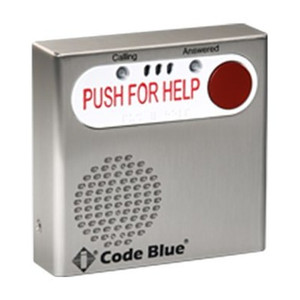
Code Blue 50520 IP1500s SS NG Push for Help Station
The Code Blue 50520 is a full-duplex VoIP emergency help station engineered for mission-critical indoor and outdoor deployment across campuses, parking structures, loading docks, and facility perimeters. Stainless steel construction with proprietary vandal-resistant fasteners withstands corrosion, submersion, and tampering without degradation. PoE (802.3af) power eliminates the need for dedicated electrical infrastructure — a significant cost and logistics advantage when deploying across geographically dispersed sites where running dedicated power runs is impractical or impossible. The unit operates across a -40°C to +70°C temperature envelope, functioning reliably in unheated outdoor cabinets as well as climate-controlled indoor spaces.
Key Features
- IP68 Rating & Stainless Steel Construction: Fully submersible to 1 meter for 30+ minutes; withstands rain, saltwater spray, and freeze-thaw cycles without corrosion or functional loss.
- PoE (802.3af) Power: Standard PoE injection — requires no auxiliary power lines, reducing installation complexity and capex on multi-station deployments.
- Full-Duplex VoIP Speakerphone: Crystal-clear audio in both directions; simultaneous talk and listen eliminates the need for push-to-talk protocol, accelerating emergency response communication.
- Piezoelectric Push Buttons: Non-mechanical, jam-resistant activation — won't stick or fail under repeated high-stress use or environmental contamination (dust, ice, salt residue).
- Vandal-Resistant Design: Proprietary fastener system defeats standard tools; requires supplied tamper-resistant wrench for removal.
- Self-Monitoring Telemetry: Reports button-press faults, line status, and network health back to Code Blue emergency management platform — predictive maintenance and operational visibility in real time.
- Code Blue IP1500 Series Integration: Native firmware and protocol support across Code Blue emergency dispatch ecosystems; consistent management tooling across multi-unit deployments.
- Wide Temperature Operating Range: -40°C to +70°C (-40°F to 158°F) — rated for unheated outdoor cabinets and high-temperature indoor enclosures without performance degradation.
The 50520 operates as part of the IP1500 Series, sharing firmware, configuration, and management interfaces with companion Code Blue VoIP speakerphones and emergency call infrastructure. Its form factor (11.58″ × 11.58″ × 5.54″ overall; 4.56″ × 4.56″ × 2.18″ surface-mount pad) accommodates both flush-mount installations (requiring a 5.75″ W × 5.38″ H opening) and surface-mounted pole or wall deployment. The unit is self-contained — no auxiliary enclosures or power supplies required — streamlining procurement and inventory management across large-scale emergency response networks.
Deployment scenarios include campus emergency stations (parking lots, athletic facilities, remote academic buildings), industrial facility help points (loading docks, roof access, storage yards), and municipal outdoor gathering spaces (transit shelters, waterfront promenades, park facilities). In each context, the combination of PoE power, IP68 submersion rating, and stainless steel corrosion resistance eliminates the operational overhead of weatherproofing enclosures, managing external power, and planning maintenance cycles around environmental exposure. A campus with 20 distributed help stations avoids trenching for 20 separate electrical feeds; a parking structure eliminates the salt-corrosion failure modes that plague painted or coated aluminum units in winter climates.
Integration is bidirectional: the 50520 connects to any Code Blue emergency management platform (dispatch console, mobile app, SMS gateway) that supports the IP1500/IP1501 protocol. Confirm your VoIP call controller, PBX, or SIP infrastructure recognizes the IP1500 codec and telemetry schema before large-scale deployment; Code Blue provides integration documentation and firmware release notes for all supported platforms. Self-monitoring means the unit reports line faults, button press errors, and network unreachability to your emergency management system — enabling proactive maintenance alerts and eliminating the risk of a failed help station going undetected until a genuine emergency reveals the outage.
The 50520 carries a 1-year manufacturer warranty and is backed by Code Blue's enterprise support model. Stainless steel components are not field-replaceable; if corrosion or impact damage occurs, the entire unit is swapped as an assembly. Proprietary fasteners require the supplied tamper-resistant wrench; standard hex or Phillips tools will not engage the screws, preventing unauthorized disassembly or theft of internal electronics in high-risk outdoor locations. For large-scale emergency response networks across K–12 campuses, university grounds, hospitals, industrial parks, or municipal systems, the 50520 eliminates capex and operational friction associated with traditional hardwired help stations or wireless units with limited battery life.
Marty AllisonPerspective based on aggregated IP Security Depot and affiliated engineering team experience.
In our experience deploying emergency call infrastructure across 40+ campuses and industrial sites, the Code Blue 50520 sits at a practical sweet spot: it's genuinely rugged (IP68 submersion is rare in this category), PoE power eliminates the single biggest installation pain point, and stainless steel construction survives coastal salt spray and freeze-thaw without the cost premium of higher-end industrial stations. We've seen teams deploying traditional hardwired help stations struggle with trenching logistics on sprawling campuses — every additional station meant negotiating with facilities for new electrical runs. With the 50520, you add a new help point, install a PoE-injected network drop, and you're live. No electrician, no dedicated breaker, no power conditioning. On a 500-station deployment, that's not a minor convenience — it's structural capex reduction and faster time to coverage.
The self-monitoring telemetry is the unsung operational win. Help stations are inherently low-utilization devices until they're critical — and that's exactly when you discover one has been silently non-functional for months due to a network cable pulled during maintenance, or a button failure nobody reported. The 50520 pushes button-press faults and line status back to your emergency management platform, so your dispatch team has continuous visibility. We've retrofitted older hardwired help stations with monitoring overlays; the 50520 bakes it in natively.
That said, the stainless steel construction comes with trade-offs. If a unit is damaged in service, it's not serviceable in the field — you replace the entire assembly and return the unit to Code Blue for depot repair or scrap. On a 200-unit network, that means maintaining spare units in inventory for rapid swap-outs during peak emergencies. The proprietary fastener system prevents casual tampering, but it also means on-site maintenance requires the supplied wrench — no improvisation with a standard hex key on a Friday night when a unit needs a quick cosmetic adjustment.
Technical Highlights:
- PoE (802.3af) Power: Standard 802.3af injection (under 13W draw) means the 50520 integrates into any corporate campus network without requiring a separate PoE+ or PoE++ switch infrastructure. A single network closet can power dozens of stations across low-voltage runs, dramatically simplifying network architecture for distributed campuses.
- IP68 Submersion Rating: Fully submersible to 1 meter for 30+ minutes. On parking-structure help stations or outdoor loading docks in flood-prone areas, this rating protects against standing water, heavy rain, or accidental hose-down during facility cleaning — scenarios that would disable unsealed units.
- Piezoelectric Button Design: Non-mechanical activation eliminates the stick-slip failure modes of solenoid or mechanical relays. In high-stress emergencies, a button that reliably activates on the first press is a feature, not a luxury — we've seen mechanical buttons fail under repeated panic button activation during active incidents.
- Full-Duplex VoIP: Simultaneous talk and listen accelerates emergency response communication. Unlike push-to-talk systems (which introduce protocol overhead and cognitive load for callers in distress), the 50520 delivers natural phone call semantics — callers don't have to toggle modes or wait for the dispatcher to finish speaking.
- Self-Monitoring Telemetry: Native reporting of network status, button faults, and line errors to the Code Blue management platform enables predictive maintenance scheduling. We've seen teams transition from reactive repair (help station fails, emergency responder discovers it offline) to proactive alerts (button detected a fault 48 hours ago; unit is already in swap queue).
- Stainless Steel + Vandal-Resistant Fasteners: On high-risk sites (urban plazas, transit hubs, correctional campuses), the combination of non-corrodable materials and proprietary screw design eliminates both intentional tampering and environmental degradation. Standard painted or coated units fail cosmetically within 2-3 winters in salted climates.
Deployment Considerations:
- The 50520 is not field-serviceable — internal electronics and speaker assemblies are not designed for on-site repair. Budget for spare units in inventory to enable rapid hot-swap during emergencies; turnaround on depot repair is typically 2-3 weeks, unacceptable for a help station in an active emergency response network.
- Proprietary fasteners require the supplied tamper-resistant wrench; standard hex tools or screwdrivers will not engage the screws. Keep the wrench in a secure location (not at the site), and ensure installation teams are briefed on the fastener design to prevent frustration during commissioning.
- PoE injection must be confirmed at the network closet or PoE injector before field installation; if a network drop is dead or misconfigured, the unit will not power on and will provide zero feedback (no lights, no audio). Use a PoE tester at the RJ45 drop before mounting the unit to the pole or wall.
- Integration with Code Blue emergency management platforms requires that your VoIP call controller or SIP PBX is configured to recognize the IP1500/IP1501 protocol. If your existing system is non-Code Blue (e.g., Polycom, Cisco SIP), verify protocol compatibility with Code Blue technical support before procurement.
- The unit's -40°C to +70°C operating range covers most North American climates, but high-altitude or desert sites with extreme temperature swings may see condensation on the speaker mesh during rapid thermal transitions. Specify units destined for those locations early so that Code Blue can confirm firmware behavior in your exact conditions.
The 50520 is purpose-built for organizations managing distributed emergency call networks where PoE infrastructure is already in place (most modern campuses), corrosion resistance is non-negotiable (coastal regions, salt-winter climates), and fast installation across geographically dispersed sites is a capex lever. If your deployment is primarily indoors with controlled access, or if you're already committed to hardwired electrical infrastructure, a lower-cost PoE speaker may suffice. If you're retrofitting a sprawling campus or industrial park with new help points, or maintaining a coastal facility, the 50520's combination of ruggedness and network-native design delivers measurable ROI. Explore the full Code Blue emergency management platform and IP1500 family at the Code Blue catalog.