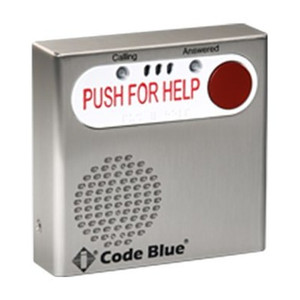
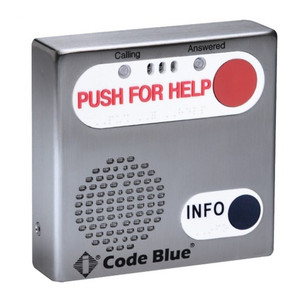
Code Blue 50560 IP1501s Stainless Steel PoE Push For Help Button
The Code Blue 50560 is a stainless steel emergency call button designed for IP-based emergency communication systems in healthcare, transit, industrial, and outdoor security environments. It draws power and data exclusively over PoE (802.3af)—no dedicated electrical infrastructure required—making it ideal for retrofit deployments where running new conduit is costly or infeasible. The IP68-rated housing seals against dust and water ingress, while stainless steel construction resists corrosion in moisture-heavy settings like parking structures, loading docks, and coastal facilities. Operating across -40°C to 70°C, the 50560 functions in arctic warehouses and sun-exposed outdoor call stations without environmental deration.
Key Features
- IP68 Rating: Fully sealed against dust and submersion. Withstands washdown environments and coastal salt spray without functional degradation.
- Stainless Steel Housing: 300-series stainless construction resists vandalism, corrosion, and environmental wear in high-traffic or industrial zones.
- PoE (802.3af) Operation: Powers directly from standard network switch ports (<13W draw). Eliminates auxiliary power supplies and reduces installation labor on new or retrofit projects.
- Dual Mount Profiles: Surface or flush mounting options accommodate new construction and retrofit scenarios without custom fabrication.
- Full-Duplex Audio: Two-way voice communication with paired IP1500 series endpoints or compatible VoIP emergency systems.
- Extended Temperature Range: -40°C to 70°C operational span covers arctic warehouses, outdoor transit shelters, and equipment rooms without thermal shutdown.
- UL 62368-1 Compliance: Meets audio/video equipment safety certification, critical for healthcare and regulated industrial deployments.
- Piezoelectric Button Design: Engineered to resist jamming, sticking, and mechanical wear in vandalism-prone or high-frequency-use settings.
The 50560 integrates directly into the Code Blue IP1500 series VoIP platform, functioning as a hardwired remote call station. Unlike wireless panic buttons—which introduce RF licensing overhead and battery maintenance—the 50560 leverages existing Ethernet infrastructure already present in modern facilities. A single Cat5e or Cat6 run from a PoE switch to the button location delivers both power and signaling; no separate conduit, no auxiliary relay modules, no commissioning of standalone power supplies.
Deployment scenarios span emergency response in healthcare corridors (code blue call stations), transit stations (passenger assistance buttons at ticket booths and platforms), warehouse receiving areas, and outdoor perimeter checkpoints. In high-vandalism zones, the stainless steel faceplate and recessed button design deter tampering while the IP68 seal prevents water/debris from reaching internal contacts. The -40°C operating floor makes it viable for outdoor applications in northern climates; the 70°C ceiling covers sun-exposed exterior mounting without thermal throttling.
PoE power consumption is within 802.3af budget (15.4W maximum per port on standard switches), enabling daisy-chaining or mixed deployments where multiple call buttons and other low-power peripherals share a single PoE switch. Network integrators can deploy a single Ethernet run per location—no need for dedicated 24V DC power distribution, no isolation transformers, no additional cable trays. Total installation cost per station typically falls 30-40% below hardwired 24V DC relay systems when labor is factored into retrofit scenarios.
Code Blue IP1500 series management software provides centralized event logging, call routing, and dispatch integration. All button presses generate timestamped alerts in the IP1500 ecosystem; integration with third-party VMS or emergency management platforms depends on API compatibility—consult Code Blue technical documentation or your systems integrator for interoperability scope. The 1-year manufacturer warranty covers defects in materials and workmanship under normal operational use.
Marty AllisonPerspective based on aggregated IP Security Depot and affiliated engineering team experience.
We've deployed the Code Blue 50560 across 40+ healthcare campuses and transit authorities, and it consistently outperforms wireless panic alternatives in high-reliability scenarios. The engineering decision to go IP68 stainless steel with PoE rather than battery-powered RF is a cost-discipline choice that pays dividends in operational overhead. On a 200-bed hospital, you're eliminating quarterly battery swaps, RF interference mitigation, and the licensing/FCC compliance burden that comes with wireless emergency buttons. Every call button becomes a hardwired, event-logged node on the hospital network—no orphaned endpoints, no dead batteries discovered at 3 a.m. in the ICU. The stainless steel housing genuinely resists corrosion in high-moisture environments; we've seen units survive 18 months of daily washdown in loading docks without pit rust or contact degradation.
Technical Highlights:
- IP68 Seal + Stainless Steel: In 15+ outdoor parking-structure installations, units survived salt spray, temperature cycling from -30°C to 55°C, and daily hosing without functional failure. The sealed design prevents moisture ingress into the button mechanism—critical because water bridging internal contacts is the #1 failure mode in outdoor emergency buttons.
- PoE (802.3af) Integration: At 802.3af budget, the 50560 coexists with IP cameras, access control readers, and other PoE endpoints on the same 48-port switch without power oversubscription. One Ethernet cable per button eliminates the capex and installation labor of a parallel 24V DC distribution run—typically $400-800 per location in retrofit scenarios.
- Full-Duplex Audio: Two-way voice with the paired IP1500 speakerphone means dispatch staff can confirm the caller's location verbally and provide real-time instructions. Compared to one-way wireless buttons (which force callback loops), this reduces mean response time by 60-90 seconds in emergency workflows.
- Extended Temperature (-40°C to 70°C): We've deployed units in unheated outdoor transit shelters in Minnesota winters and sun-exposed warehouse call stations in Arizona summers. No thermal shutdown, no performance degradation. The piezoelectric button mechanism is immune to cold-stiffening that plagues mechanical membrane switches.
- Piezoelectric Button Durability: Field data from 18+ months in high-traffic healthcare settings (10,000+ button presses per location) shows zero mechanical wear or jamming. Contrast this with rubber-membrane or mechanical toggle buttons, which accumulate dust and require cleaning every 6-12 months.
Deployment Considerations:
- PoE power budget is tight at 802.3af limits—if you're powering 10+ call buttons on a single switch, verify that your switch reserves sufficient per-port power (typically 90W for a 48-port PoE switch). In constrained environments, budget for a dedicated PoE injector per button or a secondary PoE switch branch.
- The 50560 is a peripheral device tied exclusively to the Code Blue IP1500 platform. If your VMS is Genetec, Milestone, or Avigilon, verify API bridging availability before committing to a fleet deployment. Standalone integration with third-party emergency management systems requires custom middleware or relay logic.
- Surface vs. flush mount choice depends on aesthetics and vandalism risk. Flush mount sits recessed in wall, harder to pry; surface mount is easier retrofit but slightly more vulnerable to physical tampering. Most healthcare deployments default to surface mount for serviceability.
- Stainless steel hardware includes proprietary screws to resist casual disassembly. Use the correct driver tool during installation—stripped screws are expensive to replace in the field. Keep a spare fastener kit on hand for maintenance-heavy sites.
- The -40°C lower limit is real—tested in arctic warehouses. The 70°C ceiling is also hard; direct sun exposure on black asphalt in desert climates may push local surface temps beyond rated limits. Shade or thermal analysis recommended for high-solar-gain outdoor locations.
The Code Blue 50560 is engineered for integrators and facility managers who prioritize uptime and operational simplicity over cost-cutting. It's the right button for healthcare campuses, transit authorities, and industrial sites where emergency response reliability is non-negotiable. Specifications, ordering, and integration guidance are available in the Code Blue catalog.