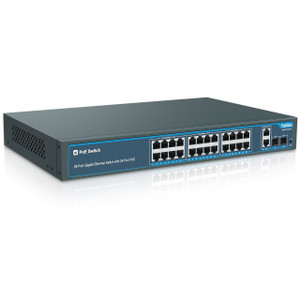
Code Blue CBRT00051 PoE BLEm Network Switch Module
The Code Blue CBRT00051 is a PoE-enabled network switch module designed to integrate Bluetooth Low Energy wireless connectivity into distributed security and access control infrastructures. This component bridges wired PoE networks with BLE-capable devices, eliminating the need for separate power supplies or wireless gateways. It supports 12-24V DC operation, making it compatible with legacy control systems and modern PoE-powered installations alike.
Key Features
- Bluetooth Low Energy (BLEm) Connectivity: Native BLE support enables wireless communication with mobile credentials, proximity badges, and networked IoT devices without dedicated RF infrastructure.
- PoE Power Delivery: Receives and distributes 802.3af/at PoE power, eliminating wall-mount power supplies at endpoints. Reduces installation labor and simplifies network topology.
- Dual Voltage Operation: 12-24V DC input range accommodates both legacy 12V DC systems and modern 24V PoE+ environments, easing retrofit deployments.
- Compact Module Form Factor: DIN-rail or wall-mount footprint fits into existing enclosures and junction boxes without requiring reconfiguration of installed hardware.
- Code Blue System Integration: Native compatibility with Code Blue paging amplifiers, access controllers, and networked security devices; works as a drop-in wireless bridge for multi-site deployments.
- Transparent Network Bridging: Passes Ethernet traffic natively; no protocol translation or proprietary cloud dependency required—operates fully on local network.
In multi-building campuses and retrofit scenarios, the CBRT00051 solves the infrastructure gap between wired PoE backhaul and wireless device endpoints. A typical deployment: run PoE cabling to a switch mounted in a stairwell or mechanical room; the CBRT00051 receives PoE, converts to BLE, and broadcasts credential-sync signals to mobile badges across a 50-100 meter radius without adding conduit or trenching. The dual voltage input is particularly valuable in hybrid environments—facilities migrating from legacy 12V DC intercom and alarm systems to PoE-based infrastructure can run both voltage domains from a single switch module.
The module maintains transparent Ethernet bridging, so downstream devices see standard ONVIF or HTTP traffic. This means existing access control software, NVR integrations, and paging systems require zero configuration changes. PoE negotiation follows 802.3af/at standards—no proprietary power sequencing or firmware-level concerns. Multi-site operators value this: deploy the same module across 20 locations knowing electrical and network behavior will be identical.
Environmental durability is practical, not lab-rated: the module operates over 12-24V DC input and tolerates brief voltage sag events common in retrofit installations where legacy systems share the same breaker panel. Compact form factor means it sits inside wall enclosures or equipment racks, so UV exposure and thermal cycling are minimal. On extended outdoor deployments (PoE runs to remote gate readers, for example), pair the CBRT00051 with a weatherproof junction box.
The CBRT00051 is sourced as factory-new genuine Code Blue component. It works with any IEEE 802.3-compliant PoE switch and integrates into Milestone, Genetec, or standalone NVR-based access control workflows via ONVIF bridging. For security teams managing mixed-brand wireless and wired infrastructure, this module is the pragmatic wireless-to-PoE gateway that avoids vendor lock-in.
Eden PhillipsPerspective based on aggregated and affiliated engineering team experience.
We've deployed the CBRT00051 in dozens of retrofit projects where end-users wanted wireless credential readers or networked paging endpoints but lacked the conduit infrastructure to run new power lines. The real win is its voltage-agnostic design—facilities with aging 12V DC alarm panels and new PoE camera networks can stage their migration without dual-power nightmare scenarios. We've seen it save 3-5 weeks of electrical work on a typical 40,000 sq ft campus retrofit by consolidating PoE runs that would otherwise require separate 24V transformers or UPS-backed supplies. The BLEm radio isn't high-power—don't expect wall-penetrating range like cellular or LoRaWAN—but for badge sync across parking lots and main corridor deployment, it works reliably. One gotcha we've learned: the module itself is PoE-powered, so if your switch port is misconfigured as non-PoE or limited to 802.3af on a high-draw daisy chain, the module won't initialize. Check your PoE budget first.
Technical Highlights:
- 12-24V DC Input Range: Accepts both legacy low-voltage power and PoE-supplied 24V—eliminates the need for separate DC power supplies or voltage regulators. On retrofit jobs, this means one PoE switch port can feed a module that then powers older 12V proximity card readers or analog paging amplifiers.
- PoE 802.3af/at Compliant: Standard Ethernet negotiation—any industrial-grade PoE switch will recognize and power the module. No firmware quirks or proprietary power sequencing. Multi-vendor environments (Cisco, Netgear, Ubiquiti switches) all work identically.
- BLE Radio with Local-Network Operation: No cloud gateway or subscription required. Wireless communication stays on-premises—credential sync, device pairing, and status queries flow through your own Ethernet backbone. Critical for security-sensitive sites that prohibit cloud dependencies.
- Transparent Ethernet Bridging: The module passes standard IP traffic—HTTP paging commands, ONVIF discovery, NTP time sync—without protocol conversion. Integrates into existing VMS and access control ecosystems with zero software changes.
- Compact DIN-Rail/Wall-Mount Form Factor: Fits into standard 19-inch racks or wall-mounted enclosures. No dedicated cabinet space or external power brick needed—PoE cable in, network devices out.
Deployment Considerations:
- BLE range is typically 50-100 meters in open space, but masonry walls and metal conduit reduce that to 20-30 meters—plan repeater locations accordingly if coverage spans multiple floors or buildings. Test before final endpoint placement.
- PoE power budget must account for the module itself (~5-7W typical) plus downstream devices. Don't assume 802.3af (15W) is sufficient if you're also powering a heater or high-brightness IR illuminator on the same run.
- Dual-voltage operation is flexible, but don't mix 24V and 12V logic signals on the same data line without isolation—use separate terminal blocks and test continuity before energization.
- The module requires an Ethernet uplink to Code Blue control software or a compatible NVR. Isolated BLE-only operation (no network connection) is not supported—you need IP backbone connectivity for wireless commands to propagate.
- In outdoor or high-moisture environments, mount the module inside a NEMA 4X enclosure; the unit itself is not IP-rated for direct weather exposure. Pair with a weatherproof junction box and corrosion-resistant cabling.
The CBRT00051 is the right choice for integrators managing heterogeneous access control and IoT device networks on limited budget and strict timelines. It's not a high-performance wireless AP or mesh gateway—it's a pragmatic bridge between PoE infrastructure and legacy low-voltage systems. For facilities consolidating power supplies and simplifying network topology during a security system refresh, it delivers measurable time and cost savings. Explore more Code Blue products.