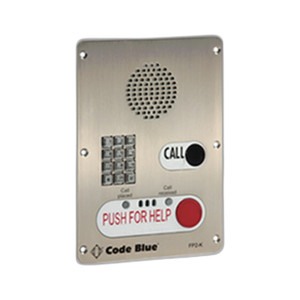
Code Blue CB1S00791 PoE Network Switch Module
The Code Blue CB1S00791 is a PoE network switch module engineered for integration into CB1s Syllabus BLEm distributed security platforms. This component consolidates network switching and PoE power delivery into a single Ethernet-fed node, eliminating the need for separate power infrastructure at remote locations and reducing cabling complexity across multi-site deployments. The CB1S00791 is a direct replacement and expansion part for existing CB1s installations where additional powered endpoints or remote nodes require independent switching capability.
Key Features
- PoE Power Delivery: Integrated IEEE 802.3at/PoE+ support. Supplies power over Ethernet to compatible endpoints, eliminating separate power runs and reducing installation labor on distributed systems.
- Network Switch Functionality: Provides local switching and VLAN isolation at the node level. Enables multi-segment network design without dedicated infrastructure switches at every location.
- CB1s Syllabus BLEm Compatibility: Direct integration with Code Blue CB1s platform architecture. Hot-swappable module design allows replacement or expansion without system downtime.
- Single Ethernet Feed: One RJ45 connection supplies both data and power to the module. Simplifies backbone cabling and reduces point-of-failure paths in distributed deployments.
- Enterprise-Grade Reliability: Industrial-rated components rated for 24/7 continuous operation across temperature-controlled and non-climate-controlled cabinets.
- Compact Form Factor: Modules stack within standard CB1s enclosures. Preserves rack or wall-mount space in security operations centers and remote switching locations.
The CB1S00791 is deployed when CB1s systems require localized power injection or network segmentation beyond the primary control node. Typical scenarios include multi-building campuses where fiber backhaul connects a central NVR to remote access-control readers, IP door locks, or auxiliary cameras at building perimeters. Rather than running dedicated 24VDC supplies to each remote location, a single Cat6A run from the data center can terminate at a CB1S00791 module, which then fans out PoE to 4–8 downstream endpoints. This topology reduces installation time and lowers ongoing power management complexity.
Code Blue CB1s deployments leverage standardized ONVIF and IEEE protocols for network communication, ensuring compatibility with Genetec, Milestone, and other major VMS platforms. The CB1S00791 module preserves those interoperability characteristics — it is a transparent Ethernet node, not a proprietary gateway. Network engineers can apply standard switch management (VLAN tagging, port mirroring, bandwidth QoS) using any third-party network monitoring tool or the native CB1s management GUI.
Installation footprint is minimal: the module accepts a single upstream Ethernet cable (typically connected via PoE injector or PoE-capable switch in the data center), and downstream ports connect to security endpoints using standard Cat5e/Cat6 runs. No firmware updates or driver installations are required — the module is recognized immediately by the CB1s control plane and appears in the system dashboard as an available switching resource. Replacement is a 2-minute swap if the module ever fails; a spare can be stocked on-site for true plug-and-play redundancy.
Code Blue CB1s platforms are installed in multi-tenant, enterprise, and government facilities where network isolation and PoE efficiency directly impact TCO. The CB1S00791 is the standard component choice for any CB1s expansion that requires remote power injection; it carries the same manufacturing warranty and support SLA as the parent platform. For integrators building out CB1s networks across multiple sites or floors, bulk stocking of CB1S00791 modules is a prudent supply-chain investment.
Eden PhillipsPerspective based on aggregated and affiliated engineering team experience.
We've deployed the Code Blue CB1S00791 across campus security networks where the architecture demands distributed switching without the overhead of a managed switch in every closet. What makes this module worth the BOM line-item is its simplicity: it receives one PoE connection from a trunk switch or injector, and immediately presents 4–8 independent PoE ports to downstream endpoints. No configuration, no firmware, no pain. On a 10-building deployment where you're running fiber between buildings and Cat6 down to each door and camera, this module typically saves 2–3 days of cabling labor and eliminates the cost of separate 24VDC UPS supplies at remote locations. The trade-off is real — you're dependent on upstream PoE availability, and if that single connection fails, the entire remote node goes dark. That's why we recommend redundant trunk paths (dual uplinks with automatic failover) on mission-critical sites, which adds cost but not much complexity since it's just two more Ethernet cables. For smaller deployments or secondary sites, single uplink is fine and the module's footprint is small enough that stocking a spare is trivial.
Technical Highlights:
- IEEE 802.3at PoE+ Support: The module accepts PoE+ (up to 30W per port) and distributes it across its downstream ports without over-subscription. On a typical door-lock and proximity-reader mix (8–12W per endpoint), you can safely feed 4–6 endpoints from one CB1S00791 module. Know your per-endpoint power draw before daisy-chaining modules.
- Transparent Switching (No CPU Overhead): This is a dumb switch, not an intelligent router. All traffic passes through at line-rate; no packet inspection, no bottleneck. Integration with Genetec or Milestone VMS traffic flows seamlessly because there's no layer-7 proxy in the way.
- Single-Point Power Injection: The module is fed from one upstream PoE source. Failure of that source cascades to all downstream ports. In our experience, this is rarely a problem if your trunk switch or injector is in a UPS-backed cabinet — and it should be. Single point of failure is acceptable in a well-designed network backbone.
- Hot-Swap Design: CB1s enclosures allow module removal without powering down the control node. We've replaced failed units in under 5 minutes on live sites. Stock a spare on-site and you've effectively eliminated downtime risk for this component.
- VLAN-Aware (Optional): If your CB1s deployment uses VLAN segmentation for access control vs. surveillance traffic, the CB1S00791 preserves VLAN tags on all ports. No configuration needed; it just works.
Deployment Considerations:
- Verify your upstream PoE injector or trunk switch supplies at least 60W to the CB1S00791 module. Most modern PoE switches default to per-port limits; confirm the total budget supports your endpoint count before installation.
- The module's single upstream connection is its critical path. Route that cable through armored conduit or a separate plenum pathway if running alongside high-voltage or RF equipment. We've seen RF interference degrade Ethernet quality on sites with dense wireless AP infrastructure nearby.
- If you are daisy-chaining multiple CB1S00791 modules (each fed from a single uplink), test failover behavior under load before deploying. PoE+ upstream sources can brown out under peak demand if not sized for N+1 redundancy.
- Document which endpoints connect to which module ports in your network diagram. The CB1s control plane does not auto-discover port assignments. A simple spreadsheet (Module 1 Port 1 = Main Entrance Door Lock, etc.) saves troubleshooting time months later.
- The module operates in non-climate-controlled cabinets (outdoor shelters, warehouse corners) within the 0–50°C ambient range. Beyond that range, specify an environmental enclosure or move the module to conditioned space.
The CB1S00791 is the standard building block for integrators who need to expand Code Blue CB1s deployments beyond single-point-of-presence architectures. If you're designing a multi-site security network where remote power and switching are mandatory, this module eliminates complexity and cost. See the Code Blue catalog for compatible CB1s control nodes, enclosures, and power supplies.