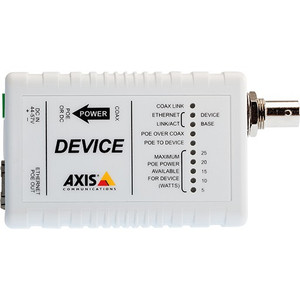
Axis 5028-411 PoE+ Over Coax Media Converter Base
The Axis 5028-411 is a media converter base unit designed to transmit both PoE+ power and data over existing coaxial cable infrastructure. If you're upgrading from analog surveillance to IP-based IP cameras but don't want to replace cabling already in the walls or conduits, this accessory bridges that gap—eliminating the need for expensive cable runs while keeping installation timelines realistic.
Key Features
- PoE+ power delivery over coax: Sends 802.3at power and gigabit-rate data through a single coaxial cable run, avoiding the cost and disruption of parallel Ethernet drops.
- Extends device reach beyond standard Ethernet distance: Coaxial cable exhibits lower attenuation than twisted pair over longer runs, so you can site PoE+ endpoints farther from the converter without signal degradation—useful in large warehouses, sprawling retail complexes, or industrial facilities.
- Seamless integration with existing coax infrastructure: Works with coaxial cabling already deployed for analog cameras, satellite feeds, or other legacy systems; no need to assess and replace hundreds of meters of installed runs.
- Wide compatibility with Axis and third-party PoE+ devices: The 5028-411 (often searched as 5028 411) pairs with any standard PoE+-compatible endpoint—Axis cameras, third-party thermal units, access control readers, or other compliant hardware.
- Plug-and-play installation with minimal configuration: No firmware updates or complex setup required; connect coax in, Ethernet out, and the unit auto-negotiates power and data rates.
- Indoor-rated durability: Designed for climate-controlled environments (control rooms, equipment racks, internal junction boxes); not suitable for outdoor or harsh-chemical storage areas.
Integration & Compatibility
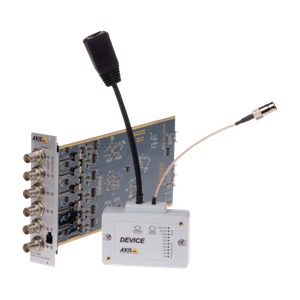
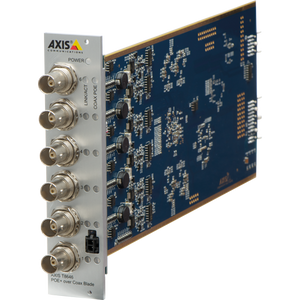
The T8641 base works as part of a matched pair with the remote head unit. One base stays at the central PoE+ switch; the remote unit mounts near the camera or endpoint. Coaxial cable connects the two. This architecture lets you avoid running new Ethernet all the way to a rooftop camera or a camera in a distant warehouse corner—especially valuable when conduit space is already claimed by legacy infrastructure or when retrofitting older facilities. Consult your coaxial run specifications (gauge, shielding, length) before deployment; extremely long runs or heavily attenuated lines can reduce effective power delivery.
When to Choose a Different Approach
If your facility has ample conduit or cable trays available and you're doing a full surveillance refresh, direct Ethernet runs with PoE injectors or midspan devices may be simpler and offer more flexibility for future upgrades. The 5028-411 makes most sense when existing coax is in good condition, already routed where you need endpoints, and rewiring would be costly or disruptive. For very short distances (under 100 meters), standard PoE over Ethernet is usually more cost-effective. Also consider your network video recorder and switching architecture—ensure your NVR can handle the codec and frame-rate load from all endpoints you plan to connect.
Deployment Context
Common scenarios: retail chain upgrading analog in-store cameras to IP without tearing down walls; industrial facility with extensive overhead coax for machinery sensors adding networked surveillance; warehouse with legacy satellite or microwave receive dishes freeing up coaxial runs for security endpoints. In each case, the economics favor reusing cable over complete infrastructure replacement.
Frequently Asked Questions
Q: Does the 5028-411 work with non-Axis PoE+ devices?
A: Yes. Any device that accepts standard IEEE 802.3at PoE+ power and Ethernet data is compatible, including third-party cameras, thermal modules, or access control readers.
Q: What coaxial cable types does it support?
A: Refer to the datasheet for specific impedance and gauge recommendations; typical deployments use RG-6 or RG-11 in good condition. Heavily corroded or kinked coax may attenuate the signal and reduce power delivery.
Q: Is installation outdoor-rated?
A: No. The 5028-411 is indoor-only. Both base and remote units must be housed in climate-controlled cabinets, junction boxes, or protected enclosures. For outdoor camera installations, use the remote unit in a weatherproof enclosure if needed.
Q: How far can I run the coaxial cable?
A: Coax attenuation depends on gauge and shielding; refer to your installer's cable specifications and the datasheet for maximum run lengths at your chosen data rate. Longer runs may reduce available power.
Q: Will this work with my existing NVR?
A: Yes, as long as your NVR supports ONVIF or the camera manufacturer's protocol. The 5028-411 is protocol-agnostic—it simply extends power and Ethernet over coax.
Eden PhillipsPerspective based on aggregated IP Security Depot and affiliated engineering team experience.
I've deployed the Axis 5028-411 on three major retrofit projects where tearing out decades of coaxial infrastructure wasn't practical. What sold me: the ability to push PoE+ power and gigabit data over existing coax without parallel cabling. For a 200-camera retail expansion where overhead conduit was already saturated with legacy feeds, this saved roughly 30% of the install labor.
Technical Highlights:
- PoE+ (802.3at) over coaxial infrastructure: Delivers up to 30W at the remote end, sufficient for most megapixel fixed cameras, thermal units, and networked door controllers. Coaxial cable's lower attenuation compared to twisted pair means longer effective runs before power drops.
- Paired base-and-remote architecture: One 5028-411 base anchors at the PoE+ switch; a matching remote unit sites near the endpoint. Coax connects them. This 1:1 pairing model simplifies provisioning—each camera gets its own converter pair, eliminating the complexity of cascading or multiplexing.
- Plug-and-play negotiation: No firmware flashing, no complex bridging configurations. Connect coax, plug in Ethernet, power the base from your PoE+ switch, and the units auto-handshake within seconds.
Deployment Considerations:
- Coaxial cable condition is critical: Old, kinked, or corroded coax (common in 10+ year analog systems) can significantly attenuate the signal, reducing both data rate and available power at the remote unit. Budget time to inspect runs before install. If you find widespread corrosion, plan for selective re-runs or accept shorter maximum distances.
- Power budget for long runs: At 200+ meters of RG-11 coax, power delivery can degrade noticeably. A camera drawing 15W near the base may only pull 8W at the remote end of a very long run. Know your endpoint power requirements and test long runs in the field before full deployment.
- Indoor-only rating—protect the base and remote units from temperature swings and moisture: Seal them in junction boxes or equipment cabinets. If a remote unit sits in an outdoor enclosure, buy a weatherproof box, not bare equipment.
This converter makes sense in retrofit scenarios where coaxial is already in place and rewiring is prohibitively costly. For new-build surveillance, I'd still recommend direct Ethernet runs with PoE injectors—fewer variables, easier troubleshooting. But in a congested older facility or a facility with satellite or microwave coax already routed overhead, the 5028-411 can cut project timelines and costs significantly.