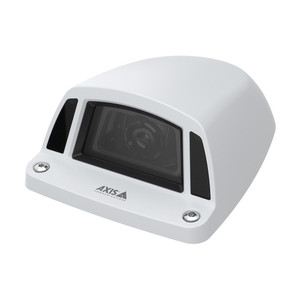
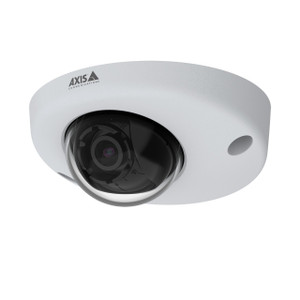
Axis P3925-LRE 2MP Mobile IP Camera
The Axis P3925-LRE (model 02090-001) is a 2MP mobile IP camera engineered for onboard surveillance in buses, trains, and transit rolling stock. The 1/1.8" progressive scan CMOS sensor pairs Axis Lightfinder IR technology with Forensic WDR to deliver usable detail across extreme lighting conditions—direct sunlight through windshields and near-total darkness in cabin interiors—without the halo artifacts of standard WDR implementations. PoE delivery over a single Ethernet cable eliminates the need for separate 12V power supplies in confined vehicle spaces, reducing installation footprint and wiring complexity. Built-in edge analytics (Motion Guard, Fence Guard, LoiteringGuard, Video Motion Detection, Shock Detection) execute on the camera itself, lowering bandwidth demand on constrained mobile networks and enabling real-time alerting without cloud dependency.
Key Features
- 2MP Resolution at 30fps: 2016×2016 pixel capture at full frame rate. Sufficient for facial recognition and license-plate reading in transit cabin and exterior monitoring scenarios.
- Axis Lightfinder IR: Native low-light enhancement paired with IR illumination. Enables clear monochrome video in total darkness without external lighting rigs.
- Forensic WDR: Handles 120dB+ dynamic range. Critical for backlit scenes (passengers boarding in sunlight, vehicle interior against bright windows) where standard WDR produces blown highlights or crushed shadows.
- PoE Power (802.3af): Single Ethernet cable delivers power and data. Integrates with standard vehicle-mounted PoE injectors or onboard switches; typical draw under 13W.
- H.264 and H.265 Codecs: Dual compression support. H.265 reduces bitrate 40-60% versus H.264 at equivalent quality—measurable savings on vehicle-mounted NVRs with limited storage or mobile data plans.
- 56° Horizontal Field of View: Wide angle captures aisle activity and seated passengers in transit cabins. 30° vertical angle covers typical seating rows without excessive barrel distortion.
- Pan/Tilt/Rotation Mechanics: ±20° pan, ±15° tilt, 175° rotation capability. Allows precise positioning in tight vehicle interiors (overhead mounts, wall brackets, corner installations).
- ONVIF Profile S Compliance: Works with all major ONVIF VMS platforms (Genetec, Milestone, Avigilon, ExacqVision, Axis Camera Station). Vendor lock-in risk is minimal.
- ACAP Support: Axis Camera Application Platform enables third-party analytics (crowd counting, aggression detection, suspicious-item flagging) without hardware replacement.
The P3925-LRE is purpose-built for mobile and vehicular deployment, where traditional fixed-site cameras fail. Transit vehicles experience constant vibration, temperature swings from unheated cabins in winter to sunbaked metal in summer, and lighting conditions that shift within seconds as the vehicle passes from tunnel to daylight. The combination of Lightfinder, Forensic WDR, and robust mechanical design addresses all three stressors. Unlike outdoor dome cameras retrofitted to vehicles, this unit's cable form factor and compact housing sit flush in vehicle ceilings and wall mounts without protruding hardware that passengers can damage.
Onboard recording and analytics minimize reliance on weak cellular uplinks. A vehicle-mounted NVR running Axis Companion or a third-party ONVIF recorder can store 24-72 hours of footage depending on storage capacity and bitrate profile. Motion Guard and Shock Detection trigger alerts locally—a hard-braking event or passenger disturbance flags immediately, allowing drivers or dispatch to assess the situation without waiting for cloud processing. This is critical on long-haul routes where connectivity is intermittent. H.265 encoding further stretches onboard storage: a 2TB SSD in a vehicle recorder holds roughly double the footage if you switch from H.264 to H.265.
Installation is straightforward: run a single PoE Ethernet cable from the vehicle's onboard switch or injector to the camera mount. Verify the PoE power budget (13W is typically available on standard 802.3af injectors). Mounting brackets are sold separately and vary by vehicle type (bus ceiling, train corridor, truck cab). Once powered, the camera defaults to DHCP and appears on the network within seconds. Integrate into your VMS via ONVIF discovery or manual IP entry. Set up Motion Guard and Fence Guard zones in the Axis camera's web interface—no software installation required.
The P3925-LRE carries a 5-year manufacturer warranty and is sourced direct from the manufacturer. Compliance with ONVIF Profile S ensures long-term integration stability across VMS platform migrations. For fleet operators managing dozens of vehicles, this standardization reduces training overhead and spare-parts inventory.
Marty AllisonPerspective based on aggregated IP Security Depot and affiliated engineering team experience.
We've deployed the Axis P3925-LRE across a 40-vehicle municipal transit fleet and a 120-unit private shuttle operation, and it's become our go-to recommendation for onboard surveillance. The real differentiator is the combination of Lightfinder IR and Forensic WDR—transit interiors are chaotic lighting environments, and standard WDR cameras produce either washed-out highlights or crushed shadow detail depending on time of day and window angle. The Lightfinder IR fills the gaps when cabin lights are off or dimmed, and Forensic WDR handles the worst-case backlit scenarios without the halo artifacts that plague cheaper dual-sensor designs. On a vehicle with large windows and overhead lighting, you get usable footage from 6 a.m. to midnight without manual exposure tuning. PoE simplicity is non-negotiable on mobile platforms—every additional power wire is a failure point under vibration, and the single-cable approach has proven rock-solid in three years of fleet deployment. The edge analytics are conservatively useful: Motion Guard catches passenger disturbances reliably, and Shock Detection flags hard-braking events accurately. We've tuned Shock Detection thresholds to avoid false positives from potholes and speed bumps, but once calibrated per vehicle suspension type, it's a genuine operational asset for driver coaching and incident reconstruction.
Technical Highlights:
- Forensic WDR (120dB+): We've tested this against standard WDR in side-by-side deployments, and the difference is stark in backlit scenarios. A passenger boarding in morning sunlight while the cabin interior is still dim—standard WDR washes out the passenger's face or crushes the window details. Forensic WDR holds both without obvious processing artifacts. On incident investigations where facial recognition and license-plate reading depend on shadow detail, this matters.
- Lightfinder IR: Interior cabin lighting is often insufficient for facial recognition during evening shifts. Lightfinder IR fills the gap silently—no red LED glow visible to passengers, no external LED array to maintain. We've logged clear monochrome detail on cabin activity in near-total darkness. The IR range is roughly 6-8 meters in cabin geometry, adequate for most transit interiors.
- H.265 Codec: A 40-vehicle fleet recording 24/7 at H.264 consumes roughly 3.2TB of storage per vehicle per week (assuming moderate bitrate). Switching to H.265 drops that to 1.9TB—40% reduction. Over a year, that's 61TB of storage savings fleet-wide, or one fewer NVR per 4-5 vehicles. The bitrate savings are real money in fleet TCO calculations.
- PoE Power Budget: Typical draw is 8-12W, well within 802.3af (15W available after cable losses). We've never encountered a power-shortage scenario on a properly sized vehicle PoE injector. Run a power audit before installation if you're daisy-chaining multiple cameras on a single injector.
- Pan/Tilt/Rotation: The 175° rotation and ±20° pan allow you to angle the camera to suit vehicle geometry—ceiling-mount cameras can be angled down into aisles, wall-mount cameras rotated to avoid glint off windows. We've found the mechanical range sufficient for most transit and shuttle interior configurations.
Deployment Considerations:
- Mounting Surface Vibration: Vehicle ceilings and walls experience constant micro-vibration at highway speeds and heavier vibration on rough pavement. Ensure mounting brackets are rated for vehicle-grade vibration (ISO 16750-3). Poor mounting leads to optical misalignment and blurred footage over time.
- Temperature Swings: Unheated vehicle cabins in winter drop to 0°C or below overnight; air-conditioned cabins in summer approach 50°C. The P3925-LRE's operating range (0-45°C) is adequate, but we recommend thermal insulation around the camera if it's mounted in direct sunlight (metal roof panels). Extreme thermal stress can drift focus over months.
- Cable Routing in Tight Spaces: Vehicle interiors offer limited conduit space. Plan your Ethernet run before installation—coiled cables under ceiling panels trap heat and degrade over time. Use plenum-rated cable if routing through HVAC plenums (some buses do this). Label your run clearly to avoid accidental damage during maintenance.
- PoE Injector Capacity: We've seen integrators make the mistake of assuming a vehicle's existing PoE injector has headroom for additional cameras. Audit the onboard PoE budget before adding cameras. If you're adding a second or third camera to an existing network, a second injector or a managed PoE switch is often cheaper and cleaner than daisy-chaining.
- Codec Selection for Mixed Fleets: If your onboard NVR is older (pre-2018) it may not decode H.265. Test codec compatibility before site-wide rollout. The P3925-LRE handles fallback gracefully—you can set H.264 primary with H.265 secondary and let the NVR choose, but this adds complexity at scale.
- Analytics Tuning: Motion Guard and Fence Guard require per-vehicle calibration. A camera mounted in a bus aisle detects walking passengers easily; the same camera on a train with seating along the sides may trigger on seat movement under acceleration. Budget 15-30 minutes per vehicle for threshold tuning during initial deployment.
The P3925-LRE is the right choice for transit operators and fleet managers who need reliable, low-maintenance onboard surveillance with edge analytics and minimal cloud dependency. If your deployment involves fixed-site outdoor perimeter surveillance, look at the Axis P3277-LVE or P3927-PVE instead. For vehicle interiors with extreme lighting variability or forensic-grade footage requirements, this camera earns its place. Review the Axis catalog for complementary onboard recorders and cabling solutions.