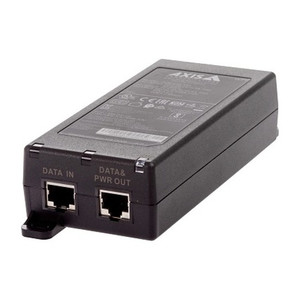
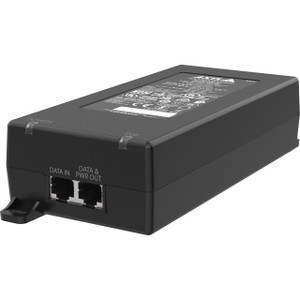
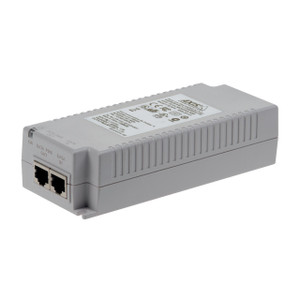
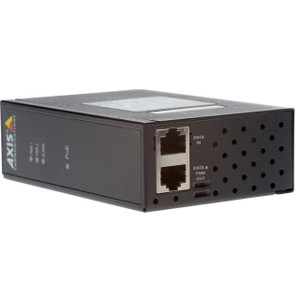
Axis 03223-001 TU8006 60W PoE++ Midspan Injector
The Axis 03223-001 is a 60W midspan power injector designed to add PoE++ (Power over Ethernet Plus) capability to network infrastructure without requiring switch replacement. In retrofit or mixed-environment deployments where upgrading core switching is impractical or cost-prohibitive, this midspan architecture lets you selectively inject Class 6 power at the edge — between existing non-PoE switches and your endpoints — making it a surgical alternative to wholesale infrastructure overhaul.
Key Features
- 60W total power budget: Enough to supply multiple moderate-power devices (e.g., 2–3 powered IP cameras or a combination of cameras and access control readers). Budget carefully: if you need to inject 80W or more across a deployment, you'll need multiple midspans or a dedicated PoE++ switch. This is a real constraint — track simultaneous draw across all downstream devices.
- PoE++ Class 6 delivery (IEEE 802.3bt): Supplies up to 90W per port in Class 6 specification, but the 60W total budget caps concurrent draw across all ports. Class 6 power supports high-bandwidth, high-compute endpoints like PTZ cameras with heaters, camera stations with onboard storage, or access control with integrated readers — not just basic fixed cameras. Verify your endpoints actually claim 802.3bt compliance before assuming compatibility.
- Midspan architecture eliminates switch replacement: Sits between a non-PoE upstream switch and your PoE++ devices. No switch firmware changes, no VLAN reconfiguration, no downtime to existing users sharing the same switch ports. This is the primary appeal in brownfield deployments where rip-and-replace is not politically or financially feasible. The midspan is transparent to the network — traffic passes through unchanged.
- Lightweight 0.52 lbs form factor: Small enough to mount in a rack, on a shelf, or even behind a camera pole — fits most deployment footprints without racking clutter or space negotiations. Standard Ethernet in/out via RJ-45 connectors.
- Wired Ethernet connectivity (RJ-45 in/out): Standard copper Ethernet, no wireless fallback, no latency risk, no RF interference concerns. Provides rock-solid link between upstream switch and powered devices. This is not a cloud appliance — power delivery is local and deterministic.
- Axis camera and third-party PoE++ device compatibility: Works with any PoE++ endpoint that conforms to IEEE 802.3bt standard. Compatible with power infrastructure planning and mixed deployments. Test compatibility with non-Axis endpoints beforehand; the midspan delivers power strictly to standard, but device firmware behavior and power negotiation can vary between manufacturers.
Integration and Deployment
The TU8006 integrates into existing network topology without disrupting live traffic. Position it in a patch panel, a distribution cabinet, or a secure wall-mounted enclosure. Power sequencing is straightforward: connect the upstream non-PoE switch to the midspan input first, then connect the midspan AC power adapter (separate wall outlet required), then patch your downstream PoE++ devices to the midspan output. The adapter must be sourced separately — verify wattage capacity for your total device load.
If you're running a mixed network switch environment with older and newer infrastructure, this midspan bridges the gap cleanly — non-PoE switch ports feed the midspan input, and the output feeds your new PoE++-hungry endpoints. For larger deployments needing more than 60W of simultaneous power, or for greenfield installations, a native PoE++ switch is more cost-effective long-term. In brownfield retrofits, weigh the midspan cost against the operational disruption and expense of replacing core switching equipment. Often the midspan makes financial sense for 12–24 months while you cycle to newer switches on standard refresh schedules.
Typical Deployment Scenarios
- Surveillance camera network retrofits: Existing non-PoE switch serving legacy analog or H.264 cameras; new high-resolution or PTZ cameras demand PoE++. Insert the midspan on the relevant switch ports, patch new cameras downstream, keep old gear running on legacy ports.
- Mixed-switch environments: Some rack ports originate from an older switch, others from newer infrastructure. Selective midspan injection on older ports ensures new devices get power without forcing a full switch replacement or waiting for refresh cycles.
- Distributed installations with centralized power management: If your architecture prefers a single power injection point feeding multiple cable runs to remote cameras, a midspan positioned near the core provides cleaner power budgeting than running individual adapters to each device.
Frequently Asked Questions
Q: Can I daisy-chain multiple Axis 03223-001 midspans to increase total power budget?
A: No. Daisy-chaining midspans (output of one feeding input of another) will not stack power budgets and may introduce instability. If you need more than 60W, deploy multiple independent midspans on separate upstream switch ports, or upgrade to a native PoE++ switch.
Q: Does the 03223-001 support PoE+ (802.3at) devices?
A: Yes. PoE++ is backward-compatible with PoE+ (802.3at) and PoE (802.3af) devices. A PoE+ camera drawing ~25W will work fine alongside an older 802.3af device drawing ~13W, as long as total simultaneous draw doesn't exceed 60W.
Q: What happens if I connect a device that draws more than 90W per port to the 03223-001?
A: The midspan will not deliver power. IEEE 802.3bt devices negotiate their power class during connection handshake. If a device requests more than 90W per port, or if total concurrent draw exceeds 60W, power delivery fails and the device will not activate on that port. No smoke, no damage — just no power. Budget conservatively before deployment.
Q: Do I need a separate power supply for the midspan?
A: Yes. The 03223-001 requires a separate AC wall adapter (not included). Verify the adapter wattage matches your total downstream device power draw plus headroom — the adapter must supply more wattage than the 60W PoE++ output to account for conversion losses. Check the datasheet or contact the manufacturer for the correct adapter specification.
Q: Is the 03223-001 suitable for outdoor or harsh-environment mounting?
A: Not directly. The midspan itself is not rated for outdoor exposure. Mount it in a climate-controlled cabinet, rack, or indoor distribution point. If your deployment requires outdoor power injection, house the midspan in a weatherproof enclosure or deploy it indoors at the base of outdoor cable runs.
Q: Will upgrading to a native PoE++ switch be cheaper than buying midspans?
A: Depends on your timeline and headcount. A managed PoE++ switch ranges from $800–3000+ depending on port count and features. One or two midspans cost $300–600 total. If you need to power 3–4 new cameras today and can absorb switch refresh over 18–36 months, the midspan is cheaper upfront. If you're deploying 8+ new PoE++ devices simultaneously, a switch is usually the better 3–5 year investment.
Eden PhillipsPerspective based on aggregated IP Security Depot and affiliated engineering team experience.
The Axis 03223-001 is a pragmatic retrofit tool — not a replacement for native PoE++ switching, but a real workaround when rip-and-replace is off the table. The 60W total power budget is the non-negotiable spec: it's enough for a small-to-medium camera upgrade, but you must track concurrent draw meticulously. I've seen deployments where two cameras plus a reader totaled 58W — mission-critical to verify actual draw from datasheets, not marketing specs.
Technical Highlights:
- IEEE 802.3bt Class 6 compliance (90W per-port max, 60W total): Delivers full Class 6 power to devices that negotiate properly. The 60W cap is your real constraint. A PTZ with heater can draw 40–60W alone, leaving little room for a second device. Do the math upfront.
- Midspan topology (transparent to network): No switch configuration, no firmware patches, no traffic steering — power is injected at the connector pair, data passes through unchanged. This is why it works in brownfield environments where you cannot touch core infrastructure.
- Lightweight form factor (0.52 lbs) for flexible placement: Unlike switches, this sits between switch and devices, so you can position it near the cable exit, in a distribution cabinet, or even on a pole-mount near your endpoints. Reduces cable runs and power loss.
Deployment Considerations:
- You must source the AC power adapter separately — verify wattage for your load. Underpowered adapter = unstable power delivery and device resets.
- Watch the gotcha: this is not a switch, so no link aggregation, no failover, no VLAN tagging — it's a dumb power injector. If your upstream switch port goes down, everything downstream loses power. Plan redundancy at the switch level if availability is critical.
- Backward-compatible with older PoE+ and PoE devices, but power budget still applies. A single older 802.3af camera (~13W) plus two new PoE+ cameras (~25W each) equals 63W — over budget. You'll need two midspans or a switch upgrade.
Position the 03223-001 in surveillance retrofits where you're adding 2–4 new PoE++ cameras to an older non-PoE switch and the customer won't approve a $2000+ switch replacement right now. It buys you 18–36 months before the next hardware refresh cycle. For greenfield or large-scale upgrades, always specify native PoE++ switching — the per-port cost is lower and you avoid midspan power budgeting nightmares.