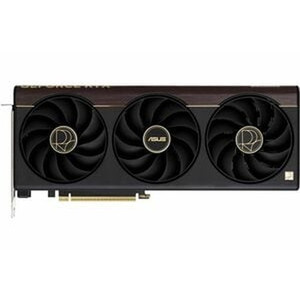
ASUS PROART-RTX5080-O16G ProArt GeForce RTX 5080 OC Edition Graphics Card
Overview
The ASUS PROART-RTX5080-O16G is a factory-overclocked GeForce RTX 5080 graphics card built for workstation-class compute and high-resolution rendering workloads. With 10,752 CUDA cores, 16GB of GDDR7 memory on a 256-bit bus, and a PCIe 5.0 interface, this card is positioned for professionals who need GPU compute headroom alongside display fidelity — including AI inference at the edge, multi-stream video analytics, and 4K/8K media pipelines. The ProArt line targets creative and technical workstations where sustained throughput matters more than peak gaming frame rates.
At 15.94 × 9.17 × 3.48 inches and 4.50 lb, the PROART-RTX5080-O16G (often searched as PROART RTX5080 O16G) occupies a 2.5-slot profile — wide enough to house a full vapor chamber but narrow enough to clear most EATX and standard ATX workstation chassis without blocking adjacent PCIe slots. Verify your chassis clearance before ordering: at nearly 16 inches, this is a long card.
Key Features
- 10,752 CUDA Cores on RTX 5080 Die: The Blackwell-generation core count is roughly 30% higher than the RTX 4080's 9,728 cores, which translates directly to faster AI inference throughput, faster render passes in offline rendering engines, and more headroom for parallel compute tasks like real-time video transcoding or analytics inference pipelines.
- 16GB GDDR7 / 256-bit / 30 Gbps: GDDR7 at 30 Gbps data rate on a 256-bit bus delivers substantial memory bandwidth — the kind needed to keep 10,752 shader processors fed during large-batch AI workloads or when handling uncompressed 4K video frames in memory. 16GB is the working minimum for serious diffusion model inference at full precision.
- PCIe 5.0 Interface: PCIe 5.0 doubles the host bandwidth ceiling versus PCIe 4.0. For GPU-compute tasks with heavy host-to-device data transfers (large model weights, bulk frame capture feeds), this reduces the bus as a bottleneck. The card is backward-compatible with PCIe 4.0 and 3.0 slots at reduced bandwidth.
- OC Mode Boost Clock: 2730 MHz: The factory overclock pushes boost frequency 30 MHz above the standard 2700 MHz performance mode. In sustained workloads this margin is modest, but it does mean ASUS has validated stability at that frequency from the factory — relevant for 24/7 inference deployments where you want a stable validated frequency without manual overclocking.
- Vapor Chamber + Phase-Change GPU Thermal Pad: The vapor chamber spreads heat across the full heatsink rather than concentrating it at the die contact point. The phase-change thermal pad conforms to die surface irregularities under operating temperature, improving thermal contact over time rather than degrading. Both matter for sustained-compute environments where the GPU runs at load continuously — not just gaming bursts.
- Axial-Tech Fan Array: ASUS's Axial-tech fans use a barrier ring design that increases downward airflow pressure versus open-frame fans of the same diameter. In a closed workstation case with limited airflow, this design sustains cooling performance where generic fan designs would thermal-throttle under continuous load.
- 4-Display Output Array (1× HDMI 2.1b + 2× DisplayPort 2.1b): Three discrete physical outputs support up to four displays simultaneously at up to 7680×4320 (8K) resolution. HDMI 2.1b and DisplayPort 2.1b both support 4K at 240Hz and 8K at 60Hz — relevant for multi-monitor operator stations or high-density video wall configurations driven from a single workstation node.
- USB Type-C Output: The USB-C display output enables direct connection to USB-C/Thunderbolt monitors without a DisplayPort adapter — a practical detail for creative workstations paired with modern reference monitors or for VR headsets that use USB-C tethering.
- 2.5-Slot Form Factor: The 2.5-slot width fits standard ATX and EATX boards without consuming a third PCIe slot. If you're pairing this with a capture card or 10GbE NIC in the adjacent slot, verify the slot pitch on your specific motherboard — some boards place PCIe slots 20mm apart versus the 25mm standard, which can create interference with 2.5-slot coolers.
Integration & Compatibility
The PROART-RTX5080-O16G connects via PCIe 5.0 x16, backward-compatible with PCIe 4.0 and 3.0 hosts. The card exposes a USB interface and Ethernet interface per the distribution feed attributes, suggesting support for ASUS's GPU monitoring and firmware tools that operate over these buses on select ProArt models — consult ASUS documentation for your specific platform. Display outputs cover HDMI 2.1b (×1) and DisplayPort 2.1b (×2) plus USB-C, enabling four simultaneous displays at up to 8K resolution. For compute-only deployments (AI inference servers, headless render nodes), display output count is irrelevant — what matters is PCIe bandwidth and VRAM capacity, both of which this card addresses with PCIe 5.0 and 16GB GDDR7.
NVIDIA's CUDA platform is confirmed supported, enabling compatibility with CUDA-accelerated frameworks including TensorRT, cuDNN, and NVENC/NVDEC for hardware video encode/decode. Parallel processing technology (typically referring to AMD's competing compute APIs) is listed as not supported — expected for an NVIDIA card. Workloads targeting OpenCL or Vulkan compute are supported through NVIDIA's standard driver stack.
At 15.94 inches in length, 9.17 inches wide, and 3.48 inches tall (2.5 slots), confirm chassis compatibility before ordering. Weight is 4.50 lb — a GPU support bracket is strongly recommended for horizontal or inverted motherboard orientations to prevent PCIe slot stress over time.
Frequently Asked Questions
Q: What is the difference between the 2700 MHz and 2730 MHz clock speeds listed for this card?
A: The PROART-RTX5080-O16G has two operating modes: Performance Mode at 2700 MHz boost and OC Mode at 2730 MHz boost. OC Mode is the factory-set default on ProArt OC Edition cards and is validated stable by ASUS at that frequency. The 30 MHz difference is modest in isolation, but the value is in factory validation — you get a confirmed stable overclock without manual tuning.
Q: Will the PROART-RTX5080-O16G fit in a standard ATX workstation case?
A: At 15.94 inches (approximately 405mm) in length and 2.5 slots wide, this card requires a full-tower or large mid-tower chassis with at least 406mm of GPU clearance. Most standard ATX mid-towers support 320–360mm. Verify your specific chassis maximum GPU length before purchasing.
Q: How many monitors can this card drive simultaneously?
A: The card supports up to 4 simultaneous displays across its three physical outputs (1× HDMI 2.1b, 2× DisplayPort 2.1b, and 1× USB-C). Maximum resolution per output is 7680×4320 (8K).
Q: Is this card suitable for AI inference and machine learning workloads?
A: Yes. The 10,752 CUDA cores, 16GB of GDDR7 memory, and confirmed CUDA support make this card a viable platform for AI inference using TensorRT and similar CUDA-accelerated frameworks. The 16GB GDDR7 frame buffer is sufficient for running mid-to-large language model inference at reduced precision or diffusion models at full resolution. For very large model training requiring multi-GPU NVLink configurations, note that NVLink support should be verified against ASUS's published specifications.
Q: What does the phase-change GPU thermal pad do differently from standard thermal paste?
A: A phase-change thermal pad is solid at room temperature and liquefies slightly at operating temperature, conforming tightly to the GPU die surface to eliminate micro air gaps. Unlike standard thermal paste that can dry out and degrade over years of operation, phase-change material maintains consistent thermal contact over the long term — relevant for 24/7 compute deployments where reapplying thermal compound would require disassembly.
Q: Is the PROART-RTX5080-O16G backward-compatible with PCIe 4.0 motherboards?
A: Yes. PCIe 5.0 is backward-compatible with PCIe 4.0 and PCIe 3.0 slots. The card will operate at the highest speed supported by the host slot. On a PCIe 4.0 × 16 slot, you will see roughly half the theoretical host bandwidth ceiling compared to PCIe 5.0, which is unlikely to be a bottleneck for most single-card workloads.
The PROART-RTX5080-O16G is one of the more interesting cards to specify for edge AI and video analytics workstations right now. The combination of 10,752 CUDA cores with 16GB of GDDR7 at 30 Gbps across a 256-bit bus means you have both the compute density and the memory bandwidth to run real-time multi-stream inference without the GPU becoming your bottleneck — which is where most analytics deployments actually hit their ceiling.
Technical Highlights:
- GDDR7 Memory Bandwidth: At 30 Gbps per pin on a 256-bit bus, the PROART-RTX5080-O16G delivers substantially higher memory bandwidth than GDDR6X-based predecessors. For multi-stream video analytics workloads where the GPU is constantly loading frame buffers and model weights, this bandwidth directly determines how many concurrent streams you can run before frame drops.
- 2730 MHz OC Mode Boost: Factory-validated at 2730 MHz means you are not relying on the GPU's own boost algorithm to decide when to hit that frequency — ASUS has binned and tested this particular GPU to sustain that clock under load. For continuous inference workloads, a stable, predictable clock matters more than a high peak that thermal-throttles.
- Vapor Chamber + Phase-Change Thermal Pad: The vapor chamber prevents hotspot throttling by distributing heat laterally across the full heatsink mass. The phase-change pad ensures that thermal contact at the GPU die does not degrade over multi-year continuous operation — a real consideration when you are running this card in a workstation that never powers down.
Deployment Considerations:
- At 15.94 inches long and 4.50 lb, this card needs a GPU support bracket in any orientation other than perfectly horizontal. PCIe slots are not designed for long-term cantilever loads at this weight — a sag bracket is not optional, it is required maintenance.
- Power connector and TDP specifications are not confirmed in the available distribution data — do not spec your PSU or rack power budget from this page. Pull the official ASUS specification sheet for confirmed TBP (Total Board Power) before finalizing your power delivery design.
For a professional workstation running sustained AI inference across multiple video streams — think a multi-camera analytics node feeding a VMS with GPU-accelerated object detection — the PROART-RTX5080-O16G's GDDR7 bandwidth and validated OC frequency make it a technically strong fit, provided your chassis can accommodate the 405mm card length and your PSU is sized to ASUS's confirmed TBP figure.