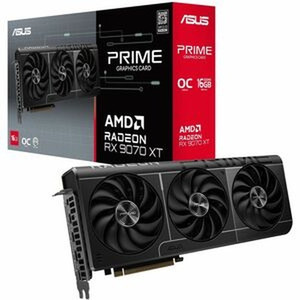
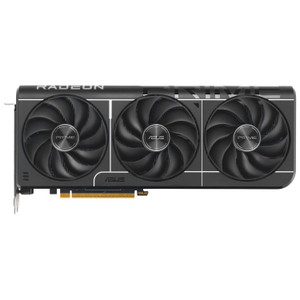
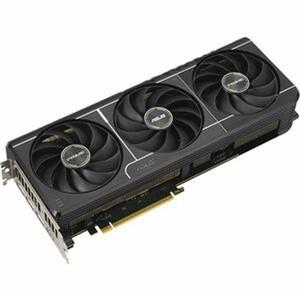
ASUS PRIME-RTX5080-O16G GeForce RTX 5080 16GB GDDR7 SFF Graphics Card
Overview
The ASUS PRIME-RTX5080-O16G puts NVIDIA's GeForce RTX 5080 GPU — 10,752 CUDA cores and 16GB of GDDR7 memory — into a 2.5-slot, SFF-ready form factor that fits compact workstations and dense rack-mount systems where full-width triple-slot cards simply won't install. If you're deploying GPU-accelerated video analytics, AI inference pipelines, or high-throughput edge compute nodes and need a card that won't fight your chassis constraints, this is the configuration to evaluate. The OC Edition runs a factory-tuned boost clock out of the box, and the dual-BIOS switch lets you drop to a quieter performance profile without flashing firmware.
For security integration projects specifically, the discrete GPU category matters when your VMS or AI analytics platform offloads decoding and inference from the host CPU — a task that scales poorly on CPU alone past 30–40 concurrent HD streams. The RTX 5080's architecture handles that workload with headroom to spare.
Key Features
- 10,752 CUDA Cores on RTX 5080 Architecture: The raw parallel-processing count determines how many simultaneous inference tasks — object detection, license plate recognition, behavioral analytics — the card can run without queuing. At 10,752 cores this card handles large multi-stream deployments that would saturate a mid-range GPU in minutes.
- 16GB GDDR7 on a 256-bit Bus at 30 Gbit/s: GDDR7 at 30 Gbit/s delivers substantially higher memory bandwidth than prior GDDR6X solutions. For AI video analytics, model weights and frame buffers compete for VRAM — 16GB gives you room to run multiple large models concurrently without swapping. The 256-bit bus keeps data moving fast enough to avoid memory-bound bottlenecks at high stream counts.
- PCIe 5.0 Interface: PCIe 5.0 doubles the theoretical bandwidth of PCIe 4.0. On platforms that support it, this eliminates the host-to-GPU transfer as a bottleneck when streaming high-bitrate encoded video from NVR storage into the GPU for re-analysis or transcoding.
- 2.5-Slot SFF-Ready Design: The 3.70 × 16.00 × 9.20 in footprint and 2.5-slot width targets small-form-factor workstations and compact tower servers. Where a standard triple-slot AIB would block adjacent PCIe slots or exceed chassis clearance, this card installs cleanly — a real consideration in purpose-built analytics appliances or edge AI boxes with limited internal volume.
- Vapor Chamber Cooling with Axial-Tech Fans: The vapor chamber base distributes heat from the GPU die across the heatsink more uniformly than heatpipe designs. In sustained workloads — 24/7 inference is not a gaming burst load — this matters for thermal stability and long-term component reliability.
- Dual BIOS: Two firmware profiles on a hardware switch. The performance BIOS runs the OC-tuned clock targets; the quiet BIOS reduces fan speed and power targets for deployments where acoustics or power budget is constrained. No software needed to switch — toggle before boot.
- 4-Display Output (1× HDMI 2.1b + 3× DisplayPort 2.1): Drives up to four monitors simultaneously at up to 7680 × 4320 (8K) per output. For operator workstations running multi-monitor video wall layouts, all four outputs from a single card eliminates the need for a second GPU purely for display.
- HDMI 2.1b and DisplayPort 2.1: Both interfaces support the latest high-refresh, high-resolution display standards. HDCP support means protected content pipelines (broadcast, DRM-encoded streams) pass through without adapter workarounds.
- OpenGL 4.6 Support: Required by several professional VMS and forensic video review applications that haven't migrated to Vulkan. OpenGL 4.6 compliance ensures compatibility with legacy and current-generation software stacks without driver workarounds.
- VR Ready: If your deployment includes operator training simulations or 3D spatial planning tools, VR-readiness is verified out of the box — no additional qualification step required.
Integration & Compatibility
The PRIME-RTX5080-O16G connects via PCIe 5.0 (backward-compatible with PCIe 4.0 and 3.0 slots at reduced bandwidth). The card also exposes an Ethernet interface per the TD Synnex structured attribute data — confirm your specific use case requirements with your system integrator, as this may relate to NVIDIA's networking feature set on the RTX 5080 platform. The card weighs 4.45 lb; verify that your chassis and PCIe slot retention mechanism can support that load in horizontal and vertical orientations before finalizing the system build.
For NVR and VMS deployments requiring GPU-accelerated decoding, verify that your software vendor's driver compatibility matrix explicitly lists RTX 5080 / Ada or Blackwell-class support. Driver qualification lags hardware release by weeks to months on some enterprise platforms. The UNSPSC code for this product is 43201401 (graphics cards/display adapters), which simplifies procurement classification in enterprise purchasing systems.
If you're pairing this card with a high-density IP camera deployment — particularly one running AI-based object analytics at the server rather than the camera edge — budget your VRAM against the number of concurrent streams and model sizes your analytics platform publishes. NVIDIA's CUDA ecosystem is well-supported by major video management software vendors for GPU-accelerated decode offload.
Frequently Asked Questions
Q: What is the form factor of the PRIME-RTX5080-O16G and will it fit a standard mid-tower chassis?
A: The PRIME-RTX5080-O16G is a 2.5-slot SFF-ready card measuring 3.70 × 16.00 × 9.20 inches and weighing 4.45 lb. It is specifically designed to fit small-form-factor and compact chassis that cannot accommodate standard triple-slot AIBs. Verify your chassis's PCIe slot clearance and card length spec (16 inches / ~406mm) before ordering.
Q: How much video memory does the PRIME-RTX5080-O16G have, and what memory type is it?
A: The card carries 16GB of GDDR7 memory on a 256-bit bus running at 30 Gbit/s. GDDR7 provides higher bandwidth than GDDR6X, which is relevant for multi-model AI inference workloads where VRAM bandwidth is often the bottleneck.
Q: How many monitors can the PRIME-RTX5080-O16G drive simultaneously?
A: Up to four displays simultaneously — one HDMI 2.1b port and three DisplayPort 2.1 ports. Maximum supported resolution is 7680 × 4320 (8K) per output.
Q: Does the PRIME-RTX5080-O16G use PCIe 5.0, and is it backward compatible with PCIe 4.0 motherboards?
A: Yes, the card uses a PCIe 5.0 interface. PCIe is backward compatible, so the card will physically install and operate in PCIe 4.0 and PCIe 3.0 slots at those slots' respective bandwidth ceilings. Full PCIe 5.0 bandwidth requires a PCIe 5.0-capable motherboard and slot.
Q: What is the Dual BIOS feature on the PRIME-RTX5080-O16G?
A: The card includes a hardware switch that toggles between two firmware profiles: a performance BIOS running the factory OC clock targets, and a quieter BIOS with reduced fan speeds and power targets. The switch is physical — no software installation required — and takes effect on the next boot.
Q: What does the CUDA core count mean for AI video analytics workloads?
A: The RTX 5080 on this card has 10,752 CUDA cores. In GPU-accelerated analytics pipelines (object detection, license plate recognition, motion classification), CUDA cores execute the parallel matrix operations that neural networks depend on. More cores allow the GPU to process more simultaneous inference tasks — translating to more concurrent camera streams handled per card before performance degrades.
The spec that jumps out on the PRIME-RTX5080-O16G is the combination of 16GB GDDR7 on a 256-bit bus at 30 Gbit/s in a 2.5-slot package. That memory bandwidth figure is the practical ceiling for how many concurrent AI inference jobs the card can sustain before the GPU sits idle waiting on data — and at 30 Gbit/s, that ceiling is high enough that most single-server analytics deployments won't hit it.
Technical Highlights:
- 10,752 CUDA Cores: Enough parallel throughput to run multiple large detection models simultaneously — object classification, LPR, and behavioral analytics can execute concurrently rather than queuing, which directly reduces per-stream latency in real-time analytics pipelines.
- PCIe 5.0 at 16.00-inch card length: The full-length PCIe 5.0 interface paired with the SFF 2.5-slot profile is a rare combination — most PCIe 5.0 AIBs are triple-slot or wider. This card installs in chassis that a standard AIB won't physically fit, without sacrificing interface bandwidth on platforms that support PCIe 5.0.
- Dual BIOS hardware switch: For 24/7 server room deployments, the quiet-mode BIOS profile reduces fan speeds and power draw without requiring any software stack changes — useful when the deployment environment penalizes acoustic output or when PSU headroom is tight.
Deployment Considerations:
- At 4.45 lb, confirm your PCIe slot and any riser card mechanism can handle the load — especially in 1U/2U chassis where cards mount horizontally and gravity works against the slot retention clip over time.
- The 16-inch card length (406mm) is at the upper end for SFF chassis. Cross-reference your chassis's published max GPU length spec before ordering — even SFF-targeted chassis vary, and 'SFF-ready' on the card side doesn't guarantee fit on the chassis side.
This card is a strong fit for purpose-built AI analytics server builds — specifically compact edge nodes running GPU-accelerated VMS decode offload or multi-model inference across 40+ concurrent HD streams — where a triple-slot AIB simply won't install and a smaller GPU would undersupply the VRAM or core throughput the workload demands.