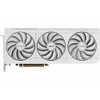
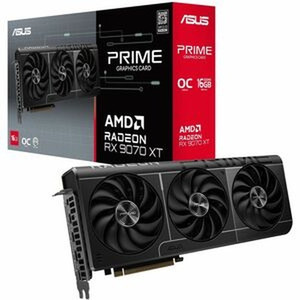
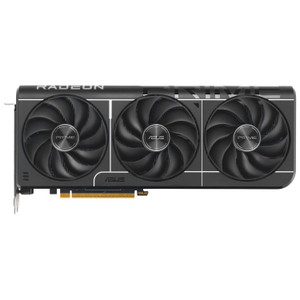
ASUS PRIME-RX9070XT-O16G-WHITE Radeon RX 9070 XT 16GB OC Edition Graphics Card
Overview
The ASUS PRIME-RX9070XT-O16G-WHITE is a factory-overclocked AMD Radeon RX 9070 XT graphics card built on the RDNA 4 architecture, pairing 16 GB of GDDR6 memory on a 256-bit bus with a 3030 MHz OC-mode boost clock. It's a 2.5-slot card aimed at workstation builders, rendering stations, and high-refresh-rate display setups where 8K output capability and PCIe 5.0 bandwidth are practical requirements rather than marketing checkboxes. The White OC Edition gives system integrators a clean aesthetic that pairs with white-themed builds without sacrificing thermal headroom.
If you're speccing a multi-display workstation or a compute-adjacent rendering rig, the graphics card selection comes down to memory bandwidth, slot geometry, and display I/O — all three of which this card addresses directly.
Key Features
- 16 GB GDDR6 on a 256-bit bus at 20 Gbps: At 20 Gbps data transfer rate, the 256-bit bus delivers 640 GB/s of peak memory bandwidth. For texture-heavy 3D workloads or high-resolution video playback pipelines, that headroom matters more than raw VRAM count alone — 16 GB is enough to hold full 8K texture sets without paging to system RAM mid-frame.
- 3030 MHz OC boost clock (3010 MHz standard OC): The PRIME-RX9070XT-O16G-WHITE ships with two performance profiles selectable via its dual BIOS switch. Performance mode hits 3030 MHz boost; switch to the standard profile at 3010 MHz for a quieter, cooler run in noise-sensitive environments. Neither mode requires manual overclocking.
- PCIe 5.0 interface: PCIe 5.0 doubles the available bandwidth over PCIe 4.0 — 128 GB/s vs. 64 GB/s on a x16 slot. For GPU-accelerated compute tasks or streaming large assets from NVMe storage directly to the GPU, that headroom eliminates the interface as a bottleneck.
- 4096 stream processors (RDNA 4): AMD's RDNA 4 compute units deliver the full 4096-shader complement without binning. This is the top-tier Radeon RX 9070 XT die configuration, relevant for render farms and GPGPU workloads beyond pure gaming.
- HDMI 2.1b + DisplayPort 2.1 outputs, up to 4 displays: HDMI 2.1b supports 4K@240Hz and 8K@60Hz without DSC compression on a single cable. The DisplayPort 2.1 outputs (UHBR20 capable) handle 8K@60Hz natively. Drive up to four monitors simultaneously — practical for trading desks, multi-monitor render preview setups, or video wall outputs.
- Maximum resolution 7680×4320 (8K): Native 8K output is supported across HDMI 2.1b and DisplayPort 2.1, which matters if you're deploying a card into a studio monitoring chain or a visualization suite with 8K reference displays rather than consumer panels.
- Axial-Tech fan design with dual ball bearings: The three-fan Axial-Tech array uses dual ball bearings rather than sleeve bearings — longer service life under sustained load and better performance in non-horizontal orientations (vertical GPU mount brackets, for example). In continuous-use workstation scenarios that run 8–12 hours daily, bearing type is a real maintenance consideration.
- 2.5-slot form factor, 15.94 × 9.17 × 3.48 in (L × W × H): At 15.94 inches long, verify clearance in smaller mid-tower cases before ordering — this is a full-length card. The 2.5-slot design leaves adjacent PCIe slots accessible for NIC or capture cards, which matters in multi-card workstation builds.
- Dual BIOS switch: Two independent firmware images mean a failed BIOS update doesn't brick the card. For managed deployments where remote firmware updates run unattended, this is a meaningful resilience feature — revert to the backup BIOS without physical RMA.
- ASUS GPU Guard: Reinforced PCIe connector bracket reduces sag stress on the motherboard slot under the card's 3.86 lb weight. In rackmount workstations or systems with vibration exposure, mechanical slot stress is a real failure mode over time.
Integration & Compatibility
The PRIME-RX9070XT-O16G-WHITE installs into any PCIe 5.0 x16 slot and is backward-compatible with PCIe 4.0 and 3.0 motherboards at reduced bandwidth — PCIe 4.0 x16 still delivers 64 GB/s, which is sufficient for all current display and compute workloads. Confirm your chassis supports at minimum a 16-inch card length and 2.5 slots of clearance. The 3.86 lb weight is typical for triple-fan cards in this class; use the GPU Guard bracket or an aftermarket GPU support bracket in cases without a dedicated support point.
Display connectivity covers the full range of professional monitor standards: HDMI 2.1b for broadcast-grade monitors and projectors, DisplayPort 2.1 for high-refresh-rate 4K/5K/8K panels, with support for up to four simultaneous outputs. AMD's Radeon driver ecosystem supports FreeSync Premium Pro displays natively; verify VRR compatibility with your specific monitor model before deployment.
For workstation builds pairing this card with high-core-count CPUs and high-bandwidth networking for render farm node use, the PCIe 5.0 interface ensures the GPU isn't starved by the interconnect. Plan your PSU capacity around the card's power draw — the RX 9070 XT reference TDP is in the 300W range; verify your power supply has the appropriate 16-pin (PCIe 5.0) or dual 8-pin connector configuration your build requires.
Frequently Asked Questions
Q: What PCIe slot does the PRIME-RX9070XT-O16G-WHITE require, and is it backward-compatible with PCIe 4.0 motherboards?
A: The card uses a PCIe 5.0 x16 interface and is fully backward-compatible with PCIe 4.0 and PCIe 3.0 x16 slots. You will get the full bandwidth benefit on a PCIe 5.0 platform, but the card will install and operate normally on older motherboards at reduced interface bandwidth.
Q: How many monitors can the PRIME-RX9070XT-O16G-WHITE drive simultaneously?
A: Up to four displays simultaneously. Outputs include one HDMI 2.1b port and multiple DisplayPort 2.1 connections (as described in the product name — 1x HDMI + 3x DP), supporting up to 8K resolution on each output.
Q: What does the dual BIOS switch on the PRIME-RX9070XT-O16G-WHITE do?
A: It provides two independent firmware images on the card. One is the Performance (OC) profile targeting 3030 MHz boost clock; the other is a quieter standard profile at 3010 MHz. If a BIOS update corrupts one image, the backup remains intact and the card can still be recovered without RMA.
Q: How long is this card, and will it fit in a mid-tower case?
A: The card measures 15.94 inches (approximately 405 mm) in length. Many mid-tower cases support up to 320–380 mm — verify your specific chassis GPU clearance specification before purchasing. Full-tower and larger mid-tower cases (e.g., those rated for E-ATX) typically accommodate this length without modification.
Q: What is the memory configuration on the PRIME-RX9070XT-O16G-WHITE?
A: 16 GB of GDDR6 memory on a 256-bit bus running at 20 Gbps data transfer rate, delivering approximately 640 GB/s of peak memory bandwidth. This is the full, non-binned memory configuration for the Radeon RX 9070 XT.
Q: Does the PRIME-RX9070XT-O16G-WHITE support CUDA?
A: No. CUDA is an NVIDIA proprietary compute API. As an AMD Radeon card, this GPU uses AMD's ROCm and OpenCL compute frameworks instead. Verify your target software stack supports AMD GPU compute before specifying this card for GPU-accelerated workloads.
The PRIME-RX9070XT-O16G-WHITE is one of the cleaner workstation GPU options in the RX 9070 XT lineup right now — the 3030 MHz OC boost clock and full 4096 stream processor count with 16 GB GDDR6 at 20 Gbps make it a legitimate choice for multi-display visualization builds, not just gaming rigs repurposed for work.
Technical Highlights:
- 256-bit / 20 Gbps memory subsystem: Peak ~640 GB/s bandwidth keeps large texture and framebuffer workloads from stalling at the memory interface — relevant in 4K-and-above rendering pipelines where VRAM bandwidth, not just capacity, is the constraint.
- Dual BIOS with 3030 MHz OC vs. 3010 MHz standard profiles: The 20 MHz spread between profiles is narrow, but the real value is the backup firmware image — for managed deployments running unattended BIOS updates on multiple cards, this prevents a single failed flash from pulling a node offline.
- PCIe 5.0 x16 interface on a 3.86 lb, 2.5-slot chassis: At 15.94 inches and 3.86 lb, this is a physically substantial card. The GPU Guard bracket addresses sag on the PCIe slot, but you'll want an aftermarket vertical support in any chassis that doesn't include one — slot stress at that weight over 24/7 uptime is a real concern.
Deployment Considerations:
- CUDA is explicitly not supported — if your render pipeline or ML inference stack is CUDA-dependent (Blender Cycles CUDA, DaVinci Resolve CUDA-only plugins, NVIDIA TensorRT), this card won't work. Verify ROCm/OpenCL support in your software before specifying.
- At 15.94 inches, pre-clear case GPU length before ordering — this is longer than most mid-towers accommodate without removing a drive cage.
Best fit: a white-build workstation or visualization node running AMD-compatible software stacks (Blender HIP, DaVinci ROCm, OpenCL compute) with a PCIe 5.0 motherboard and four-display output requirements. It's not the card for CUDA-dependent pipelines, but for AMD-native compute and multi-monitor professional use, the PRIME-RX9070XT-O16G-WHITE is well-specced for the role.