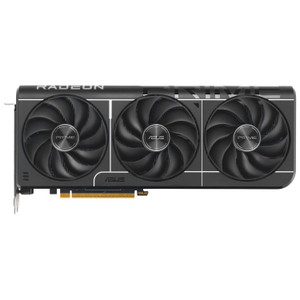
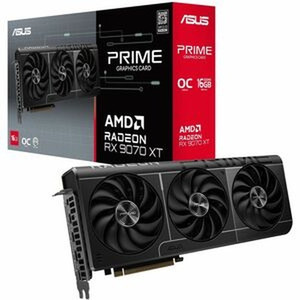
ASUS PRIME-RX9070-O16G Radeon RX 9070 OC Edition Graphics Card
Overview
The PRIME-RX9070-O16G is ASUS's PRIME-series OC Edition discrete graphics card built around AMD's Radeon RX 9070 GPU. It pairs 16GB of GDDR6 memory on a 256-bit bus with a PCIe 5.0 x16 interface — giving workstations and compute-forward deployments both the memory capacity and bus bandwidth to handle demanding multi-display rendering, GPU-accelerated compute workloads, and high-resolution video decoding. At 3.86 lb and 15.94 × 9.17 × 3.48 inches, this is a full triple-slot card that requires a case and PSU sized accordingly.
Key Features
- 16GB GDDR6 on a 256-Bit Bus at 20 Gbit/s: 16GB of frame buffer means large textures, multi-stream video decode, and GPU-compute datasets fit in VRAM without paging to system memory — the bottleneck that kills throughput on 8GB cards under production workloads. The 256-bit bus at 20 Gbit/s delivers the memory bandwidth to keep 3,584 stream processors fed.
- 3,584 Stream Processors — AMD Radeon RX 9070: The RX 9070's shader count sits in the range where parallel workloads — video transcoding, AI inferencing on the edge, multi-camera decode — can be offloaded from the CPU meaningfully. Not a data-center accelerator, but a capable mid-range compute card for workstation-class tasks.
- 2,590 MHz Boost Clock (OC Edition): ASUS's OC Edition factory overclock pushes the boost clock to 2,590 MHz above AMD's reference spec. In practice this translates to higher sustained GPU compute throughput without requiring manual overclocking or BIOS changes — the card ships tuned.
- PCIe 5.0 Interface: PCIe 5.0 doubles the available bus bandwidth versus PCIe 4.0. For current GPU workloads the practical benefit is headroom — this card will not become bus-bandwidth-limited as platform demands grow, and it runs backward-compatible in PCIe 4.0 or 3.0 slots at reduced bandwidth.
- Four-Display Output — 1× HDMI 2.1b + 3× DisplayPort 2.1a: Four simultaneous outputs support up to 7680×4320 (8K) resolution per display. DisplayPort 2.1a's increased bandwidth (up to 80 Gbps UHBR20) handles high-refresh 4K and emerging 8K panels without compression. HDMI 2.1b covers connection to professional displays and video walls requiring HDMI. Four-head configurations are directly supported without a hub or MST adapter.
- 8K Maximum Resolution (7680×4320): The card's display engine supports 7680×4320 output natively. For video wall control rooms, digital signage driving large-format displays, or forensic review workstations requiring full-resolution playback, this headroom matters — you are not upscaling.
- No Parallel Processing (CUDA) — AMD Architecture: This is an AMD card; NVIDIA CUDA is not supported. Workloads or software stacks written specifically for CUDA (certain VMS GPU-acceleration plugins, some AI analytics SDKs) will need to use AMD's ROCm or OpenCL equivalents, or a different hardware platform. Verify your software stack's GPU support before specifying this card in a compute-heavy deployment.
Integration and Compatibility
The PRIME-RX9070-O16G connects via PCIe 5.0 x16 and is backward-compatible with PCIe 4.0 and 3.0 motherboard slots. At 15.94 inches in length and a triple-slot profile, chassis clearance and slot availability must be confirmed before deployment — mid-tower and compact workstation cases may not accommodate this card. Power requirements are not specified in available evidence; consult the ASUS product page for TDP and PSU connector requirements before system integration.
Display outputs support up to four simultaneous connections across the card's 1× HDMI 2.1b and 3× DisplayPort 2.1a ports. For graphics card deployments in command center or video wall environments, the native four-head output eliminates the need for additional display adapters in most configurations. Review your workstation components compatibility — particularly PCIe slot generation, chassis length, and PSU capacity — before procurement. Buyers evaluating GPU compute options for edge analytics or VMS acceleration should confirm their software platform supports AMD's ROCm or OpenCL, as CUDA is not available on this architecture. For broader ASUS hardware in your deployment, the PRIME series covers both consumer and prosumer-grade builds. Pair with an appropriate workstation platform that provides PCIe 5.0 support to take full advantage of the interface bandwidth.
Frequently Asked Questions
Q: What PCIe slot does the PRIME-RX9070-O16G require?
A: The PRIME-RX9070-O16G uses a PCIe 5.0 x16 interface. It is backward-compatible with PCIe 4.0 and PCIe 3.0 slots at reduced bandwidth. Confirm your motherboard has a full-length PCIe x16 slot and that your chassis can accommodate a card measuring 15.94 inches in length.
Q: How many monitors can the PRIME-RX9070-O16G drive simultaneously?
A: Up to four displays simultaneously — via 1× HDMI 2.1b and 3× DisplayPort 2.1a outputs. Maximum supported resolution is 7680×4320 (8K) per display.
Q: Does this card support CUDA for GPU-accelerated applications?
A: No. The PRIME-RX9070-O16G is based on AMD's Radeon RX 9070 architecture and does not support NVIDIA CUDA. GPU-accelerated workloads must use AMD ROCm or OpenCL-compatible software. Verify your application's GPU compute stack before specifying this card.
Q: How much video memory does the PRIME-RX9070-O16G have, and what type?
A: 16GB of GDDR6 on a 256-bit memory bus, with a data transfer rate of 20 Gbit/s. This capacity is sufficient for multi-stream video decode, large texture workloads, and GPU-compute tasks that exceed the 8GB VRAM threshold common on lower-tier cards.
Q: What are the physical dimensions of the PRIME-RX9070-O16G?
A: The card measures 15.94 × 9.17 × 3.48 inches (L × W × H) and weighs 3.86 lb. It is a triple-slot design. Verify chassis clearance — particularly card length — before installation in mid-tower or compact workstation cases.
Q: Is the PRIME-RX9070-O16G suitable for 8K video wall or command center deployments?
A: It supports 8K (7680×4320) output natively across its DisplayPort 2.1a outputs and drives up to four displays simultaneously, making it a viable option for multi-display command center workstations or high-resolution digital signage controllers, provided the software stack is AMD-compatible.
The PRIME-RX9070-O16G caught my attention for workstation deployments specifically because of how ASUS positioned the memory spec: 16GB GDDR6 at 20 Gbit/s on a full 256-bit bus is meaningfully different from the 128-bit or 192-bit configurations you see on cards marketed at roughly the same tier. That bus width keeps the memory controller from becoming the constraint when you are decoding multiple high-resolution streams or running parallel GPU workloads.
Technical Highlights:
- 16GB GDDR6 / 256-bit Bus: At 20 Gbit/s across 256 bits, memory bandwidth is in the range where multi-stream 4K decode and GPU-compute tasks stay resident in VRAM rather than stalling on host transfers. The practical ceiling compared to 8GB cards is significant for workloads that load large models or manage many simultaneous video channels.
- 2,590 MHz Boost Clock (OC Edition): Factory-tuned above AMD reference. In GPU-accelerated video processing or analytics pipelines, higher sustained clock translates directly to frames-per-second throughput. You get this without touching overclocking utilities — useful in managed enterprise environments where BIOS changes are discouraged.
- 4× Display Outputs — DP 2.1a + HDMI 2.1b: Three DisplayPort 2.1a outputs supporting up to 8K natively is the spec that makes this card usable in serious multi-display control room builds. You are not bridging through MST hubs or sacrificing refresh rate to drive four heads.
Deployment Considerations:
- At 15.94 inches long and triple-slot width, chassis selection is non-trivial. Measure twice — many rack-mount workstations and compact towers physically cannot fit this card regardless of slot availability.
- CUDA is not supported. If your VMS, analytics platform, or AI inference stack has a hard CUDA dependency, this card will not work. AMD ROCm support varies significantly by software vendor — confirm compatibility with your specific application version before procurement.
For a four-screen security operations center workstation running AMD-compatible VMS software with 4K displays, the PRIME-RX9070-O16G delivers the memory capacity and native multi-head output to handle that configuration without compromise — provided the chassis and PSU are specced to match.