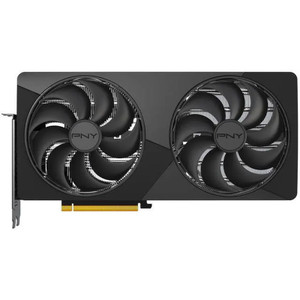
ASUS RTX5080-O16G-NOCTUA GeForce RTX 5080 16GB GDDR7 Noctua OC Edition Graphics Card
Overview
The ASUS RTX5080-O16G-NOCTUA pairs NVIDIA's GeForce RTX 5080 GPU with a purpose-built Noctua cooling solution — a combination that targets workstation operators and compute-intensive deployments where sustained thermal performance and acoustic discipline matter as much as raw throughput. With 10,752 CUDA cores, 16GB of GDDR7 memory on a 256-bit bus, and a factory-overclocked boost clock of 2,730 MHz in OC mode, this card is positioned for AI inference workloads, real-time video analytics, and professional visualization tasks that would saturate a mid-range GPU in minutes. At 20.55 × 10.35 × 4.94 inches and 7.74 lb, this is a physically substantial card — confirm your chassis clearance before ordering.
Key Features
- 10,752 CUDA Cores at 2,730 MHz (OC Mode): The GeForce RTX 5080 architecture delivers compute headroom for parallel workloads — AI model inference, real-time multi-stream video decoding, and dense rendering pipelines all benefit directly. The 2,730 MHz OC frequency (2,700 MHz standard boost) gives you a modest but real performance margin over reference clocks without manual tuning.
- 16GB GDDR7 on a 256-bit Bus at 30 Gbit/s: GDDR7 at 30 Gbit/s delivers substantially higher memory bandwidth than previous-generation GDDR6X at comparable bus widths. For workloads that are bandwidth-bound — large model inference, 8K texture pipelines, multi-camera analytics engines — this directly reduces per-frame latency and improves sustained throughput.
- Triple Noctua NF-A12x25 G2 PWM 120mm Fans: Noctua's NF-A12x25 G2 is one of the most acoustically engineered 120mm fans available. Three of them on a GPU cooler means you can run sustained compute loads at significantly lower RPMs than a conventional blower or dual-fan shroud, translating to lower noise floor in open-office or studio environments where GPU acoustics are a real operational concern.
- Optimized Vapor Chamber with Phase-Change GPU Thermal Pad: The vapor chamber spreads heat from the GPU die uniformly before it reaches the fin stack, eliminating hot spots that cause thermal throttling under sustained load. The phase-change thermal pad at the GPU interface improves long-term thermal contact versus conventional pads, which can dry out and degrade over years of operation.
- 0dB Technology: At idle and light loads, all three fans stop completely. In a quiet workstation environment, this eliminates the low-level fan hum that can be distracting during non-compute tasks. Fans spin up automatically when the GPU temperature rises — no manual intervention needed.
- Dual BIOS: Two independent BIOS profiles let you switch between performance (OC) and quiet/efficiency modes without software, and provide a fallback if a firmware update goes wrong. For production workstations where uptime matters, this is a meaningful reliability feature.
- PCIe 5.0 Interface: PCIe 5.0 doubles the available bandwidth versus PCIe 4.0. Current RTX 5080 workloads don't fully saturate PCIe 4.0, but the headroom ensures this card won't become a bottleneck as CPU platforms and NVMe storage evolve. Install into a PCIe 5.0 x16 slot for full bandwidth; the card will negotiate down gracefully on PCIe 4.0 systems with no functional loss at current workload levels.
- Five Display Outputs (2× HDMI 2.1b, 3× DisplayPort 2.1b), Up to 7680×4320: Four simultaneous displays are supported at up to 8K resolution. For multi-monitor operator workstations — video wall controllers, command centers, or dense analytics dashboards — this eliminates the need for a secondary display card. HDMI 2.1b supports 4K/144Hz and 8K/60Hz; DisplayPort 2.1b handles 8K/60Hz and 4K/240Hz depending on display capability.
- 7.74 lb / 20.55 × 10.35 × 4.94 in Form Factor: At nearly 7.75 pounds and over 20 inches long, this card requires a full-tower or large mid-tower chassis with adequate PCIe slot support. Verify motherboard GPU support brackets or chassis reinforcement before installation — inadequately supported cards of this mass can stress PCIe slots over time, particularly in transported or rack-mounted systems.
Integration & Compatibility
The RTX5080-O16G-NOCTUA connects via PCI Express 5.0, making it compatible with current-generation Intel and AMD platforms supporting PCIe 5.0 x16 slots. It will operate on PCIe 4.0 and 3.0 systems at negotiated speeds — confirm your platform's mechanical slot length (x16 physical) and power delivery capacity before deployment. The card requires a motherboard slot capable of supporting its weight and length; use GPU support brackets in horizontally-oriented builds.
For graphics cards deployed in AI inference or video analytics roles, pair with a platform offering sufficient system memory bandwidth and NVMe storage to avoid upstream bottlenecks. The five display outputs make this suitable as the sole display adapter in a professional workstation driving multi-monitor analyst setups. For builds requiring multiple high-bandwidth peripherals, review your platform's PCIe lane allocation — a CPU with 24+ PCIe lanes avoids contention between the GPU, NVMe drives, and any capture or network cards.
Power supply requirements scale with the RTX 5080's TDP — size your PSU to the card's published power specification with a margin for system load. Use high-quality PCIe power cables rated for the connector type the card specifies; do not use daisy-chained connectors from a single PSU rail for this class of card. For deployment planning support, ASUS GPU configurations are available with pre-sales guidance. Also consider workstation cooling accessories to complement the Noctua thermal solution at the case level, and review GPU selection guidance for workload-matching advice.
Frequently Asked Questions
Q: What are the physical dimensions of the RTX5080-O16G-NOCTUA, and will it fit in a standard mid-tower case?
A: The card measures 20.55 inches long × 10.35 inches wide × 4.94 inches tall (L × W × H) and weighs 7.74 lb. Most standard mid-tower cases top out at 14–16 inches of GPU clearance — this card requires a large mid-tower or full-tower chassis. Measure your case's GPU length clearance before ordering.
Q: How many monitors can the RTX5080-O16G-NOCTUA drive simultaneously, and at what resolutions?
A: The card supports up to four simultaneous displays using any combination of its five outputs (2× HDMI 2.1b, 3× DisplayPort 2.1b). Maximum resolution is 7680×4320 (8K). HDMI 2.1b supports up to 4K/144Hz or 8K/60Hz; DisplayPort 2.1b supports up to 4K/240Hz or 8K/60Hz depending on display capability.
Q: What is the difference between OC mode and standard mode on the RTX5080-O16G-NOCTUA?
A: In OC mode the GPU boost clock runs at 2,730 MHz versus 2,700 MHz in standard mode. The Dual BIOS feature lets you switch between these profiles via a physical switch on the card — no software required. OC mode delivers slightly higher peak performance; standard mode runs marginally cooler and quieter under sustained load.
Q: Does the 0dB technology on the RTX5080-O16G-NOCTUA mean the fans never spin?
A: No — 0dB technology means the three Noctua NF-A12x25 G2 fans stop completely at idle and under light load, eliminating fan noise when the GPU is not under compute stress. The fans spin up automatically as GPU temperature rises during active workloads. You will hear the fans during sustained GPU-intensive tasks.
Q: What PCIe slot does the RTX5080-O16G-NOCTUA require?
A: The card uses a PCI Express 5.0 interface and requires a physical x16 PCIe slot. It is backward compatible with PCIe 4.0 and 3.0 x16 slots at negotiated bandwidth. For full PCIe 5.0 throughput, install into a PCIe 5.0 x16 slot on a compatible current-generation motherboard.
Q: Is the RTX5080-O16G-NOCTUA suitable for AI inference and video analytics workloads?
A: The 10,752 CUDA cores and 16GB of GDDR7 memory make it capable for AI inference tasks and real-time video analytics pipelines. Suitability for a specific workload depends on the software framework, model size, and throughput requirements — verify against your application's published GPU compatibility list before deploying in a production environment.
The RTX5080-O16G-NOCTUA is one of those cards I recommend when the workload is real and the environment doesn't tolerate fan noise. The combination of 10,752 CUDA cores with 16GB of GDDR7 at 30 Gbit/s gives you genuine headroom for AI inference and multi-stream video analytics — and the three Noctua NF-A12x25 G2 PWM fans mean you can sustain those loads without the GPU becoming the loudest thing in the room.
Technical Highlights:
- GDDR7 at 30 Gbit/s, 256-bit bus: Memory bandwidth is the limiting factor on most inference and video pipeline workloads. GDDR7 at 30 Gbit/s on a 256-bit bus delivers meaningfully higher sustained bandwidth than GDDR6X at comparable configurations — relevant when you're running large batch sizes or multi-stream decode.
- 2,730 MHz OC boost clock: The factory OC mode runs 30 MHz above the standard boost — not a dramatic gap, but it's pre-validated and covered under the product warranty as shipped. You get the performance without the risk of manual overclocking instability.
- Dual BIOS with hardware switch: In production systems, the ability to fall back to a known-good BIOS profile without OS access is underrated. If an update corrupts one profile, the physical switch gets you back up without a service call.
Deployment Considerations:
- At 20.55 inches long and 7.74 lb, this card needs a chassis rated for its length and a motherboard with GPU weight support or a physical brace — don't skip that step in rack-adjacent or frequently moved workstations.
- The 0dB fan-stop feature is welcome in quiet environments, but verify your chassis has adequate passive airflow across the card during idle periods — some compact cases create hot pockets around a stationary GPU fan stack.
This card fits best in a dedicated AI inference workstation or a command-center build where an operator runs four high-resolution displays and analytics software simultaneously — the memory capacity, CUDA throughput, and acoustic profile all line up for that scenario.