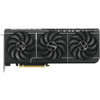
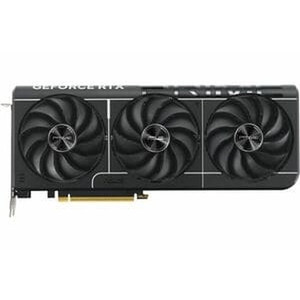
ASUS PRIME-RTX5070TI-O16G GeForce RTX 5070 Ti OC 16GB GDDR7 Graphics Card
The ASUS PRIME-RTX5070TI-O16G is a factory-overclocked GeForce RTX 5070 Ti graphics card built around NVIDIA's Blackwell architecture — 8960 CUDA cores paired with 16GB of GDDR7 memory on a 256-bit bus, in a 2.5-slot SFF-ready footprint that fits compact workstations and dense rack-mount builds without sacrificing thermal headroom. If you're provisioning GPU compute for graphics cards or compute-accelerated workloads and need a card that clears modern small-form-factor chassis clearance constraints while still delivering high-bandwidth memory throughput, this is a serious candidate to evaluate.
Overview
The RTX 5070 Ti generation steps up memory bandwidth meaningfully over its predecessor: GDDR7 at 28 Gbit/s per pin across a 256-bit interface translates to approximately 896 GB/s of peak memory bandwidth. For workloads that are memory-bandwidth bound — inference on large models, real-time rendering, multi-stream video decode — that number matters more than raw core count. The PRIME-RTX5070TI-O16G (often searched as PRIME RTX5070TI O16G) pairs that bandwidth with a factory OC configuration, meaning ASUS has validated the boost clock headroom above NVIDIA reference spec before the card ships.
The physical envelope is 15.94 × 9.17 × 3.48 inches and 4.01 lb — a 2.5-slot design that threads the needle between reference blower cards (thermally constrained) and triple-slot behemoths (physically incompatible with SFF chassis). The Axial Tech fan array and Dual BIOS switch give you a noise-optimized profile for office or lab environments and a performance profile when the workload demands it, without cracking the chassis open to swap hardware. Explore the full ASUS graphics and compute lineup for companion products in this family.
Key Features
- 16GB GDDR7 on a 256-bit bus at 28 Gbit/s: Peak memory bandwidth of roughly 896 GB/s. For GPU-accelerated inference, video analytics, or multi-stream 4K/8K processing, memory bandwidth is frequently the bottleneck — not core count. 16GB also gives enough headroom to load mid-size models without falling back to system RAM.
- 8960 CUDA cores (GeForce RTX 5070 Ti / Blackwell): The core count positions this card solidly in the high-performance segment. In parallel compute workloads — transcoding, simulation, ML training on modest datasets — more execution units mean shorter wall-clock time per batch.
- PCIe 5.0 interface: PCIe 5.0 ×16 doubles the host-to-GPU bandwidth ceiling versus PCIe 4.0. On workloads that stream large datasets from system memory to the GPU (common in data pipeline acceleration and real-time analytics), the wider pipe reduces CPU-GPU transfer stalls. Compatible with PCIe 4.0 and 3.0 slots at reduced bandwidth — backwards compatible by design.
- SFF-ready 2.5-slot form factor (15.94 × 9.17 × 3.48 in): Many high-performance GPUs are 3+ slots and exceed 330mm in length, locking out compact chassis. At 2.5 slots and a validated SFF-ready designation, the PRIME-RTX5070TI-O16G fits a broader range of small workstations and edge compute platforms where physical clearance is a hard constraint, not a preference.
- 4× simultaneous display outputs (1× HDMI 2.1b + 3× DisplayPort 2.1b): Driving a four-head control room display wall or multi-monitor analytics dashboard is native — no display splitters, no daisy-chain complexity. HDMI 2.1b and DP 2.1b both support up to 8K resolution, so you're not capped at 4K even on ultra-high-density monitoring deployments.
- 8K maximum resolution (7680 × 4320): For visualization workloads — GIS, forensic video review, simulation rendering — 8K output means you can drive a single ultra-high-density display natively rather than tiling lower-resolution panels. Fewer display connections, simpler cabling, more pixels per logical screen.
- Dual BIOS: Two independent firmware images let you switch between a performance-tuned profile and a quiet/efficiency profile without software. In lab environments where GPU is shared across workloads with different noise and power envelopes, this is a practical hardware-level control that doesn't depend on driver state or OS configuration.
- Axial Tech fan array: Designed for sustained boost-clock operation under continuous load — relevant if the card is running inference or video processing jobs that don't idle between frames. Sustained cooling directly impacts whether the GPU maintains its OC frequency or throttles under thermal pressure.
- OpenGL 4.6 support: Relevant for deployments running visualization software, CAD applications, or simulation environments that target OpenGL rather than Vulkan or DirectX. Full 4.6 compliance means no capability gaps on legacy professional application stacks.
- Factory OC Edition: ASUS has validated the overclocked operating point at the factory — this isn't user-applied overclocking that voids support. The OC Edition ships tested at its rated boost frequency, which matters if you're deploying into an environment where GPU stability and sustained compute throughput need to be predictable from day one.
Integration and Compatibility
The PRIME-RTX5070TI-O16G connects via PCIe 5.0 and includes an Ethernet interface for management or data plane connectivity depending on platform. The SFF-ready designation means it has been validated against small-form-factor chassis standards — verify your specific chassis against ASUS's SFF compatibility list, paying attention to the 15.94-inch card length and the 3.48-inch (2.5-slot) width, which can conflict with M.2 slot placement or storage bays in tighter builds.
The card supports up to four simultaneous displays across its HDMI 2.1b and three DisplayPort 2.1b outputs — useful in workstation and compute deployments running multi-monitor control interfaces, video walls, or high-density analytics dashboards. For environments running NVIDIA CUDA-accelerated software stacks — including video analytics platforms, AI inference servers, and GPU-accelerated network video recorder platforms that offload decode to discrete GPU — confirm CUDA and driver version compatibility with your software vendor before procurement.
Power delivery requirements are not listed in the available evidence — consult the ASUS product page or your system integrator for PSU wattage and PCIe power connector specifications before ordering, particularly for SFF builds where PSU headroom is tight. Pair with an appropriate managed switch or server platform that provides the PCIe 5.0 slot and PSU capacity this card requires.
Frequently Asked Questions
Q: What is the memory configuration on the PRIME-RTX5070TI-O16G?
A: The card carries 16GB of GDDR7 memory on a 256-bit bus, running at 28 Gbit/s per pin. Peak memory bandwidth is approximately 896 GB/s.
Q: Is the PRIME-RTX5070TI-O16G compatible with small-form-factor workstations?
A: Yes — it carries an SFF-ready designation. Physical dimensions are 15.94 × 9.17 × 3.48 inches and the card occupies 2.5 slots. Verify card length and slot width against your specific chassis before ordering.
Q: How many monitors can the PRIME-RTX5070TI-O16G drive simultaneously?
A: Up to four displays simultaneously. Outputs are 1× HDMI 2.1b and 3× DisplayPort 2.1b, all supporting up to 8K (7680 × 4320) resolution.
Q: Does the PRIME-RTX5070TI-O16G support PCIe 4.0 motherboards?
A: The card uses PCIe 5.0 as its native interface but is backwards compatible with PCIe 4.0 and 3.0 slots at reduced bandwidth — standard PCIe backwards compatibility applies.
Q: What is the Dual BIOS feature on the PRIME-RTX5070TI-O16G?
A: Dual BIOS provides two independent firmware profiles switchable via a hardware toggle. This allows switching between a performance-tuned profile and a quieter/lower-power profile without software or driver changes.
Q: What does the OC Edition designation mean on this card?
A: OC Edition means the card ships from ASUS with a factory-validated overclocked boost clock frequency above NVIDIA's reference specification. The operating point is tested at the factory, not user-applied post-purchase.
The PRIME-RTX5070TI-O16G is the card I'd reach for when a build needs meaningful GPU compute in a chassis where a triple-slot 340mm card simply won't fit. The 2.5-slot, 15.94-inch envelope with the SFF-ready certification isn't a marketing label — it's a dimensional spec that either clears your chassis or doesn't, and in edge AI or compact workstation deployments, that clearance decision drives the entire GPU selection before you even look at core count or memory bandwidth.
Technical Highlights:
- GDDR7 at 28 Gbit/s / 256-bit bus: ~896 GB/s peak bandwidth. Memory-bandwidth-bound workloads — multi-stream video decode, real-time inference, large-dataset visualization — will see the benefit of GDDR7 directly. 16GB headroom also means you're not paging large models to system RAM mid-inference.
- 8960 CUDA cores (Blackwell): Dense parallel execution. For GPU-accelerated video analytics or AI inference running alongside a VMS backend, the core count provides enough parallel throughput to handle multiple concurrent processing streams without serialization bottlenecks at the GPU level.
- Dual BIOS with Axial Tech cooling: The hardware BIOS toggle is genuinely useful in shared lab or ops environments — flip to the quiet profile during low-utilization windows, switch to performance mode before a heavy batch job, no driver changes required. The Axial Tech array is built to sustain the OC boost clock under continuous load, not just burst-and-throttle.
Deployment Considerations:
- Card length is 15.94 inches — longer than many SFF builds nominally support. Measure your specific chassis clearance against that number, not just the SFF-ready designation. Some SFF cases have drive bays or front-panel headers that reduce usable GPU length below spec-sheet maximum.
- PSU wattage and PCIe power connector requirements are not published in the available evidence — this is a non-negotiable pre-procurement check, especially in SFF builds where PSU headroom is compressed. Confirm with ASUS specs or your system integrator before ordering.
For a compact edge AI node or a GPU-accelerated workstation running multi-camera video analytics — where you need Blackwell-generation compute, 16GB GDDR7 bandwidth, and a card that physically fits a 2.5-slot SFF chassis — the PRIME-RTX5070TI-O16G is the right evaluation target. It's not the right call if your chassis is full ATX with no clearance constraints and you're optimizing purely for maximum throughput without size limits, where a triple-slot variant would give you more thermal margin.