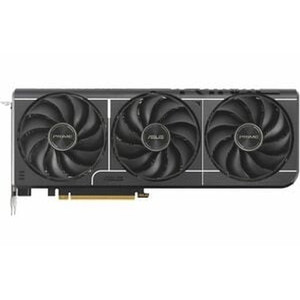
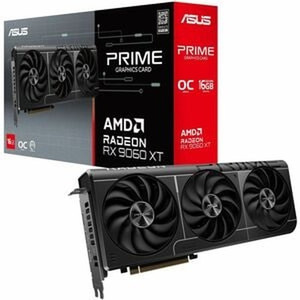
ASUS PRIME-RTX5060TI-O16G GeForce RTX 5060 Ti 16GB GDDR7 OC Graphics Card
The ASUS PRIME-RTX5060TI-O16G puts NVIDIA's GeForce RTX 5060 Ti GPU into a compact 2.5-slot, SFF-ready form factor — making it a viable option for edge AI workstations, compact surveillance decode servers, and small-chassis builds where full-size triple-slot cards simply won't fit. With 16GB of GDDR7 memory across a 128-bit bus, it carries enough frame buffer for demanding multi-stream inference and high-resolution decode workloads without requiring a full workstation-class GPU. Sourced factory-new through distribution — no grey-market, no parallel imports.
Key Features
- 16GB GDDR7 at 28 Gbit/s: GDDR7 at 28 Gbit/s delivers substantially higher memory bandwidth than GDDR6 at comparable bus widths. On a 128-bit bus, that translates to usable throughput for multi-stream AI inference pipelines where memory bandwidth — not raw CUDA count — is the bottleneck. If you're running simultaneous detection models across a high camera count, this headroom matters.
- 4608 CUDA Cores, 2647 MHz OC Boost: The PRIME-RTX5060TI-O16G ships in OC Edition trim, boosting to 2647 MHz versus the reference 2617 MHz. The delta is modest, but it's factory-stable and ships with ASUS's Dual BIOS — letting you drop back to the standard profile for quieter, lower-power operation in rack-adjacent deployments.
- PCIe 5.0 Interface: PCIe 5.0 x16 doubles the theoretical bandwidth of PCIe 4.0. For most GPU workloads today, PCIe 4.0 isn't a bottleneck — but if your workstation platform is PCIe 5.0-capable, you're not leaving bandwidth on the table, and you're not future-constraining the slot if workloads scale.
- 4x Display Output (1x HDMI 2.1b + 3x DisplayPort): Four simultaneous outputs up to 7680×4320 (8K) resolution. For a video wall control station or multi-monitor VMS operator console, this means a single card handles up to four 4K displays — no display splitter, no secondary card, no additional PCIe slot consumed.
- SFF-Ready 2.5-Slot Form Factor: At 15.94 × 9.17 × 3.48 in and 3.27 lb, this card is explicitly SFF-certified. Small-chassis AI workstations and compact edge NVR builds often max out at 2.5–3 slots. A standard triple-slot AIB won't close the case; this one will.
- Axial-Tech Dual-Fan Cooling: ASUS's Axial-tech fan design uses a smaller hub and longer blade sweep to move more air at lower RPM. In sustained-inference workloads — where the GPU runs at high utilization continuously — thermal headroom determines whether boost clocks hold. Fan-stop mode at low loads keeps noise down in operator-adjacent environments.
- Dual BIOS: Two independent BIOS profiles (Performance and Quiet) let you switch operational modes without software. In a 24/7 surveillance or AI workstation context, the Quiet BIOS reduces fan speed and power draw — useful when the workstation lives in an occupied space.
Integration and Compatibility
The PRIME-RTX5060TI-O16G connects via PCIe 5.0, backward-compatible with PCIe 4.0 and PCIe 3.0 slots — so it drops into current-generation Intel and AMD workstation platforms without issue. The PCIe + Ethernet interface notation in the spec sheet indicates the card integrates into platforms where the GPU coexists with onboard NIC resources; confirm your chassis has adequate PCIe slot clearance for a 15.94-inch card length. Display connectivity covers 1× HDMI 2.1b and 3× DisplayPort, supporting up to four concurrent outputs at up to 8K resolution — suitable for multi-display VMS consoles or AI model monitoring dashboards. For GPU workstation builds targeting AI video analytics, verify the host system's PCIe power delivery and chassis airflow align with continuous-load GPU operation. Pair with a compatible DDR5 memory configuration for maximum throughput on inference workloads. Browse the full ASUS product line for complementary compute and networking components. If your deployment targets dedicated network video recorders for high-channel surveillance, evaluate whether a purpose-built NVR appliance or a GPU-accelerated server platform better matches your storage and decode requirements. For guidance on matching GPU resources to camera-count and analytics workloads, see the AI workstation selection guide.
Frequently Asked Questions
Q: What is the PRIME-RTX5060TI-O16G's VRAM capacity and memory type?
A: The PRIME-RTX5060TI-O16G carries 16GB of GDDR7 memory on a 128-bit bus, operating at 28 Gbit/s data transfer rate — providing high bandwidth for AI inference and multi-stream decode workloads.
Q: How many displays can the PRIME-RTX5060TI-O16G drive simultaneously?
A: Up to four displays simultaneously: one HDMI 2.1b port and three DisplayPort outputs, each supporting resolutions up to 7680×4320 (8K).
Q: Will the PRIME-RTX5060TI-O16G fit in a small form factor (SFF) chassis?
A: Yes — ASUS explicitly rates this card as SFF-Ready. It occupies a 2.5-slot profile and measures 15.94 × 9.17 × 3.48 inches. Verify your chassis's card-length clearance (minimum ~16 inches recommended) and slot count before ordering.
Q: What is the PCIe generation of the PRIME-RTX5060TI-O16G?
A: PCIe 5.0. The card is backward-compatible with PCIe 4.0 and PCIe 3.0 motherboard slots, though bandwidth is limited to the slot's native generation when installed in older platforms.
Q: Does the PRIME-RTX5060TI-O16G support CUDA?
A: Yes. The card includes 4608 CUDA cores on the NVIDIA GeForce RTX 5060 Ti GPU, supporting CUDA-based compute workloads including AI inference frameworks compatible with NVIDIA's CUDA platform.
Q: What is the difference between the OC mode and standard mode on the Dual BIOS?
A: The OC BIOS boosts the GPU to 2647 MHz. The standard (Quiet) BIOS runs at the reference 2617 MHz boost with lower fan speeds and reduced power draw — better suited for 24/7 operation in noise-sensitive environments. Switching between profiles requires a physical toggle on the card and a system reboot.
The PRIME-RTX5060TI-O16G is the card I reach for when someone needs RTX 5060 Ti performance inside a constrained chassis. That 2.5-slot, SFF-certified footprint at 15.94 inches long is a genuine differentiator — most RTX 50-series AIBs have crept to triple-slot designs that won't close a compact workstation case. The 16GB GDDR7 frame buffer at 28 Gbit/s on a 128-bit bus is the spec that makes this interesting for AI video analytics: you can hold multiple detection model weights in VRAM simultaneously without spilling to system RAM, which is where inference latency typically collapses.
Technical Highlights:
- GDDR7 at 28 Gbit/s: Higher per-pin bandwidth than GDDR6X at similar bus width — on a 128-bit bus, this closes some of the gap typically filled by wider buses on higher-tier cards. Critical for workloads that are memory-bandwidth-bound, not just CUDA-bound.
- Dual BIOS (OC: 2647 MHz / Quiet: 2617 MHz): The 30 MHz delta between profiles isn't the story — the story is having a factory-supported, hardware-switched quiet mode for deployments where the workstation lives in a server-room-adjacent or operator-room environment. No software required, no driver risk.
- 4× Display Output (HDMI 2.1b + 3× DP): A single card handles a four-display 4K operator console for a VMS deployment. That eliminates the second GPU slot, simplifies driver management, and keeps PCIe lanes free for capture cards or NIC expansion.
Deployment Considerations:
- At 15.94 inches, this card is long for an SFF chassis — confirm physical clearance, not just slot count. Many mini-ITX and mATX SFF cases list a shorter max card length. Measure twice.
- The spec sheet lists PCIe + Ethernet as the interface. This is a GPU, not a GPU-plus-NIC combo card — the Ethernet notation reflects platform integration, not an onboard port. Don't provision it expecting a discrete NIC.
This card is the right call for a compact AI workstation driving a four-monitor VMS console in a control room where rack depth or case size is a hard constraint — not a full-tower workstation build where a larger card would be a better value per CUDA core.