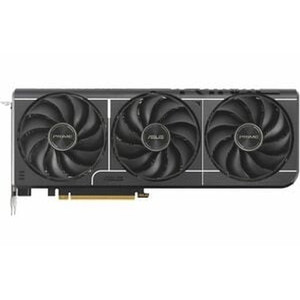
ASUS PRIME-RTX5060TI-O8G SFF-Ready GeForce RTX 5060 Ti 8GB OC Graphics Card
Overview
The ASUS PRIME-RTX5060TI-O8G is a factory-overclocked GeForce RTX 5060 Ti built around NVIDIA's Ada-successor Blackwell architecture, packing 4,608 CUDA cores and 8GB of GDDR7 memory into a 2.5-slot form factor rated SFF-ready — which means it fits compact workstation chassis where a triple-slot card simply won't go. If you're deploying GPU-accelerated GPU computing hardware for AI inference, video analytics, or dense multi-display workstation builds, this card slots in where space is the constraint and performance still has to hold up. Pair it with any professional workstation running a PCIe 5.0 platform and it runs at full bandwidth from day one.
Key Features
- 4,608 CUDA Cores on GeForce RTX 5060 Ti: The RTX 5060 Ti die gives you 4,608 CUDA cores — enough parallel throughput for real-time AI inference workloads, accelerated video transcoding pipelines, and multi-stream decode tasks that would saturate a CPU-only server. This is the compute density that separates a rendering workstation from a basic display card.
- 8GB GDDR7 on a 128-bit Bus: GDDR7 delivers up to 28 GB/s peak memory bandwidth over the 128-bit interface. For a card at this tier, GDDR7 narrows the gap between bus width and throughput compared to GDDR6 designs — the result is better sustained performance on memory-bound workloads like texture-heavy rendering and batch inference.
- OC Mode Boost Clock 2,647 MHz: Factory OC mode pushes the boost clock to 2,647 MHz (versus 2,617 MHz in performance mode and 2,602 MHz base OC frequency), delivered through ASUS's Dual BIOS — switch between OC and standard modes without reflashing. For operators who want deterministic clocks, this means you're not depending on dynamic boost headroom to hit rated throughput.
- PCIe 5.0 Interface: The PCIe 5.0 x16 slot doubles available bandwidth over PCIe 4.0. For GPU-to-CPU data movement in analytics pipelines, that headroom eliminates the bus as a bottleneck — especially relevant when streaming compressed video frames at high frame rates from NVMe-backed storage to the GPU decode engine.
- 4-Display Output — HDMI 2.1b + 3x DisplayPort 2.1: Four simultaneous outputs supporting up to 7,680 × 4,320 (8K) resolution. HDMI 2.1b handles high-refresh AV systems; the three DisplayPort 2.1 heads cover multi-monitor control room layouts or dense analyst workstations with four screens without a hub or daisy-chain. Maximum four displays per card means a single-GPU workstation can drive an entire four-screen SOC wall station.
- 2.5-Slot SFF-Ready Form Factor: At 15.94 × 9.17 × 3.48 in (L × W × H) and 3.27 lb, the PRIME-RTX5060TI-O8G fits compact tower and SFF chassis that can't accommodate standard triple-slot cards. For integrators building compact deployments — edge AI nodes, small-footprint analyst stations — this form factor removes the chassis compatibility barrier without sacrificing the full RTX 5060 Ti compute envelope.
- Axial-Tech Fans with Dual BIOS: ASUS's Axial-tech fan design uses a barrier ring and reverse-rotation outer fan to maximize static pressure across the heatsink fins. Combined with the Dual BIOS (OC vs. standard), you can tune the acoustic-performance trade-off for the deployment environment — quieter standard mode for open-plan offices, OC mode for compute-dense server rooms where fan noise is irrelevant.
- Up to Four Independent Displays at 8K: Maximum resolution of 7,680 × 4,320 means this card can drive a single 8K display at full resolution, or four independent 4K outputs simultaneously — directly relevant to video wall applications, multi-source monitoring stations, and broadcast preview setups.
Integration and Compatibility
The PRIME-RTX5060TI-O8G connects via PCIe 5.0, which is backward-compatible with PCIe 4.0 and 3.0 slots — though bandwidth will be capped at the slot's native generation. The card ships with one HDMI 2.1b and three DisplayPort 2.1 outputs, covering the full range of modern professional monitors and AV receivers without adapters in most deployments. CUDA support means compatibility with the NVIDIA CUDA ecosystem: NVENC/NVDEC hardware encode/decode pipelines, TensorRT inference acceleration, and any video management software with GPU-accelerated analytics such as deep learning-based object detection. The SFF-ready designation means verified clearance for compact chassis; verify your specific chassis's GPU length limit against the 15.94-inch card length before ordering. For NVR and server builds requiring GPU decode offload, confirm your platform's PCIe slot physical length and power connector availability before specifying this card.
Frequently Asked Questions
Q: What is the boost clock speed of the PRIME-RTX5060TI-O8G in OC mode?
A: In OC mode, the boost clock reaches 2,647 MHz. In standard performance mode the boost clock is 2,617 MHz. The Dual BIOS lets you switch between modes without software reflashing.
Q: How many displays can the PRIME-RTX5060TI-O8G drive simultaneously?
A: Up to four displays simultaneously — one via HDMI 2.1b and three via DisplayPort 2.1. Maximum output resolution is 7,680 × 4,320 (8K).
Q: Is the PRIME-RTX5060TI-O8G compatible with PCIe 4.0 motherboards?
A: Yes. PCIe 5.0 is backward-compatible with PCIe 4.0 and PCIe 3.0 slots. Bandwidth will be limited to the slot's native generation, but the card will operate normally.
Q: What memory type and bandwidth does this card use?
A: The card uses 8GB of GDDR7 memory on a 128-bit bus, delivering up to 28 GB/s of memory bandwidth. GDDR7 provides higher throughput per pin compared to GDDR6, which benefits memory-bound workloads.
Q: Does the PRIME-RTX5060TI-O8G fit in a small form factor chassis?
A: It is rated SFF-ready at a 2.5-slot profile. Physical dimensions are 15.94 × 9.17 × 3.48 inches (L × W × H) and it weighs 3.27 lb. Verify your chassis GPU length clearance (minimum ~16 inches) before installing.
Q: Does this card support CUDA for AI or analytics workloads?
A: Yes. The RTX 5060 Ti includes 4,608 CUDA cores and full CUDA support, enabling hardware-accelerated AI inference, video transcoding (NVENC/NVDEC), and GPU-based analytics pipelines compatible with NVIDIA's CUDA ecosystem.
The PRIME-RTX5060TI-O8G is one of the more practically sized RTX 5060 Ti options I've seen spec'd for compact AI-inference and multi-display workstation deployments. At 2.5 slots and 15.94 inches long, it clears most SFF tower chassis where a standard triple-slot would physically not seat — that's a real deployment differentiator, not a marketing label. The 4,608 CUDA cores and GDDR7 memory are the compute engine; the form factor is what makes it installable in the environments where those cores actually get used.
Technical Highlights:
- GDDR7 at 28 GB/s: On a 128-bit bus, GDDR7 sustains higher bandwidth than GDDR6 designs at the same bus width — directly reduces latency on memory-bound inference and batch-decode tasks.
- OC Mode 2,647 MHz Boost: The Dual BIOS locks in OC mode independent of driver boost algorithms — you get a deterministic clock ceiling useful when benchmarking or sizing GPU capacity for a fixed workload throughput target.
- Four-Head Output (HDMI 2.1b + 3× DP 2.1): Driving four independent 4K displays from a single card without a hub is directly applicable to four-screen analyst workstations and SOC monitoring layouts — no MST daisy-chain complexity.
Deployment Considerations:
- At 15.94 inches card length, confirm your chassis's GPU clearance spec before ordering — some SFF cases rated for 'full-length' cards top out at 310mm (~12.2 in), which this card exceeds.
- The 28 GB/s bandwidth ceiling on the 128-bit bus will constrain workloads that require high-resolution texture streaming or large-batch model inference — for those use cases, a wider-bus card in the same GPU family is the better spec.
Best fit: compact four-screen analyst workstations, edge AI inference nodes in space-constrained rack bays, and multi-display control room builds where chassis depth rules out a wider card.