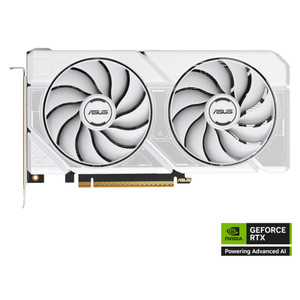
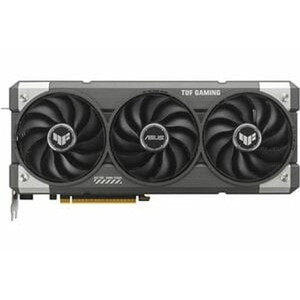
ASUS DUAL-RTX5060-O8G Dual GeForce RTX 5060 8GB GDDR7 OC Edition Graphics Card
Overview
The ASUS DUAL-RTX5060-O8G is a factory-overclocked GeForce RTX 5060 graphics card built around NVIDIA's Blackwell architecture. With 3840 CUDA cores, 8GB of GDDR7 memory on a 128-bit bus, and a PCIe 5.0 x16 interface, it targets workstation deployments, AI-inferencing edge nodes, and multi-display surveillance operator consoles where compute throughput and display density both matter. At 14.49 × 8.68 × 2.68 inches and 2.44 lb, the DUAL-RTX5060-O8G (often searched as DUAL RTX5060 O8G) fits standard full-height ATX and E-ATX chassis without major clearance concerns.
Key Features
- 3840 CUDA Cores on Blackwell Architecture: NVIDIA's current-generation Blackwell GPU delivers substantially higher parallel throughput than prior Ada Lovelace generation cards at this memory tier — relevant for AI inference workloads, video analytics acceleration, and real-time transcoding on a surveillance server or edge node.
- 8GB GDDR7 at 28 Gbit/s on a 128-bit Bus: GDDR7 doubles effective bandwidth efficiency versus GDDR6 at equivalent bus widths. At 28 Gbit/s per pin, the 128-bit interface delivers approximately 224 GB/s of memory bandwidth — enough headroom for multi-stream 4K decode or concurrent AI analytics pipelines without constant VRAM thrashing.
- OC Mode Boost Clock of 2565 MHz: The factory overclock pushes the GPU 30 MHz above ASUS's own Gaming Mode (2535 MHz). For inference or rendering workloads measured in throughput-per-second, that headroom is pre-validated and thermally characterized by ASUS at the factory — no end-user tuning required.
- PCIe 5.0 x16 Interface: Gen 5 doubles peak slot bandwidth versus PCIe 4.0 (up to 128 GB/s bidirectional). For current GPU workloads the card won't saturate even PCIe 4.0, but PCIe 5.0 compatibility ensures it drops into next-generation server and workstation platforms without a bandwidth bottleneck as data pipelines scale.
- DLSS 4 Support: NVIDIA's fourth-generation Deep Learning Super Sampling enables AI-based upscaling and frame generation — directly relevant in AI-accelerated visualization workflows, operator console rendering, and any application leaning on NVIDIA's RTX stack for real-time output quality improvements without proportional compute cost increases.
- Four-Display Output — 1× HDMI 2.1b + 3× DisplayPort 2.1b: All four outputs support up to 7680 × 4320 (8K) resolution. For a security operations center or multi-screen command console, this means a single card can drive four independent 4K monitors at full resolution simultaneously, eliminating the need for a second GPU in most operator workstation builds.
- HDMI 2.1b and DisplayPort 2.1b: Both connector standards support Display Stream Compression and high refresh rates at 4K and above. DisplayPort 2.1b's 80 Gbps bandwidth ceiling handles 4K @ 240Hz or 8K @ 60Hz — future-proofing display infrastructure against monitor refreshes over a standard hardware lifecycle.
- 2.5-Slot Axial-Tech Fan Design with 0dB Technology: The 2.5-slot footprint uses ASUS's Axial-Tech fan design — blades angled for higher static pressure through the heatsink fin stack. The 0dB mode spins fans down completely under light or idle loads, reducing acoustic output in operator room or office deployments where ambient noise matters.
- Dimensions: 14.49 × 8.68 × 2.68 in / Weight: 2.44 lb: At just over 14 inches long, verify chassis GPU clearance before ordering — particularly in short-depth rack workstations or small-form-factor enclosures. The 2.68-inch height confirms the 2.5-slot profile, so adjacent PCIe slots remain usable for a capture card, NIC, or additional I/O in a surveillance server build.
Integration and Compatibility
The DUAL-RTX5060-O8G connects via PCIe 5.0 x16 and is backward compatible with PCIe 4.0 and 3.0 motherboards at reduced bandwidth — confirmed non-issue for this GPU's actual throughput demands. The card exposes both an Ethernet interface and the standard PCIe bus per the distribution data, suggesting platform-level connectivity flexibility. For security and surveillance deployments, the RTX 5060's NVDEC/NVENC hardware codec engines (NVIDIA standard on Blackwell) support hardware-accelerated H.265 and H.264 decode, offloading stream processing from the host CPU in multi-camera NVR or video analytics server builds. Pair this card with an NVR or analytics server targeting AI-based motion detection, license plate recognition, or crowd analytics to leverage the CUDA core count. For broader context, explore the full ASUS hardware catalog or review our graphics cards category for alternative configurations. If you are speccing a complete analytics workstation, our workstation components section covers compatible platforms. Buyers evaluating GPU-accelerated AI inference should also consult our AI compute hardware guide for platform pairing context.
Frequently Asked Questions
Q: What is the boost clock speed on the DUAL-RTX5060-O8G in OC mode versus Gaming mode?
A: In OC mode the DUAL-RTX5060-O8G boosts to 2565 MHz. In Gaming mode it runs at 2535 MHz. Both are factory-set and pre-validated — no manual overclocking is required to reach these clocks.
Q: How many monitors can the DUAL-RTX5060-O8G drive simultaneously, and at what resolutions?
A: The card supports up to four displays simultaneously via its 1× HDMI 2.1b and 3× DisplayPort 2.1b outputs. Maximum resolution per output is 7680 × 4320 (8K), making it suitable for high-density 4K operator console builds.
Q: Is the DUAL-RTX5060-O8G compatible with PCIe 4.0 motherboards?
A: Yes. PCIe 5.0 is backward compatible with PCIe 4.0 and PCIe 3.0 slots. The card will operate at the host slot's maximum supported bandwidth — bandwidth reduction at PCIe 4.0 does not create a practical bottleneck at this GPU performance tier.
Q: What memory type and bandwidth does the DUAL-RTX5060-O8G use?
A: The card uses 8GB of GDDR7 memory on a 128-bit bus at 28 Gbit/s per pin. This delivers approximately 224 GB/s of memory bandwidth — meaningful for multi-stream 4K video decode, AI inference, and compute workloads that stress VRAM throughput.
Q: Does the DUAL-RTX5060-O8G support DLSS 4?
A: Yes. As a Blackwell-generation RTX card, the DUAL-RTX5060-O8G supports DLSS 4, which includes AI-based upscaling and frame generation for compatible applications and workflows.
Q: What are the physical dimensions and how many PCIe slots does the DUAL-RTX5060-O8G occupy?
A: The card measures 14.49 × 8.68 × 2.68 inches (L × W × H) and weighs 2.44 lb. It occupies 2.5 PCIe slots. Verify GPU clearance in your chassis before ordering, particularly in short-depth rack workstations.
The DUAL-RTX5060-O8G is one of the more interesting GPU options I've seen land in the commercial compute space recently. The combination of 3840 CUDA cores, GDDR7 memory at 28 Gbit/s, and a factory-validated 2565 MHz OC boost clock puts it meaningfully ahead of prior-generation parts in raw parallel throughput per dollar — and that matters when you're running AI-based video analytics or multi-stream transcoding at the edge rather than discrete cloud inference.
Technical Highlights:
- GDDR7 at 28 Gbit/s: On a 128-bit bus that translates to roughly 224 GB/s — substantially higher effective bandwidth than GDDR6X parts at the same bus width. For concurrent inference pipelines or 4K multi-stream decode, this headroom keeps VRAM from being the bottleneck before compute is.
- Four Outputs via HDMI 2.1b + DisplayPort 2.1b: All four ports top out at 7680 × 4320. In a security operations center driving four independent 4K monitors, this card handles the full console from a single slot — no secondary GPU, no display adapter daisy-chaining required.
- 2.5-Slot Axial-Tech Cooling with 0dB Idle: The 0dB fan-stop mode is genuinely useful in operator rooms and office-adjacent deployments where acoustic noise is a facility constraint. Under compute or decode load the fans spin up; at idle or light GUI work they stop entirely.
Deployment Considerations:
- At 14.49 inches long, measure your chassis GPU bay before ordering — particularly in 2U rack workstations or compact ATX builds where clearance to front-panel connectors or drive cages is tight.
- The 2.5-slot width consumes the adjacent PCIe slot mechanically even if it doesn't electrically claim it — confirm your motherboard layout leaves enough spacing for a capture card or 10GbE NIC in the next slot if your build needs both.
For an AI-accelerated video analytics server — the kind driving 16–32 camera streams through a deep learning motion or LPR engine — the DUAL-RTX5060-O8G sits at a practical sweet spot: enough VRAM and CUDA throughput to handle production analytics loads, PCIe 5.0 for forward platform compatibility, and a factory OC that removes the guesswork from performance tuning.