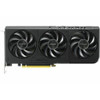
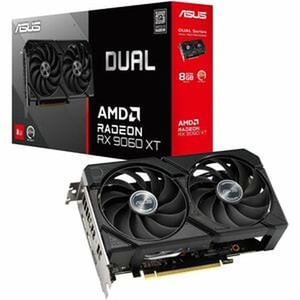
ASUS PRIME-RTX5060-8G GeForce RTX 5060 8GB GDDR7 Graphics Card
Overview
The ASUS PRIME-RTX5060-8G is a 2.5-slot, SFF-ready discrete graphics card built around NVIDIA's GeForce RTX 5060 GPU with 3,840 CUDA cores and 8GB of GDDR7 memory on a 128-bit bus. Running at a 2,497 MHz boost clock (2,527 MHz in OC mode), it delivers a meaningful step up in compute throughput over prior-generation mid-range cards — relevant for video analytics inference workloads, AI-assisted VMS edge processing, and workstation rendering tasks where you need Blackwell-architecture performance without a full workstation card budget. At 15.94 × 9.17 × 3.48 in and 3.12 lb, the PRIME-RTX5060-8G fits SFF chassis that would reject a 3-slot card, making it a practical choice for rack-adjacent or space-constrained deployments.
Key Features
- 3,840 CUDA Cores at 2,497 MHz Boost: The RTX 5060's Blackwell-generation shader count at this clock drives real-time inference and compute tasks faster than prior Ampere/Ada mid-range cards at comparable price points. The 2,527 MHz OC mode (selectable via Dual BIOS) is available when thermals and chassis airflow permit without voiding standard operation.
- 8GB GDDR7 on a 128-bit Bus at 28 Gbit/s: GDDR7 at 28 Gbit/s delivers approximately 448 GB/s of memory bandwidth on this 128-bit interface — roughly 40% more than GDDR6X at the same bus width. For inference batches, multi-stream video decode, or simultaneous display output at 8K, that bandwidth headroom prevents the memory bottleneck that limits GDDR6 cards on sustained workloads.
- PCIe 5.0 Interface: The x16 PCIe 5.0 slot doubles the host-to-GPU transfer bandwidth compared to PCIe 4.0, reducing latency on large frame buffer uploads. Backward compatible with PCIe 4.0 and 3.0 motherboards — the card will operate in older platforms, just capped at that slot's bandwidth.
- Four Simultaneous Displays (1× HDMI 2.1b + 3× DisplayPort 2.1): HDMI 2.1b supports 4K/120Hz and 8K/60Hz to a single display; the three DisplayPort 2.1 outputs each handle up to 7680 × 4320 at 60Hz. Running four 4K monitors simultaneously from a single card is practical here — no need for a secondary GPU in multi-screen operator workstations or video wall controllers.
- 2.5-Slot SFF-Ready Form Factor: At 2.5 slots wide rather than the 3-slot or 3.5-slot profiles common on higher-TDP cards, the PRIME-RTX5060-8G fits a broader range of chassis — including SFF-certified cases and 4U rackmount workstations with tight expansion clearances. Verify your chassis has the PCIe slot spacing and CPU cooler clearance before ordering.
- Dual BIOS: Two on-board BIOS chips let you switch between Performance (OC) mode at 2,527 MHz and standard mode at 2,497 MHz via a physical switch, without software. If a BIOS update causes instability, reverting to the backup chip takes seconds — a useful safeguard in production workstation environments where downtime for flashing recovery is disruptive.
- Axial-Tech Fan Design: ASUS Axial-Tech fans use a smaller hub with longer blades and a barrier ring to increase airflow volume compared to standard fan designs. Under sustained compute loads — video analytics inference running 24/7, for example — better airflow directly translates to lower sustained GPU temperatures and more consistent boost clock maintenance.
- Maximum Resolution 7680 × 4320 (8K): Relevant for digital signage controllers, high-resolution video wall segments, and pre-production review workstations where native 8K output is required without a separate capture or scaling device.
Integration and Compatibility
The PRIME-RTX5060-8G connects via PCIe 5.0 (backward compatible to PCIe 3.0) and exposes a standard x16 edge connector, fitting any full-length PCIe slot on a current-generation workstation or server board. The Ethernet interface noted in the distribution data is the standard NVIDIA framelock/sync header present on RTX-class cards for multi-GPU synchronization in visualization environments — verify your chassis and system integrator documentation before relying on this for networked sync.
For graphics cards deployed in physical security or video analytics contexts, the RTX 5060's Blackwell NVENC encoder handles multi-stream H.264/H.265 encode offload, freeing CPU cycles on NVR servers running software-based video management. Pairing this card with a network video recorder host platform running a CUDA-aware VMS (Milestone XProtect, Genetec Security Center with GPU acceleration enabled, or similar) puts AI-driven object detection and metadata extraction on the GPU rather than the CPU — a meaningful operational difference at 16+ camera channel counts.
If your application is a workstation build for forensic video review or video wall control, the four-output capability means a single card drives a quad-monitor operator console without daisy-chaining or secondary display adapters. Review the GPU selection guide for display count, resolution, and compute workload matching before specifying this or an adjacent model. The 3.12 lb weight and 15.94 in length require a chassis with adequate card support — use a GPU support bracket in any horizontal mid-tower or rackmount deployment to prevent PCIe slot stress over time.
Frequently Asked Questions
Q: What PCIe slot does the ASUS PRIME-RTX5060-8G require, and is it backward compatible with PCIe 4.0 motherboards?
A: The card uses a PCIe 5.0 x16 interface. It is backward compatible with PCIe 4.0 and PCIe 3.0 x16 slots — it will operate in older platforms, but bandwidth is capped at the host slot's generation. For full PCIe 5.0 throughput, a PCIe 5.0-capable motherboard is required.
Q: How many monitors can the PRIME-RTX5060-8G drive simultaneously?
A: Up to four displays simultaneously — one via HDMI 2.1b and three via DisplayPort 2.1. Maximum single-display resolution is 7680 × 4320 (8K) on any output.
Q: What is the difference between the standard and OC BIOS modes on the PRIME-RTX5060-8G?
A: The Dual BIOS switch selects between standard mode (2,497 MHz boost clock) and OC (Performance) mode (2,527 MHz boost clock). Switch selection is physical, not software-dependent. The backup BIOS also functions as a recovery chip if a firmware update causes an issue.
Q: Is the PRIME-RTX5060-8G compatible with SFF (Small Form Factor) cases?
A: Yes. The card carries SFF-Ready certification and occupies 2.5 slots (3.48 in height). At 15.94 in length and 3.12 lb, confirm your specific chassis's maximum card length and slot pitch before installation.
Q: What memory type and bandwidth does this card provide?
A: 8GB GDDR7 on a 128-bit bus running at 28 Gbit/s, yielding approximately 448 GB/s of memory bandwidth. This is substantially higher than GDDR6 at the same bus width, benefiting sustained inference and multi-stream video processing workloads.
The PRIME-RTX5060-8G lands in an interesting spot for integrators speccing out AI-assisted VMS servers or operator workstations: 3,840 Blackwell CUDA cores at 2,497 MHz boost with 8GB GDDR7 at 28 Gbit/s gives you real inference headroom without the card footprint or power draw of the RTX 5070 tier. The 2.5-slot SFF-Ready profile is the specific reason I'd reach for this over a standard 3-slot card when the chassis is a 4U rackmount workstation with tight bay spacing.
Technical Highlights:
- GDDR7 Memory at 28 Gbit/s: ~448 GB/s on a 128-bit bus. That bandwidth is sufficient for simultaneous multi-stream NVENC offload and real-time object detection inference on 16–24 camera channels — you won't hit a memory wall the way GDDR6 cards choke on sustained batch inference.
- Dual BIOS with Physical Switch: Standard at 2,497 MHz, OC at 2,527 MHz, switchable without software. In a production server environment, having a backup BIOS chip means a failed flash doesn't brick the card — recovery is a switch toggle and a reboot, not an RMA.
- Four-Output Display Stack (HDMI 2.1b + 3× DP 2.1): Drives a quad-4K operator console from a single card with no daisy-chain adapters. Relevant on forensic review workstations or video wall segment controllers where the display count per GPU matters for rack density.
Deployment Considerations:
- At 15.94 in length and 3.12 lb, verify chassis card-length clearance and use a GPU support bracket in any horizontal deployment — PCIe slot stress from unsupported card weight is a real long-term reliability concern in always-on server environments.
- The card's PCIe 5.0 interface delivers full bandwidth only on a PCIe 5.0 motherboard. In PCIe 4.0 or 3.0 systems it will operate, but throughput for large model inference or high-frame-rate multi-stream decode may be partially constrained by host bus bandwidth rather than GPU compute.
The PRIME-RTX5060-8G is the right specification for a compact analytics workstation or 4U rackmount VMS server where slot count is limited, a 3-slot card physically won't fit, and you need genuine Blackwell-generation inference performance rather than settling for a prior-gen card in a slim form factor.