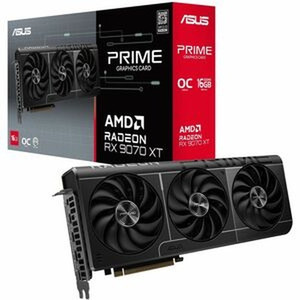
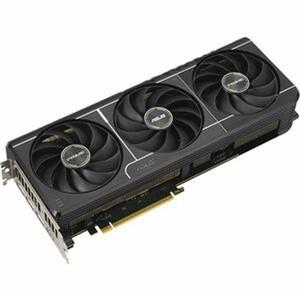
ASUS PRIME-RTX5070TI-16G GeForce RTX 5070 Ti 16GB GDDR7 Graphics Card
Overview
The ASUS PRIME-RTX5070TI-16G puts NVIDIA's GeForce RTX 5070 Ti GPU into a 2.5-slot, SFF-ready package that fits compact workstation builds without sacrificing the full 16GB GDDR7 memory configuration. If you're specifying AI inference workstations, GPU-accelerated video analytics servers, or dense compute nodes where chassis space is a real constraint, this card threads the needle between workstation-class performance and physical footprint. The PCIe 5.0 x16 interface ensures you're not leaving bandwidth on the table when paired with a current-generation platform.
Key Features
- 16GB GDDR7 on a 256-bit bus at 28 Gbit/s: The wider bus combined with GDDR7's higher data rate delivers substantially more memory bandwidth than GDDR6X configurations at the same capacity — relevant when loading large inference models or processing multiple high-resolution video streams simultaneously without constant VRAM swapping.
- 8,960 CUDA cores: A large parallel compute array means this card handles batch inference, transcoding, and simultaneous multi-stream analytics without queuing stalls. For GPU-accelerated VMS or AI workloads, core count directly correlates to concurrent job throughput.
- PCIe 5.0 interface: Doubles the host-to-GPU bandwidth ceiling versus PCIe 4.0, keeping the interconnect from becoming the bottleneck in data-intensive pipelines — particularly useful in NVR appliances or edge AI servers processing multiple 4K feeds.
- SFF-ready 2.5-slot form factor (16.00 x 9.60 x 3.80 in): PRIME-RTX5070TI-16G (often searched as PRIME RTX5070TI 16G) is explicitly rated for small form factor chassis, expanding deployment options in rack-dense or space-constrained environments where a standard 3-slot card simply won't fit.
- Four simultaneous display outputs — 1x HDMI 2.1b + 3x DisplayPort 2.1b: Drive up to four 8K monitors or a mixed array of 4K/8K displays from a single card. HDMI 2.1b and DisplayPort 2.1b both support up to 7680×4320 resolution at high refresh rates — the full 4-display array at 4K is practical for multi-screen control room or video wall deployments.
- Axial-tech fans with Dual BIOS: The Dual BIOS switch lets you select between performance and quiet operating profiles without reflashing firmware — useful in shared office environments where fan noise matters, or in always-on server rooms where you want to maximize cooling without manual intervention.
- VR-ready certification: Meets the hardware requirements for full VR workloads, which matters for simulation, training, and visualization applications beyond standard display output.
- OpenGL 4.6 support: Maintains compatibility with legacy visualization software and industrial applications that have not yet migrated to Vulkan or DirectX 12 — important in CAD, simulation, and certain VMS client environments.
Integration & Compatibility
The PRIME-RTX5070TI-16G connects via PCIe 5.0, so it requires a host platform with a PCIe 5.0 x16 slot for full bandwidth — PCIe 4.0 motherboards will accept the card electrically but cap the interconnect at Gen 4 speeds. The card also exposes an Ethernet interface alongside the PCIe bus, which may be leveraged for management or direct NIC functionality depending on platform configuration; verify with your system integrator if this is a deployment requirement.
With four display outputs across HDMI 2.1b and DisplayPort 2.1b, the card integrates directly into discrete graphics card workflows that demand multi-monitor output at 4K or 8K. For AI compute workstations and GPU-accelerated edge servers, the 8,960 CUDA cores and 16GB GDDR7 frame rate handle parallel inference pipelines from network video recorders and video analytics platforms. Consult your GPU selection guide to match VRAM requirements against your inference model sizes before committing to this SKU. If your chassis supports it, pairing with a high-airflow workstation cooling solution will help sustain boost clocks under sustained GPU compute loads at the card's 4.05 lb operating weight.
Frequently Asked Questions
Q: Will the PRIME-RTX5070TI-16G fit in a standard small form factor (SFF) chassis?
A: Yes. ASUS explicitly rates this card as SFF-ready. Its 2.5-slot, 16.00 x 9.60 x 3.80 inch footprint is designed to fit compact chassis, but always verify your case's maximum GPU length and slot clearance before ordering.
Q: Does the PRIME-RTX5070TI-16G require a PCIe 5.0 motherboard?
A: The card uses a PCIe 5.0 interface. It will physically seat in PCIe 4.0 slots via backward compatibility, but the interconnect will operate at Gen 4 bandwidth. For full Gen 5 throughput, a PCIe 5.0 x16 slot is required.
Q: How many monitors can I connect to the PRIME-RTX5070TI-16G?
A: Up to four displays simultaneously — one via HDMI 2.1b and three via DisplayPort 2.1b. Maximum supported resolution is 7680 x 4320 (8K) per output.
Q: How much does the PRIME-RTX5070TI-16G weigh, and what are its dimensions?
A: The card weighs 4.05 lb and measures 16.00 x 9.60 x 3.80 inches (L x W x H). Account for this weight when evaluating riser card or vertical GPU mount configurations.
Q: Is the PRIME-RTX5070TI-16G suitable for AI inference or GPU-accelerated video analytics?
A: The 8,960 CUDA cores and 16GB of GDDR7 VRAM on a 256-bit bus make it a capable choice for GPU-accelerated inference workloads. Validate that your inference framework (e.g., TensorRT, CUDA-based VMS analytics engines) supports the RTX 5070 Ti architecture before deployment.
Q: Does the PRIME-RTX5070TI-16G support VR?
A: Yes, it is VR-ready per the published specifications, meeting the hardware requirements for VR workloads including simulation, training, and immersive visualization applications.
The PRIME-RTX5070TI-16G is one of the more practical SFF-ready RTX 5070 Ti options I've specced for dense compute builds — the 2.5-slot profile is the headline, but the 256-bit GDDR7 bus running at 28 Gbit/s is what actually changes the math on multi-stream inference throughput compared to narrower-bus alternatives at the same VRAM capacity.
Technical Highlights:
- 16GB GDDR7 / 256-bit / 28 Gbit/s: The combination of wide bus and high data rate gives this card real headroom for large model inference — you're not artificially throttled by a 128-bit bus at the same VRAM count.
- 8,960 CUDA cores: Enough parallel compute to handle simultaneous inference jobs without serializing queues; relevant in any multi-stream GPU analytics pipeline where job latency compounds across feeds.
- SFF form factor at 4.05 lb: At 16 inches long and 2.5 slots wide, it clears most SFF chassis specs, but the 4.05 lb weight is worth flagging if you're running a vertical GPU riser — check your riser's rated load before mounting.
Deployment Considerations:
- PCIe 5.0 is the intended interface — if your target server platform is still on Gen 4, you'll get the card working but won't realize the full interconnect bandwidth, which matters most in sustained high-throughput inference or real-time video transcode pipelines.
- The Dual BIOS switch is a physical toggle; document its position at deployment time so field technicians don't inadvertently flip it during maintenance — mode changes affect fan curves and power targets.
For GPU-accelerated edge AI appliances in surveillance operations centers — where chassis depth is limited, multiple 4K feeds need simultaneous processing, and the system runs 24/7 — the PRIME-RTX5070TI-16G's SFF profile and GDDR7 bandwidth make it a logical fit over a full 3-slot card that may not physically install.