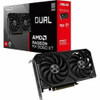
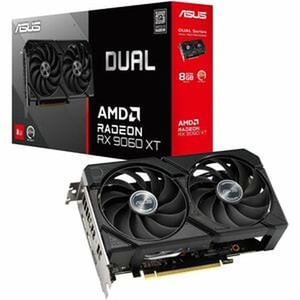
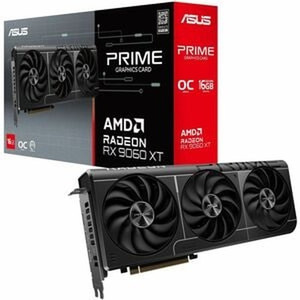
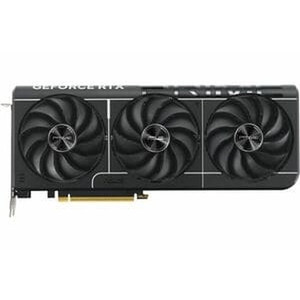
ASUS DUAL-RX9060XT-16G Radeon RX 9060 XT 16GB GDDR6 Graphics Card
The ASUS DUAL-RX9060XT-16G pairs AMD's Radeon RX 9060 XT GPU with a 16GB GDDR6 frame buffer on a PCIe 5.0 interface — a combination that gives workstation integrators, video wall architects, and AI-inference engineers a high-bandwidth, multi-display-capable card without stepping up to full workstation-class pricing. If your deployment needs three simultaneous 8K-capable outputs, substantial VRAM for inference workloads, or a modern PCIe 5.0 slot to future-proof a new server chassis, this card covers the spec sheet.
Key Features
- 16GB GDDR6 on a 128-bit Bus at 20 Gbit/s: 16GB of on-board GDDR6 running at 20 Gbit/s keeps large texture sets, multi-stream decode buffers, and inference model weights resident on-card — reducing system RAM pressure and avoiding the PCIe bus bottleneck that plagues smaller-VRAM cards when handling concurrent 4K or 8K video streams. The 128-bit bus delivers 320 GB/s of theoretical bandwidth, sufficient for most multi-display and decode-heavy workloads.
- PCIe 5.0 Interface: Slots into any PCIe 5.0 x16 slot and remains backward-compatible with PCIe 4.0 and 3.0 hosts. On a PCIe 5.0 platform this doubles the available lane bandwidth versus PCIe 4.0 — relevant when the card is doing heavy back-and-forth with system memory during inference or real-time transcoding pipelines. Install this in a current-gen AMD or Intel platform and you won't be leaving bandwidth on the table.
- Radeon RX 9060 XT — 2048 Stream Processors: The AMD RDNA architecture underneath delivers 2048 stream processors with a boost clock of 3230 MHz in standard mode and 3250 MHz in OC mode. Gaming mode runs at a more conservative 2640 MHz for thermally constrained enclosures. For compute-adjacent workloads (transcoding acceleration, display rendering in digital signage, OpenCL-based analytics offload), the 3230 MHz boost clock provides meaningful headroom.
- Triple-Display Output — Up to 7680×4320: Two DisplayPort 2.1a outputs and one HDMI 2.1b port support up to three simultaneous displays, each capable of driving 8K (7680×4320) resolution. For video wall deployments, command centers, or multi-monitor operator stations, this means a single card can cover a three-screen 4K array without a second GPU or a splitter box adding latency and complexity.
- HDMI 2.1b and DisplayPort 2.1a: HDMI 2.1b supports the latest consumer and commercial panel specs — useful when integrating with large-format displays in control rooms or briefing environments. DisplayPort 2.1a's increased bandwidth ceiling handles high-refresh 4K and native 8K without compression artifacts that affect older DP 1.4 connections.
- 2.5-Slot Dual-Fan Axial-Tech Cooling with 0dB Technology: The dual Axial-Tech fans and 2.5-slot cooler keep thermals managed without requiring a 3-slot sacrifice. The 0dB mode stops the fans entirely under light load — an advantage in open-office operator stations or low-noise server rooms where fan noise is a concern. Under full load the fans spin up; under idle or light display output they cut off.
- OC Mode at 3250 MHz: The factory OC mode adds 20 MHz over standard boost (3250 vs. 3230 MHz) — a minor delta that won't transform workloads but confirms the card ships already validated above AMD's reference clock, meaning you're not leaving frequency on the table without manual tuning.
- Physical Footprint — 14.50 × 8.54 × 2.60 in, 2.30 lb: At 14.5 inches long this is a full-length card — verify clearance in short-depth chassis before specifying. The 2.60-inch height fits a 2.5-slot profile, preserving the adjacent slot for an NVMe or capture card. At 2.30 lb it won't stress standard PCIe slot retention brackets.
Integration and Compatibility
The DUAL-RX9060XT-16G (often searched as DUAL RX9060XT 16G) installs in any system with a PCIe 5.0 or PCIe 4.0/3.0 x16 slot and adequate chassis clearance for a 14.50-inch card. Parallel processing via CUDA is not supported — this is an AMD GPU; OpenCL and AMD's compute stack are the relevant APIs for offload workloads. For AI-inference workflows using AMD ROCm, verify your software stack's ROCm compatibility with the RDNA architecture generation before specifying. Three display outputs are supported simultaneously; exceeding three requires a second card. The card ships from CN and carries a standard UNSPSC code of 43201401 (graphics accelerators/display adapters).
For graphics cards and display adapters, slot compatibility and chassis depth are the first two checks. Pair with a modern workstation board carrying PCIe 5.0 for full lane bandwidth, or drop into a PCIe 4.0 system with the understanding that bandwidth is halved at the slot level — still adequate for most display and light-compute tasks. If you're building a dedicated workstation or rendering node, also verify PSU rail capacity for the card's power requirements before finalizing the BOM.
Frequently Asked Questions
Q: Does the ASUS DUAL-RX9060XT-16G support CUDA for AI or compute workloads?
A: No. CUDA is an NVIDIA-proprietary technology and is not supported on this AMD Radeon card. For AMD GPU compute, the relevant stack is OpenCL or AMD ROCm, depending on your software framework.
Q: How many monitors can I connect to the DUAL-RX9060XT-16G simultaneously?
A: Up to three displays simultaneously — two via DisplayPort 2.1a and one via HDMI 2.1b. Maximum output resolution per display is 7680×4320 (8K).
Q: Is the DUAL-RX9060XT-16G compatible with PCIe 4.0 motherboards?
A: Yes. PCIe 5.0 is backward-compatible with PCIe 4.0 and 3.0 slots. You lose some peak lane bandwidth running on an older generation slot, but the card will install and operate normally.
Q: What is the physical length of this graphics card?
A: 14.50 inches (approximately 368mm). This is a full-length card — measure your chassis internal clearance from the PCIe slot bracket to the nearest obstruction before ordering.
Q: Does the 0dB fan mode mean the card runs passively at all times?
A: No. The 0dB technology stops the Axial-Tech fans under low-load and idle conditions. Under sustained GPU load the fans engage and spin at speeds appropriate to the thermal demand. It is not a fully passive cooler.
Q: How much does this card weigh, and will it stress a standard PCIe slot?
A: The card weighs 2.30 lb (approximately 1.04 kg). This is within normal range for a dual-fan mid-to-high-end GPU. Standard PCIe slot retention is rated for cards in this weight class; a GPU support bracket is still a best practice in vibration-prone rack environments.
The DUAL-RX9060XT-16G is an interesting spec at this tier: 16GB GDDR6 at 20 Gbit/s on a 128-bit bus is a larger memory endowment than you'd typically see in this GPU class, and it's what makes this card worth considering for workloads beyond pure display output. For multi-stream surveillance decode workstations — where you're running 32+ channel decode in a VMS client while simultaneously rendering a video wall — that 16GB headroom keeps the GPU from paging frames out to system RAM mid-session.
Technical Highlights:
- 16GB GDDR6 / 20 Gbit/s: At 320 GB/s theoretical bandwidth, the card doesn't bottleneck on large frame buffers. Relevant for simultaneous 4K decode across multiple streams or loading large AI-inference model weights directly on-card.
- 3230 MHz Boost Clock (3250 MHz OC mode): The 2048 RDNA stream processors running at 3230 MHz deliver solid throughput for OpenCL-accelerated workloads. The OC mode 3250 MHz is a validated factory overclock — not a manual push — so it carries the same reliability expectations as standard boost.
- Dual DisplayPort 2.1a + HDMI 2.1b — Three Simultaneous 8K Outputs: A single card can drive a three-display 4K operator station or a mixed 4K/8K command center layout without a second GPU. DisplayPort 2.1a's higher bandwidth ceiling handles high-refresh 4K without compression, unlike DP 1.4 daisy-chain setups.
Deployment Considerations:
- At 14.50 inches long, this card will not fit short-depth workstation chassis. Measure before spec — most rack-mount workstations with 300mm depth clearance will be tight or incompatible. Full-tower and mid-tower ATX cases typically clear 14.5 inches without issue.
- CUDA is explicitly not supported. If your VMS, analytics engine, or AI inference pipeline has a hard CUDA dependency (common in NVIDIA-optimized frameworks), this card is the wrong choice regardless of VRAM size — spec an NVIDIA equivalent instead.
For an operator station in a physical security operations center running a multi-monitor VMS layout with 16–32 camera streams, the DUAL-RX9060XT-16G's 16GB buffer and three-output capability make it a practical fit — provided the software stack supports AMD GPU acceleration and the chassis has the clearance for a 14.5-inch card.