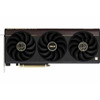
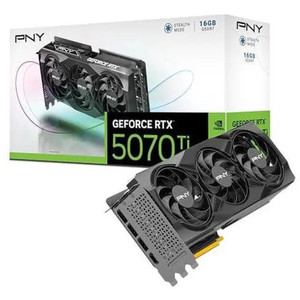
ASUS PROART-RTX5070TI-O16G ProArt GeForce RTX 5070 Ti OC Edition Graphics Card
The ASUS PROART-RTX5070TI-O16G is a workstation-class discrete GPU built around NVIDIA's GeForce RTX 5070 Ti silicon, targeting AI-compute workflows, multi-display rendering, and professional visualization tasks where raw throughput and thermal headroom both matter. It ships with 16GB of GDDR7 memory on a 256-bit bus, a vapor chamber cooling stack, and phase-change GPU thermal pad — a combination you typically see on cards intended to run hard for extended periods, not just gaming bursts.
Key Features
- 8,960 CUDA Cores at 2,610 MHz (OC Mode): The factory overclock pushes the boost to 2,610 MHz versus the reference 2,588 MHz — a modest but validated gain that means ASUS has binned and stress-tested these units past stock spec. For AI inference or video transcoding workloads that run continuously, that headroom is backed by the vapor chamber rather than just higher fan RPM.
- 16GB GDDR7 on a 256-Bit Bus at 28 Gbit/s: GDDR7 at 28 Gbit/s delivers substantially higher memory bandwidth than GDDR6X at equivalent bus widths. For large-model inference, 8K video decoding, or multi-stream surveillance analytics running on-card, having 16GB of fast VRAM means fewer context switches to system RAM — keeping throughput up where it matters.
- PCIe 5.0 Interface: PCIe 5.0 x16 doubles the host-to-card bandwidth ceiling versus PCIe 4.0. On AI inference servers or NVR appliances ingesting compressed multi-channel video streams, that headroom reduces CPU-to-GPU data starvation under peak load.
- Vapor Chamber + Phase-Change GPU Thermal Pad: The vapor chamber spreads heat uniformly across the die rather than relying on a copper heatpipe contact patch. Combined with the phase-change thermal pad — which conforms at operating temperature for better GPU die contact — this cooling stack is better suited to sustained compute workloads than standard heatsink designs on comparably priced cards.
- Axial-Tech Fan Array: ASUS's Axial-Tech fans are designed for higher static pressure through a smaller hub and reinforced blade geometry. In a tight server rack or workstation chassis with restricted airflow, higher static pressure translates to usable cooling performance where standard fans stall.
- USB Type-C Output: The onboard USB Type-C port supports direct connection to USB-C displays and VR headsets without a separate adapter — useful in control-room or NOC environments running mixed display setups.
- HDMI 2.1b + Dual DisplayPort 2.1b, Up to 4 Displays: HDMI 2.1b and DP 2.1b both support 8K (7680×4320) at high refresh rates. Drive up to four simultaneous outputs — a practical count for video walls, multi-monitor operator stations, or forensic review workstations where analysts need multiple streams side-by-side.
- 2.5-Slot Form Factor, 15.94 × 9.17 × 3.48 in, 4.50 lb: At 2.5 slots wide, this card occupies more physical space than a dual-slot design — verify clearance against adjacent PCIe slots and case width before ordering. At 4.50 lb, bracket and riser support should be confirmed on rack-mount chassis.
Integration & Compatibility
The PROART-RTX5070TI-O16G connects via PCIe 5.0 x16 and is compatible with any motherboard exposing a full-length PCIe slot — PCIe 4.0 and 3.0 slots will accept the card at reduced bandwidth. The card exposes USB Type-C, HDMI 2.1b, and two DisplayPort 2.1b outputs, covering the display interfaces used across enterprise AV, surveillance video wall, and workstation-class review systems. For AI-compute builds, the NVIDIA GeForce RTX 5070 Ti architecture supports CUDA (8,960 cores), making it compatible with CUDA-accelerated video analytics engines and inference frameworks commonly deployed alongside IP camera pipelines. Verify PSU capacity and PCIe power connector count before installation — the card's vapor chamber and OC profile indicate meaningful TDP that a marginal power supply may not sustain under full load. For rack-mount deployments paired with network video recorders, confirm chassis depth against the 15.94-inch card length. Integrators building GPU-accelerated network infrastructure for high-throughput video analytics should also reference a camera selection guide to match upstream sensor resolution and stream count to GPU VRAM headroom. When planning multi-GPU or AI-compute rack builds, a PoE and power planning guide helps size the overall power budget correctly across all active components.
Frequently Asked Questions
Q: What PCIe generations does the PROART-RTX5070TI-O16G support?
A: The card is natively PCIe 5.0 x16, but PCIe slots are backward compatible — it will install and operate in PCIe 4.0 or 3.0 slots at reduced bandwidth. For AI-compute or high-throughput video analytics, PCIe 5.0 is recommended to avoid host-to-card bandwidth bottlenecks.
Q: How many displays can the PROART-RTX5070TI-O16G drive simultaneously?
A: Up to four simultaneous displays. Output options are one HDMI 2.1b port, two DisplayPort 2.1b ports, and one USB Type-C port. All outputs support up to 7680×4320 (8K) resolution.
Q: What are the physical dimensions and weight of the PROART-RTX5070TI-O16G?
A: The card measures 15.94 × 9.17 × 3.48 inches (L × W × H) and weighs 4.50 lb. It occupies 2.5 expansion slots. Verify chassis depth, slot clearance, and bracket support before installation.
Q: What memory type and capacity does this card use?
A: 16GB of GDDR7 on a 256-bit memory bus at 28 Gbit/s data transfer rate. GDDR7 at this bus width provides meaningfully higher bandwidth than GDDR6X equivalents, which matters for large-model AI inference and multi-stream video decode tasks.
Q: What is the factory overclock frequency on the PROART-RTX5070TI-O16G?
A: In OC mode the GPU boost clock runs at 2,610 MHz, versus 2,588 MHz in standard performance mode. The difference is modest but reflects ASUS's bin-selection and factory validation process rather than user-applied overclocking.
Q: Does this card fit in a standard ATX workstation or rack-mount chassis?
A: It will fit most full-tower ATX workstations and extended ATX rack-mount chassis, but at 15.94 inches long and 2.5 slots wide, it is larger than a typical dual-slot card. Measure chassis internal depth and confirm no adjacent slot conflicts before ordering.
When I spec the PROART-RTX5070TI-O16G for a client, the combination I keep coming back to is the vapor chamber paired with the phase-change GPU thermal pad — this isn't the cooler you see on a gaming SKU that runs hot for 20 minutes and then idles. It's designed for sustained compute, which is exactly what you need when you're running CUDA-accelerated video analytics against 32 or 64 camera streams continuously.
Technical Highlights:
- 16GB GDDR7 at 28 Gbit/s, 256-bit bus: At that bandwidth, you can hold large inference model weights in VRAM without spilling to system RAM — critical when you're running concurrent deep-learning analytics on high-resolution multi-channel video.
- 8,960 CUDA Cores, 2,610 MHz OC Mode: The factory OC isn't just a marketing number — ASUS validates it with the vapor chamber backing it. For GPU-accelerated transcoding on an NVR appliance, more CUDA cores at a validated clock means more concurrent encode/decode sessions without thermal throttling.
- PCIe 5.0, 2.5-Slot, 15.94-Inch Length: The PCIe 5.0 interface future-proofs the host platform for next-gen CPU generations, but the 15.94-inch card length and 2.5-slot width are the specs to measure before you order — rack-mount 4U chassis are usually fine, but 2U or short-depth enclosures will reject this card outright.
Deployment Considerations:
- At 4.50 lb, this card is heavy enough that you should verify the PCIe slot's mechanical support and use a GPU brace or riser support in any chassis that isn't horizontal-desktop — vertical rack-mount installations are particularly prone to PCIe slot flex over time under this weight.
- The card's interfaces (PCIe, USB, Ethernet per the TD Synnex feed) suggest platform-level connectivity; confirm your motherboard's PCIe 5.0 slot spacing against the 2.5-slot width before assuming adjacent slots remain usable.
This card is the right call for a GPU-accelerated video analytics workstation or AI-compute node where the thermal profile matters as much as peak clock speed — specifically, operator review stations running simultaneous 4K stream decode, or edge inference servers processing camera feeds from large-site deployments where a thermally marginal card would throttle under sustained load.