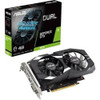
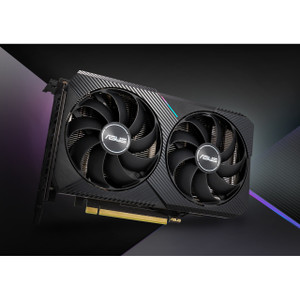
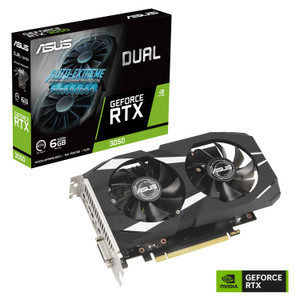
ASUS DUAL-GTX1650-4GD6-P-V2 GeForce GTX 1650 4GB GDDR6 Dual-Fan Graphics Card
Overview
The DUAL-GTX1650-4GD6-P-V2 is ASUS's dual-fan take on NVIDIA's GeForce GTX 1650 — a compact, low-profile-adjacent discrete GPU built for workstations and decode-heavy surveillance workstations that need reliable multi-display output without a supplemental power connector. At 4GB of GDDR6 memory across a 128-bit bus clocked at 12,000 MHz, this card handles simultaneous video wall configurations, VMS client decoding, and general compute acceleration that integrated graphics simply cannot sustain across long shifts. If you're running a security camera management station or a 3-monitor operations console, this is the class of card worth evaluating.
Key Features
- 896 CUDA Cores at up to 1620 MHz (OC Mode): NVIDIA's Turing architecture delivers the parallel compute throughput needed to decode multiple high-definition camera streams simultaneously in a VMS client — 896 cores at 1620 MHz (OC mode) or 1590 MHz (Gaming mode) means you're not dropping frames on a 16-camera wall when an operator scrubs through recorded footage.
- 4GB GDDR6 at 12,000 MHz on a 128-bit Bus: GDDR6 at 12,000 MHz delivers noticeably higher memory bandwidth than the GDDR5 variant of the GTX 1650 — relevant when you're pushing texture data for multiple simultaneous decoded streams. The 128-bit bus keeps power draw modest while still feeding the framebuffer fast enough for 4K single-display or triple-1080p layouts.
- Triple-Display Output (HDMI 2.0b + DisplayPort 1.4a + DVI-D): Three discrete outputs — one HDMI 2.0b, one DisplayPort 1.4a, one DVI-D — let you drive three monitors from a single card. HDMI 2.0b supports up to 7680×4320 (8K) at compatible refresh rates, making this forward-compatible with high-density video walls. DisplayPort 1.4a handles 4K at 120Hz or daisy-chaining where monitors support it. DVI-D covers legacy operator displays without an adapter.
- Maximum Resolution 7680×4320 (8K): The card's maximum addressable resolution of 7680×4320 means it won't become a display bottleneck if your facility upgrades to 4K monitors or a large-format 8K video wall panel — the GPU output already supports it over HDMI 2.0b.
- PCI Express 3.0 Interface: PCIe 3.0 x16 slots are universal in current and prior-generation workstations, so this card drops into virtually any corporate workstation or security server chassis without a compatibility concern. PCIe 4.0 systems are fully backward-compatible.
- No External Power Connector Required: The GTX 1650 GDDR6 draws power entirely from the PCIe slot — no 6-pin or 8-pin connector needed. This matters in commercial tower deployments where the OEM PSU may not have spare PCIe power leads, and in rack-mount workstations with space-constrained cabling.
- NVIDIA CUDA Support: CUDA support means the card can offload GPU-accelerated tasks beyond display — including NVENC/NVDEC hardware video encode/decode used by VMS platforms like Milestone and Genetec to reduce CPU load during multi-stream recording or export operations.
Integration & Compatibility
The DUAL-GTX1650-4GD6-P-V2 pairs naturally with surveillance workstations running network video recorders or VMS client software where CPU offload for video decode matters. NVIDIA's NVDEC block in the Turing architecture accelerates H.264 and H.265 decode — the two codecs dominant across modern IP camera deployments — reducing CPU utilization on operator stations running live and playback views simultaneously. The card's PCIe 3.0 interface is compatible with Intel and AMD platform workstations from the past decade. Triple-output support is directly useful for video surveillance control rooms where operators require separate windows for live view, map, and alarm management without a second GPU. For larger video wall deployments requiring more than three outputs, a second card or a higher-tier GPU would be needed — this card caps at three simultaneous displays. Consult a workstation GPU selection guide to match card tier to stream count and resolution requirements before ordering.
Frequently Asked Questions
Q: Does the DUAL-GTX1650-4GD6-P-V2 require an external PCIe power connector?
A: No. The GTX 1650 GDDR6 draws all power through the PCIe slot — no 6-pin or 8-pin connector is required. This makes it compatible with OEM workstations and rack-mount systems that lack spare PCIe power leads.
Q: How many monitors can I connect to the DUAL-GTX1650-4GD6-P-V2?
A: The card supports up to three simultaneous displays via one HDMI 2.0b port, one DisplayPort 1.4a, and one DVI-D port. For more than three outputs, a second card or a higher-channel GPU would be needed.
Q: What is the maximum resolution supported by the DUAL-GTX1650-4GD6-P-V2?
A: The card supports up to 7680×4320 (8K) resolution over HDMI 2.0b, making it forward-compatible with 4K and large-format display upgrades.
Q: Is the DUAL-GTX1650-4GD6-P-V2 compatible with H.265 hardware decode for VMS workloads?
A: Yes. NVIDIA's Turing NVDEC block supports hardware-accelerated H.265 (and H.264) decode, which reduces CPU load on VMS client stations handling simultaneous live and recorded stream playback.
Q: What is the difference between OC mode and Gaming mode on this card?
A: OC mode boosts the GPU core to 1620 MHz; Gaming mode runs at 1590 MHz. The 30 MHz difference is marginal for video decode workloads — both modes deliver equivalent performance in surveillance applications. OC mode may increase fan activity slightly under sustained load.
Q: What memory type does the DUAL-GTX1650-4GD6-P-V2 use, and why does it matter?
A: The card uses GDDR6 at 12,000 MHz — a step up in memory bandwidth over the GDDR5 variant of the GTX 1650. Higher bandwidth supports smoother framebuffer throughput when driving multiple high-resolution streams or displays simultaneously.
The DUAL-GTX1650-4GD6-P-V2 lands in a specific sweet spot I see often in mid-size security operations: the workstation already has a capable CPU, but integrated graphics collapses under a 12- or 16-camera live view because the iGPU is starved of dedicated memory bandwidth. Swapping in this card — 4GB GDDR6 at 12,000 MHz, 896 Turing CUDA cores — offloads decode entirely to NVDEC and frees the CPU for VMS analytics and alarm processing. No power connector to fish through a cramped chassis. That's a real-world install concern, and this card sidesteps it entirely.
Technical Highlights:
- GDDR6 at 12,000 MHz: Roughly 40% more memory bandwidth than the GDDR5 GTX 1650 — the difference shows up in sustained multi-stream decode where the framebuffer needs constant replenishment.
- Triple Output with HDMI 2.0b + DP 1.4a + DVI-D: Three physically distinct connectors cover every monitor type in an existing ops center — new 4K panels on HDMI, DP daisy-chains, and legacy operator screens on DVI — without an adapter chain.
- 1620 MHz Boost (OC Mode): The dual-fan cooler is doing real work here — sustaining 1620 MHz under prolonged decode load without throttling is what separates a purpose-built ASUS Dual from a reference blower design.
Deployment Considerations:
- PCIe slot power only — verify your target workstation's PCIe slot is a full x16 mechanical slot and not an x1 or x4 electrical slot, which would bottleneck bandwidth even though the card would physically seat.
- Three displays is a hard ceiling. If your control room layout calls for four or more monitors per seat, plan for a second card or a higher-tier GPU — the DUAL-GTX1650-4GD6-P-V2 will not drive a fourth output.
This card is the right fit for a three-display VMS operator workstation in a mid-size physical security operations center — one running Milestone, Genetec, or Avigilon Control Center client software where NVDEC offload meaningfully reduces CPU overhead during peak alarm-review periods.