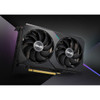
ASUS DUAL-RTX3060-O12G-V2 GeForce RTX 3060 OC Edition 12GB Graphics Card
The ASUS DUAL-RTX3060-O12G-V2 is a 2-slot, dual-fan NVIDIA GeForce RTX 3060 graphics card carrying 12GB of GDDR6 memory — a configuration that targets workstation users, simulation engineers, and video analytics platforms that need a capable mid-range GPU without the bulk or power draw of a high-end card. With a PCIe 4.0 interface and a factory-overclocked boost clock of 1867 MHz in OC mode, this card punches above its segment for compute-adjacent workloads including AI inference, multi-stream video decoding, and deep-learning-assisted surveillance analytics.
Key Features
- 12GB GDDR6 on a 192-bit Bus: The 12GB frame buffer — unusually generous for this GPU tier — means you can load larger inference models or maintain multiple high-resolution video streams in GPU memory without paging. The 192-bit bus delivers up to 15 GB/s bandwidth, keeping texture and compute throughput from becoming a bottleneck on sustained workloads.
- 3584 CUDA Cores (GeForce RTX 3060): NVIDIA's Ampere architecture brings hardware-accelerated ray tracing and Tensor cores alongside the CUDA count. For video analytics workloads, the Tensor cores accelerate deep-learning inference — relevant if you're running on-host AI analytics engines (e.g., Milestone Husky IVO, Genetec with GPU inference, or custom YOLO deployments) rather than offloading to a dedicated NPU.
- OC Mode Boost Clock — 1867 MHz: ASUS ships the DUAL-RTX3060-O12G-V2 with a factory OC profile that pushes the GPU boost to 1867 MHz (versus 1837 MHz in standard mode). That roughly 1.6% headroom is pre-validated — no manual tuning required, and it maintains full manufacturer warranty coverage.
- PCIe 4.0 Interface: PCIe 4.0 doubles the bandwidth ceiling over PCIe 3.0. For GPU-accelerated analytics on a modern server or workstation with a PCIe 4.0 host, this matters when streaming high-bitrate video data directly to GPU memory. The card remains backward compatible with PCIe 3.0 slots at reduced bandwidth.
- Four Simultaneous Display Outputs (1x HDMI 2.1 + 3x DisplayPort 1.4a): HDMI 2.1 supports up to 7680×4320 (8K) resolution, and DisplayPort 1.4a handles 4K at high refresh rates. For a video wall operator or a command center with four monitors, this card drives all four from a single 2-slot add-in card — no secondary GPU or splitter hardware needed.
- Axial-Tech Dual-Fan Cooling, 0dB Technology: The Axial-tech fan design uses a smaller hub to maximize blade surface area and a barrier ring to increase downward airflow pressure. The 0dB mode spins fans down completely under light load — useful in near-silent control rooms or shared office environments where fan noise is a concern.
- 2-Slot Form Factor: The dual-slot profile fits in standard ATX workstations and compact server chassis without consuming a third expansion slot — a practical consideration in rack-mount systems with limited PCIe real estate.
Integration and Compatibility
The DUAL-RTX3060-O12G-V2 connects via PCIe 4.0 x16 and is compatible with any PCIe 4.0 or PCIe 3.0 motherboard. Display output is handled through one HDMI 2.1 port and three DisplayPort 1.4a ports, supporting up to four simultaneous monitors at resolutions up to 7680×4320. Driver support is provided through NVIDIA's standard GeForce and Studio driver branches, with CUDA support enabling GPU-accelerated workloads in NVIDIA-supported frameworks (TensorRT, CUDA Toolkit, OpenCV with CUDA backend). The card does not support parallel processing technology (SLI/NVLink multi-GPU configurations are not supported on RTX 3060). Verify your chassis and power supply before deploying: the card requires a PCIe power connector — confirm your PSU provides adequate connectors and wattage for this tier of discrete GPU.
Frequently Asked Questions
Q: What is the boost clock speed of the ASUS DUAL-RTX3060-O12G-V2 in OC mode?
A: In OC mode, the DUAL-RTX3060-O12G-V2 reaches a boost clock of 1867 MHz. In standard mode it boosts to 1837 MHz. The OC profile is factory-set — no manual tuning is required.
Q: How many monitors can the DUAL-RTX3060-O12G-V2 drive simultaneously?
A: The card supports up to four simultaneous displays using its one HDMI 2.1 port and three DisplayPort 1.4a ports. Maximum resolution per output is 7680×4320 (8K).
Q: Does the DUAL-RTX3060-O12G-V2 support multi-GPU (SLI or NVLink)?
A: No. Parallel processing technology (SLI/NVLink) is not supported on this card. It operates as a single-GPU solution only.
Q: What memory specification does the DUAL-RTX3060-O12G-V2 use?
A: The card ships with 12GB of GDDR6 memory on a 192-bit bus, with a maximum memory bandwidth of 15 GB/s.
Q: Is the DUAL-RTX3060-O12G-V2 compatible with PCIe 3.0 motherboards?
A: Yes. The PCIe 4.0 interface is backward compatible with PCIe 3.0 slots. Bandwidth will be limited to PCIe 3.0 speeds in that configuration, which is generally sufficient for display-driving and most compute workloads at this GPU tier.
Q: Does the DUAL-RTX3060-O12G-V2 support CUDA?
A: Yes. The card includes 3584 CUDA cores based on NVIDIA's Ampere architecture, supporting CUDA-accelerated applications including deep-learning inference frameworks, video transcoding, and GPU-accelerated analytics platforms.
The DUAL-RTX3060-O12G-V2 is a card I'd reach for when the deployment spec calls for GPU-accelerated video analytics on a budget-conscious platform — specifically because of the 12GB GDDR6 frame buffer, which is the defining differentiator here. At this price tier, most RTX 3060 competitors top out at 8GB; that extra 4GB of VRAM is the difference between running a single inference model and running concurrent models for multi-camera deep-learning analytics without memory-swapping overhead.
Technical Highlights:
- 12GB GDDR6 / 192-bit Bus: 15 GB/s memory bandwidth keeps inference throughput from stalling on sustained multi-stream workloads. The 12GB capacity accommodates larger YOLO or ResNet variants without model quantization workarounds.
- 3584 CUDA Cores + Tensor Cores (Ampere): Ampere-generation Tensor cores accelerate FP16 and INT8 inference — the data types most GPU analytics engines use. This is materially faster than Pascal-generation CUDA-only pipelines for the same TDP.
- Factory OC at 1867 MHz: ASUS validated the 1867 MHz OC profile at the factory, so you get a modest but reliable clock advantage over reference without touching GPU tuning utilities — important in managed enterprise environments where overclocking tools are restricted.
Deployment Considerations:
- Confirm your server or workstation chassis has a free PCIe x16 slot and that the PSU provides the necessary power connectors for a discrete RTX 3060-class card before ordering — the 2-slot design fits most ATX cases, but rack-mount 1U chassis will not accommodate this card without a riser and adequate airflow clearance.
- SLI/NVLink is explicitly not supported — if your analytics platform requires multi-GPU scaling (e.g., to handle 64+ camera streams simultaneously), plan for multiple independent host machines rather than a multi-GPU workstation build.
This card is best positioned in a dedicated video analytics server running GPU-accelerated VMS software (Milestone Husky IVO, Genetec Omnicast with GPU inference, or a custom TensorRT pipeline) handling 16–32 camera streams — where the 12GB VRAM headroom and Ampere Tensor core throughput justify the selection over a cheaper 8GB alternative.