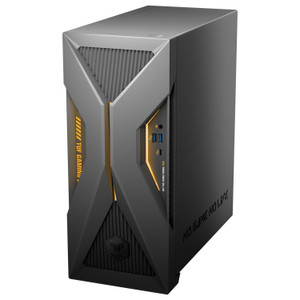
ASUS DUAL-RTX3050-6G GeForce RTX 3050 6GB Dual-Fan Graphics Card
Overview
The ASUS DUAL-RTX3050-6G is a compact dual-fan discrete graphics card built around NVIDIA's GeForce RTX 3050 GPU with 6GB of GDDR6 memory. At 11.90 x 8.70 x 2.20 inches and 1.55 lb, it fits a wide range of workstation and tower chassis without demanding the slot footprint of larger cards — relevant when you're integrating GPU acceleration into a surveillance workstation or video analytics server with real physical constraints. The 6GB frame buffer paired with a 96-bit GDDR6 bus running at 14 Gbit/s delivers enough bandwidth for multi-stream video decoding and lightweight AI inference tasks without the cost and power draw of a mid-to-high tier GPU.
Key Features
- 2304 CUDA Cores on RTX 3050 Silicon: The GeForce RTX 3050 GPU in the DUAL-RTX3050-6G delivers enough parallel compute throughput for hardware-accelerated video transcoding, NVIDIA NVDEC decode offload, and lightweight deep learning inference — workloads that would otherwise saturate a CPU on a 16–32 camera analytics server.
- 6GB GDDR6 at 14 Gbit/s over a 96-bit Bus: The 96-bit memory interface is narrower than higher-tier cards, so raw bandwidth tops out at roughly 168 GB/s — adequate for 1080p and 4K multi-stream decode but not ideal for simultaneous high-resolution AI model inference on a dense channel count. Know this ceiling before specifying it in a 64+ channel deployment.
- PCIe 4.0 Interface: The x16 PCIe 4.0 slot connection doubles the theoretical bandwidth ceiling versus PCIe 3.0, giving headroom for GPU-CPU data transfers in analytics pipelines where model inputs and outputs are streamed continuously. It installs into PCIe 3.0 motherboards as well, dropping to that interface's bandwidth without issue.
- 1470 MHz Base / 1500 MHz OC Boost Clock: The factory OC mode pushes boost to 1500 MHz, a modest 2% lift over the standard 1470 MHz — useful in sustained compute tasks like continuous video encode but not a material differentiator when selecting between GPU models. Both clocks are within NVIDIA's validated operating envelope for this SKU.
- Up to 3 Simultaneous Display Outputs: One HDMI 2.1 port, one DisplayPort, and one DVI-D connector allow connection of up to three monitors simultaneously — practical for a control room workstation running a VMS console, a map view, and a camera wall without an additional display adapter.
- HDMI 2.1 — 8K/60Hz Capable Output: The HDMI 2.1 port supports up to 7680×4320 resolution output, making this card forward-compatible with ultra-high-resolution display setups. For standard 1080p or 4K operator displays, this headroom simply means the display path will never be the bottleneck.
- Dual-Fan Cooling in a 2.20-inch Profile: The dual-fan shroud keeps the card within a 2.20-inch height — it occupies two expansion slots but doesn't encroach on a third, preserving adjacent PCIe slot availability for a capture card, NIC, or additional storage controller in a dense workstation build.
Integration and Compatibility
The DUAL-RTX3050-6G connects via PCI Express 4.0 x16 and is backward-compatible with PCIe 3.0 and 2.0 motherboards. NVIDIA driver support covers Windows 10/11 and major Linux distributions, enabling integration with NVIDIA-accelerated VMS platforms and transcoding software stacks. The RTX 3050 architecture includes NVENC and NVDEC hardware encode/decode engines, which most enterprise VMS platforms — including those relying on NVIDIA's Video Codec SDK — can leverage to offload stream processing from the host CPU. Verify your VMS vendor's GPU acceleration compatibility matrix before procurement, as acceleration support varies by VMS version and codec profile. The card requires a PCIe power connector; confirm your workstation PSU provides the necessary connector before specifying this in a system build.
Frequently Asked Questions
Q: What are the physical dimensions of the DUAL-RTX3050-6G and will it fit a standard tower workstation?
A: The DUAL-RTX3050-6G measures 11.90 x 8.70 x 2.20 inches (L x W x H) and weighs 1.55 lb. It occupies two expansion slots. Most standard ATX and mid-tower workstation chassis accommodate this size without modification, but verify your chassis clearance for card length (11.90 inches) before ordering.
Q: How much VRAM does the DUAL-RTX3050-6G have, and is it sufficient for AI-based video analytics?
A: The card carries 6GB of GDDR6 memory. For lightweight AI inference tasks — object detection on 4–8 concurrent camera streams — 6GB is generally adequate. For dense multi-stream deployments running larger deep learning models (16+ channels with simultaneous inference), consider a GPU with 8GB or more VRAM to avoid memory pressure.
Q: What display outputs does the DUAL-RTX3050-6G provide?
A: It has one HDMI 2.1 port (supporting up to 7680x4320 / 8K resolution), one DisplayPort, and one DVI-D port — supporting up to three simultaneous displays.
Q: Is the DUAL-RTX3050-6G compatible with PCIe 3.0 motherboards?
A: Yes. The card is PCIe 4.0 native but backward-compatible with PCIe 3.0 and 2.0 motherboard slots. Performance in a PCIe 3.0 system will be limited by that interface's bandwidth ceiling, though for typical VMS and analytics workloads this is rarely the bottleneck.
Q: What is the memory bus width and data transfer rate of the DUAL-RTX3050-6G?
A: The memory interface is 96-bit with GDDR6 running at 14 Gbit/s, yielding approximately 168 GB/s of memory bandwidth. This is a narrower bus than higher-tier RTX cards, so it is a consideration in workloads that are memory-bandwidth-bound rather than compute-bound.
The DUAL-RTX3050-6G is a card I'd pick for a surveillance workstation where you need GPU-accelerated decode offload and a multi-monitor operator display without occupying a high-wattage slot in a rack-mount chassis. The 2304 CUDA cores and 6GB GDDR6 hit a practical sweet spot for NVDEC-assisted stream decode — you're pulling CPU utilization down meaningfully on a 16–24 camera station without committing to the cost and thermal footprint of an RTX 4060 or above.
Technical Highlights:
- 96-bit / 14 Gbit/s GDDR6: Delivers ~168 GB/s memory bandwidth — enough for simultaneous 4K stream decode on a moderate channel count, but you will hit the ceiling if you attempt dense AI inference (multiple concurrent models) on top of active decode. Size your workload accordingly.
- HDMI 2.1 + DP + DVI-D (3 outputs): Three independent display outputs let you run a full operator console — VMS live view, map, and alarm panel — off a single card without a USB display adapter or secondary GPU. The HDMI 2.1 port handles 8K output, so any 4K operator monitor you connect today will never be the constraint.
- PCIe 4.0 at 1.55 lb / 2.20-inch profile: At just over one and a half pounds and two slots wide, this card installs cleanly in compact tower workstations and doesn't block an adjacent PCIe slot — useful when you need to co-install a 10GbE NIC or RAID controller in the same chassis.
Deployment Considerations:
- Verify PCIe power connector availability on the host PSU before ordering — the RTX 3050 requires supplemental power beyond slot-provided wattage, and compact workstation PSUs are sometimes tight on available connectors.
- The 96-bit memory bus is the binding constraint in this card's compute profile. If your VMS's GPU acceleration plugin is memory-bandwidth-heavy (e.g., simultaneous transcoding of high-bitrate 4K streams plus live AI analytics), benchmark with your specific channel count before standardizing this card across a fleet — a 128-bit or wider card will scale further without a second GPU.
Best fit: a 16–24 channel surveillance workstation or an analytics edge node where GPU-accelerated NVDEC decode and a three-monitor operator display are the primary requirements, and slot space or chassis thermals rule out a higher-tier discrete GPU.