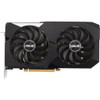
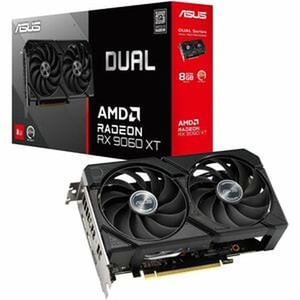
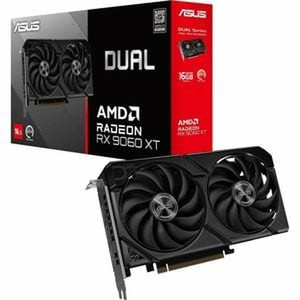
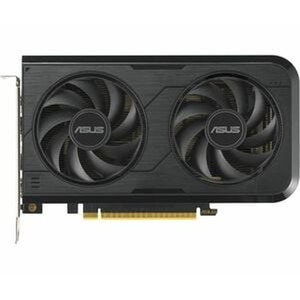
ASUS DUAL-RX6600-8G Dual-Fan AMD Radeon RX 6600 8GB Graphics Card
The ASUS DUAL-RX6600-8G delivers AMD's Radeon RX 6600 GPU in a dual-fan configuration with 8GB of GDDR6 memory — a practical mid-range discrete card for workstation builds, multi-display deployments, and GPU-accelerated video decoding tasks. With a 2491MHz boost clock and PCIe 4.0 interface, it provides headroom for demanding decode pipelines without the power draw or cost of a high-end workstation card. If you're specifying a system that needs to drive four monitors from a single slot while maintaining smooth playback of high-bitrate streams, the DUAL-RX6600-8G is worth a close look.
Key Features
- 8GB GDDR6 at 14 Gbit/s over 128-bit bus: The 8GB frame buffer handles simultaneous decode and display of multiple high-resolution streams without swapping to system memory. At 14 Gbit/s data rate on a 128-bit bus, peak memory bandwidth reaches 224 GB/s — enough to keep 1792 stream processors fed in GPU-accelerated workloads.
- Radeon RX 6600 GPU — 1792 Stream Processors: AMD's RDNA 2 architecture powers 1792 compute units clocked at 2044MHz base and boosting to 2491MHz in standard mode (2064MHz base / 2491MHz boost in OC mode). The OC mode offers a modest but consistent frequency ceiling for sustained workloads like frame rendering or batch transcoding.
- PCIe 4.0 Interface: PCIe 4.0 doubles the host bus bandwidth compared to PCIe 3.0 — relevant when streaming large textures or transferring GPU output buffers to system memory at high throughput. The card is also backward-compatible with PCIe 3.0 slots, so it drops into existing server or workstation platforms without a motherboard upgrade.
- Four Independent Display Outputs (up to 7680×4320): The card supports up to four simultaneous displays at resolutions up to 8K (7680×4320). For control room operators or analysts running a multi-monitor setup, this eliminates the need for a second card or a display hub — one card handles the full operator station.
- HDMI 2.1 Output: The single HDMI 2.1 port supports 4K at 120Hz or 8K at 60Hz without a DSC compression requirement. That matters for high-refresh-rate monitoring applications or when connecting to 4K displays that require uncompressed signal paths for maximum image fidelity.
- AMD CrossFire Support: Multi-GPU scaling via AMD CrossFire is supported, giving integrators a path to expand GPU compute capacity in systems where a single card isn't sufficient for the decode or rendering load — without replacing the primary card.
- GDDR6 Memory Type: GDDR6 offers better power efficiency per GB/s compared to GDDR5, which matters in rack-mounted or semi-sealed enclosures where thermal headroom is limited. The lower heat output per unit of memory throughput keeps the card's thermal profile manageable in tight chassis builds.
Integration and Compatibility
The DUAL-RX6600-8G connects via a standard PCIe 4.0 x8 or x16 slot and is compatible with any platform supporting PCIe 4.0 or 3.0. AMD's Radeon Software stack supports hardware-accelerated decode for H.264, H.265/HEVC, and AV1 content — relevant for VMS workstations decoding live or recorded streams from IP camera systems. When paired with a network video recorder workstation or a dedicated video management software client PC, the GPU offloads decode from the CPU, freeing system resources for analytics and recording tasks.
For integrators building workstations or GPU-accelerated edge nodes, the card's four display outputs and PCIe 4.0 bandwidth make it a capable base. Note that NVLink is listed under parallel processing technologies in the spec sheet, though NVLink is an NVIDIA interconnect standard — confirm compatibility requirements with your specific platform before specifying multi-GPU configurations. CrossFire remains the native AMD multi-GPU path for this card.
Frequently Asked Questions
Q: What PCIe slot does the ASUS DUAL-RX6600-8G require?
A: The DUAL-RX6600-8G uses a PCIe 4.0 interface and is backward-compatible with PCIe 3.0 slots. A x8 or x16 slot is recommended for full bandwidth.
Q: How many monitors can the DUAL-RX6600-8G drive simultaneously?
A: Up to four independent displays at a maximum resolution of 7680×4320 (8K) per output.
Q: What is the boost clock speed of the RX 6600 on this card?
A: The DUAL-RX6600-8G boosts to 2491MHz in both standard and OC modes. The OC mode raises the base clock from 2044MHz to 2064MHz while maintaining the same 2491MHz boost ceiling.
Q: Does the DUAL-RX6600-8G support hardware-accelerated video decode?
A: Yes. The Radeon RX 6600 GPU includes AMD's VCN (Video Core Next) hardware decode engine, which supports H.264, H.265/HEVC, and AV1. This is relevant for VMS client workstations where CPU decode of multiple high-resolution streams creates a bottleneck.
Q: What is the memory configuration on this card?
A: 8GB of GDDR6 running at 14 Gbit/s over a 128-bit memory bus, delivering up to 224 GB/s of memory bandwidth.
Q: Is the DUAL-RX6600-8G compatible with AMD CrossFire multi-GPU configurations?
A: Yes, CrossFire is listed as a supported parallel processing technology, allowing multi-GPU scaling in compatible platforms.
When specifying a GPU for a VMS workstation or multi-display operator console, the ASUS DUAL-RX6600-8G hits a useful price-to-performance point: 1792 RDNA 2 stream processors, a 2491MHz boost clock, and 8GB GDDR6 in a dual-fan thermal package that handles sustained decode loads without thermal throttling in typical office or control room enclosures.
Technical Highlights:
- 2491MHz Boost Clock: Consistent across both standard and OC mode — the OC mode shifts the base from 2044MHz to 2064MHz but doesn't move the ceiling, so the practical performance delta between modes is narrow. Useful to know when configuring BIOS settings: OC mode is low-risk here.
- 8GB GDDR6 / 128-bit / 14 Gbit/s: At 224 GB/s peak bandwidth, this frame buffer handles simultaneous decode of multiple 4K H.265 streams without stalling. That's the spec that matters most in a multi-camera VMS client scenario — not raw shader performance.
- PCIe 4.0 Host Interface: The doubled bus bandwidth vs. PCIe 3.0 is most relevant when the GPU is feeding large frame buffers back to system memory for recording or analytics processing. In pure display-only builds on PCIe 3.0 hardware, the difference is negligible.
Deployment Considerations:
- Four display outputs max — if your operator console runs more than four monitors, you'll need a second card or a display controller. Plan the display layout before finalizing the chassis spec.
- The spec sheet lists NVLink under parallel processing support, which is an NVIDIA interconnect standard — not applicable to AMD hardware. Treat that spec entry with skepticism and verify multi-GPU requirements against AMD CrossFire documentation specifically.
This card is best positioned in a dedicated VMS client workstation or security operations center console where hardware-accelerated decode of H.265/HEVC streams from 8–16 IP cameras needs to run alongside a four-monitor display layout — replacing a CPU-only decode setup where frame drops and high CPU utilization are already a documented problem.