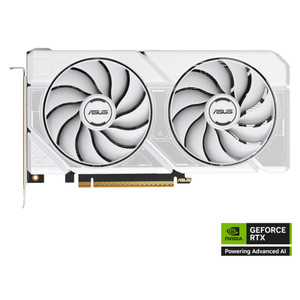
ASUS DUAL-RTX5050-8G Dual GeForce RTX 5050 8GB Graphics Card
Overview
The ASUS DUAL-RTX5050-8G brings NVIDIA's GeForce RTX 5050 architecture into a dual-fan, wide-compatibility form factor — a practical pick for workstation builds, edge AI inference nodes, and multi-display professional setups where you need modern GPU headroom without committing to a full-length, high-wattage flagship. With 2560 CUDA cores, 8GB of GDDR6 memory on a 128-bit bus, and a PCIe 5.0 interface, the DUAL-RTX5050-8G fits systems ranging from compact professional workstations to small-footprint surveillance analytics servers that demand local GPU acceleration.
ASUS carries thermal engineering from its higher-end Dual series down to this tier, pairing two Axial-tech fans with a full heatsink stack — an important detail on cards that run sustained workloads like real-time AI inference or multi-stream video decoding rather than just burst gaming.
Key Features
- 2560 CUDA Cores / RTX 5050 GPU: The Blackwell-generation core count gives this card enough parallel throughput for real-time AI inferencing tasks — think on-premise video analytics, object detection pipelines, or LLM acceleration at the edge. Not a data-center-class accelerator, but a meaningful upgrade over previous-gen entry GPUs for sustained inference workloads.
- 8GB GDDR6 at 20 Gbit/s on a 128-bit Bus: 8GB VRAM keeps mid-complexity AI models fully resident without spilling to system RAM. The 20 Gbit/s data rate on the 128-bit bus translates to 320 GB/s peak memory bandwidth — enough for smooth multi-stream video frame buffering at 4K or simultaneous batch inference passes without memory bottlenecking the pipeline.
- PCI Express 5.0 Interface: PCIe 5.0 x16 doubles the theoretical slot bandwidth over PCIe 4.0, which matters when the GPU is pulling large model weights or transferring high-resolution frames from system memory at sustained rates. The card is backward-compatible with PCIe 4.0 and 3.0 slots — useful when dropping into an existing server chassis that hasn't been refreshed to a current-gen platform.
- Boost Clock to 2572 MHz (OC Mode: 2602 MHz): The factory boost of 2572 MHz reflects the card's sustained-performance tuning. The OC mode ceiling of 2602 MHz provides a modest additional headroom for builds with adequate chassis airflow. For sustained server-room workloads, the standard boost figure is the one to plan against — OC mode is thermally contingent.
- Quad Display Output — HDMI 2.1b + 3x DisplayPort 2.1b: Four simultaneous display outputs supporting up to 7680×4320 (8K) resolution. For a video surveillance operator workstation or a command center console driving multiple 4K monitoring screens, this eliminates the need for a secondary display adapter. HDMI 2.1b handles 4K/120Hz and 8K/60Hz; DisplayPort 2.1b extends those ceiling specs further for high-refresh professional monitors.
- Dual Axial-Tech Fan Cooling: ASUS's Axial-tech fan design increases blade count and optimizes airflow angle relative to standard blower fans, reducing heatsink temperatures under sustained load. For edge deployments running 24/7 inference jobs, sustained thermal headroom matters more than peak boost numbers — this cooling approach is designed for that duty cycle.
- Compact Dimensions — 11.93 × 8.66 × 2.17 in: At just over 11.9 inches in length and a 2-slot profile, the DUAL-RTX5050-8G fits in standard ATX and mATX cases with conventional PCIe slot spacing. The 1.87 lb weight is unremarkable for a dual-fan card — no reinforced slot bracket typically required.
Integration and Compatibility
The DUAL-RTX5050-8G connects via a PCI Express 5.0 x16 slot and is backward-compatible with PCIe 4.0 and 3.0 motherboards — no platform lock-in. The card supports up to four simultaneous displays across its one HDMI 2.1b and three DisplayPort 2.1b outputs, making it a practical solution for NVR operator workstations and multi-screen command center deployments without requiring additional hardware.
For IP camera analytics and AI-accelerated video processing workflows, the 2560 CUDA cores and 8GB GDDR6 frame buffer provide a capable local inference engine. NVIDIA's CUDA ecosystem is broadly supported across major deep learning frameworks (TensorFlow, PyTorch, TensorRT), which translates directly to compatibility with most commercial video analytics platforms that expose GPU acceleration.
The card's UNSPSC code 43201401 classifies it as a discrete graphics adapter, relevant for procurement systems that require commodity classification for IT hardware purchasing workflows. When speccing into a new workstation or server build, verify that the target chassis has at least 11.93 inches of PCIe card clearance and two available expansion slot bays for the 2.17-inch height profile. Review system power supply capacity against the card's TDP before finalizing the build — consult ASUS's published power requirements for the DUAL-RTX5050-8G to confirm PSU headroom.
For enterprise deployments, pair this card with a purpose-built workstation or tower server platform with adequate PCIe 5.0 slot support to take full advantage of the interface bandwidth. If your analytics server chassis is PCIe 4.0, the card operates normally — just at PCIe 4.0 bandwidth ceiling.
Frequently Asked Questions
Q: What PCIe slot does the ASUS DUAL-RTX5050-8G require?
A: The DUAL-RTX5050-8G uses a PCI Express 5.0 x16 interface. It is backward-compatible with PCIe 4.0 and PCIe 3.0 motherboard slots, though maximum bandwidth is only achieved on a PCIe 5.0 platform.
Q: How much video memory does the DUAL-RTX5050-8G have, and what type?
A: The card carries 8GB of GDDR6 memory on a 128-bit memory bus, operating at 20 Gbit/s data transfer rate — translating to approximately 320 GB/s peak memory bandwidth.
Q: How many monitors can the DUAL-RTX5050-8G drive simultaneously?
A: Up to four displays simultaneously: one HDMI 2.1b port and three DisplayPort 2.1b ports. Maximum resolution supported is 7680×4320 (8K).
Q: What are the physical dimensions of the DUAL-RTX5050-8G?
A: The card measures 11.93 × 8.66 × 2.17 inches (L × W × H) and weighs 1.87 lb. Verify at least 11.93 inches of PCIe card clearance in the target chassis before ordering.
Q: Is the DUAL-RTX5050-8G suitable for AI inference and video analytics workloads?
A: Yes. The 2560 CUDA cores and 8GB GDDR6 frame buffer support NVIDIA's CUDA ecosystem, which underpins most commercial deep learning and video analytics platforms. It is positioned as an edge inference and professional workstation GPU, not a data-center accelerator.
Q: What is the boost clock speed of the DUAL-RTX5050-8G?
A: The standard boost clock is 2572 MHz. In OC mode, the ceiling reaches 2602 MHz, contingent on chassis airflow and thermal conditions.
The DUAL-RTX5050-8G is the card I'd reach for when a deployment calls for a capable, form-factor-friendly GPU that can pull sustained AI inference duty without the thermal, power, or dimensional overhead of a flagship board. The 2560 CUDA cores paired with 8GB of GDDR6 at 20 Gbit/s give it real utility for on-premise video analytics workloads — object detection, license plate recognition pipelines, or multi-stream deep learning inference — where you need GPU acceleration at the edge but can't justify a full data-center SKU in a tower workstation chassis.
Technical Highlights:
- PCIe 5.0 Interface: Full PCIe 5.0 x16 connectivity doubles the theoretical slot bandwidth versus PCIe 4.0, which is relevant when the card is continuously transferring large model weights or high-resolution video frames through the host bus. Backward-compatible with 4.0 and 3.0 slots for existing server refreshes.
- 128-bit GDDR6 at 20 Gbit/s: Peak bandwidth sits around 320 GB/s — sufficient to keep mid-scale AI models fully VRAM-resident during batch inference passes. The 8GB ceiling is the spec to watch for larger model deployments; size your model quantization strategy accordingly.
- Quad Display via HDMI 2.1b + 3× DP 2.1b: Four simultaneous outputs at up to 8K resolution make this a genuinely useful card for multi-monitor operator consoles — no secondary display card needed in a standard ATX workstation chassis.
Deployment Considerations:
- At 11.93 inches in length, measure PCIe card clearance in the target chassis before committing — particularly in compact tower or small-form-factor workstation builds where GPU clearance can be tight even on cards marketed as mid-range.
- OC mode boost of 2602 MHz is thermally contingent. For 24/7 analytics server deployments, plan against the standard boost figure of 2572 MHz and ensure chassis airflow can sustain the dual-fan cooling load over continuous operation.
This card fits best in a dedicated on-premise analytics workstation running continuous inference pipelines — a deployment scenario where you want Blackwell-generation CUDA compute in a manageable physical and power envelope, without the procurement complexity of data-center GPU SKUs.