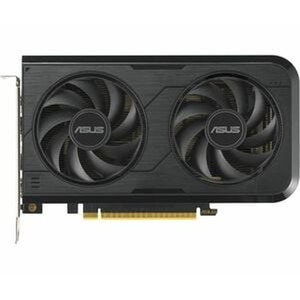
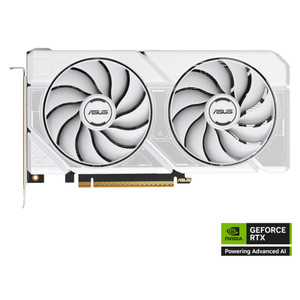
ASUS DUAL-RTX5050-O8G Dual GeForce RTX 5050 8GB GDDR6 Discrete Graphics Card
Overview
The ASUS DUAL-RTX5050-O8G is a discrete graphics card built around NVIDIA's GeForce RTX 5050 GPU, pairing 2560 CUDA cores with 8GB of GDDR6 memory on a 128-bit bus. At 11.93 x 8.66 x 2.17 inches, it fits standard ATX mid-tower and full-tower enclosures without the clearance concerns that come with triple-slot flagship cards. The dual-fan thermal design — derived from ASUS's higher-tier DUAL series — keeps the 2647 MHz boost clock (2677 MHz in OC mode) stable under sustained workloads without requiring elaborate cooling infrastructure. For workstations running multi-display surveillance review stations, video wall controllers, or GPU-accelerated analytics decoding, this is a practical entry point into the RTX 5050 generation.
Key Features
- 2560 CUDA Cores at 2647 MHz Boost: The GeForce RTX 5050 GPU delivers enough parallel compute headroom for hardware-accelerated video decoding across multiple streams simultaneously — relevant in surveillance review workstations where software decoding taxes the CPU and introduces latency during playback scrubbing. OC mode pushes the clock to 2677 MHz if your enclosure has adequate airflow.
- 8GB GDDR6 at 20 Gbit/s on a 128-bit Bus: 8GB of GDDR6 is sufficient frame buffer for multi-monitor workstation use and moderate GPU-compute tasks. The 20 Gbit/s data transfer rate keeps memory bandwidth from becoming a bottleneck during concurrent decode operations, though buyers with very high-resolution multi-stream decode workloads should assess whether the 128-bit bus width meets their throughput requirements before specifying.
- PCIe 5.0 Interface: The PCIe 5.0 x16 slot connection doubles the theoretical bandwidth ceiling versus PCIe 4.0 — future-proofing for workstation refreshes and ensuring this card won't create an interface bottleneck on current-generation server or workstation motherboards.
- Four Simultaneous Display Outputs (1x HDMI 2.1b + 3x DisplayPort 2.1b): Four outputs mean a single card drives a quad-monitor review station without a hub or daisy-chain. HDMI 2.1b and DisplayPort 2.1b both support up to 7680x4320 (8K) at the panel, giving flexibility to mix display types — useful when pairing existing 1080p monitors with newer 4K reference displays in a mixed-generation workstation build.
- 8K Maximum Resolution Support (7680x4320): The 7680x4320 maximum resolution ceiling means the card can drive ultra-high-resolution displays natively, relevant for forensic review stations requiring pixel-accurate playback of high-megapixel camera footage without scaling artifacts.
- Dual Axial-Tech Fan Cooling in a 2.17-Inch Profile: The two-slot thermal footprint keeps adjacent PCIe slots accessible — important in workstations where a capture card or additional NIC occupies the neighboring slot. The Axial-tech fan design, carried over from ASUS's enthusiast lineup, sustains boost clocks without the thermal throttling that plagues reference-cooler cards in enclosed rack workstations.
- 1.87 lb Card Weight: At 1.87 lb, the DUAL-RTX5050-O8G is light enough that most standard PCIe slot braces handle the load without a GPU support bracket — one fewer installation detail to manage in dense workstation deployments.
Integration and Compatibility
The DUAL-RTX5050-O8G (often searched as DUAL RTX5050 O8G) connects via PCIe 5.0, which is backward-compatible with PCIe 4.0 and 3.0 slots — verify your workstation motherboard slot length (x16) before ordering. The four display outputs support simultaneous operation: one HDMI 2.1b port handles AV receivers or displays requiring HDMI, while the three DisplayPort 2.1b outputs cover the majority of commercial monitor installations. NVIDIA driver support extends to CUDA-accelerated applications including surveillance VMS platforms that leverage GPU decode offload. Confirm your VMS vendor's NVIDIA driver version requirements against current NVIDIA GeForce driver releases before deploying in a production workstation environment. The 11.93-inch card length requires verification against your chassis's GPU clearance specification — measure from the rear I/O bracket to the nearest obstruction (cable bundle, drive cage, or front fan) before installation.
Frequently Asked Questions
Q: What PCIe slot does the ASUS DUAL-RTX5050-O8G require?
A: The DUAL-RTX5050-O8G uses a PCIe 5.0 x16 interface. It is backward-compatible with PCIe 4.0 and PCIe 3.0 x16 slots, though bandwidth is limited to the slot's native generation when installed in older platforms.
Q: How many monitors can the DUAL-RTX5050-O8G drive simultaneously?
A: Up to four displays simultaneously — one via HDMI 2.1b and three via DisplayPort 2.1b. All four outputs can operate at the same time, supporting quad-monitor workstation configurations without additional hardware.
Q: What is the maximum resolution supported by the DUAL-RTX5050-O8G?
A: 7680x4320 pixels (8K) is the maximum supported resolution, achievable on displays connected via either HDMI 2.1b or DisplayPort 2.1b outputs.
Q: What are the physical dimensions of the DUAL-RTX5050-O8G, and will it fit my workstation?
A: The card measures 11.93 inches long x 8.66 inches wide x 2.17 inches tall (two slots). Verify your chassis GPU length clearance against the 11.93-inch card length before ordering.
Q: What memory type and capacity does the DUAL-RTX5050-O8G use?
A: 8GB of GDDR6 on a 128-bit memory bus, with a data transfer rate of 20 Gbit/s.
Q: What is the boost clock speed of the DUAL-RTX5050-O8G in OC mode versus standard mode?
A: Standard boost clock is 2647 MHz. In OC mode, the processor frequency reaches 2677 MHz, a modest 30 MHz uplift suitable for well-ventilated enclosures.
The DUAL-RTX5050-O8G lands in a practical spot for workstation builds where the priority is multi-display output and GPU-accelerated decode rather than gaming-class rasterization throughput. The 2560 CUDA core count at a 2647 MHz boost clock is the number to anchor your decode-capacity estimate against — NVIDIA's NVDEC engine on RTX 5050 handles multiple simultaneous H.264 and H.265 decode sessions without leaning on the host CPU, which matters when operators are scrubbing through 16- or 32-channel recordings on a review station.
Technical Highlights:
- GDDR6 at 20 Gbit/s: The memory subsystem keeps pace with multi-stream frame buffer demands; 8GB is adequate for quad-4K display driving plus concurrent decode, but size this against your VMS frame buffer requirements before assuming headroom.
- Four Outputs — HDMI 2.1b + 3x DP 2.1b: All four active simultaneously at up to 7680x4320 per output — a single card replaces what previously required two mid-range GPUs to achieve quad-4K on a review station.
- PCIe 5.0 Interface: Backward-compatible to PCIe 3.0 slots, so this card slots into existing workstation refreshes without a motherboard swap, while leaving bandwidth headroom for next-generation platform builds.
Deployment Considerations:
- At 11.93 inches, measure your chassis GPU clearance before ordering — cable bundles routed behind the motherboard tray in mid-towers frequently encroach on that dimension, and a 0.5-inch shortfall means the card physically won't seat.
- OC mode (2677 MHz) requires adequate chassis airflow to sustain without thermal throttling; in 1U or 2U rack workstations with restricted airflow, run at standard 2647 MHz boost to keep temperatures in range.
This card is the right specification for a dedicated four-screen surveillance review workstation — one running a VMS client with GPU-offloaded decode across 16+ camera streams — where a single-slot or reference-cooler card would thermal-throttle under sustained playback load and a triple-slot enthusiast card would consume the adjacent expansion slots needed for a capture card or additional NIC.