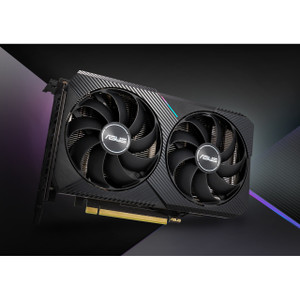
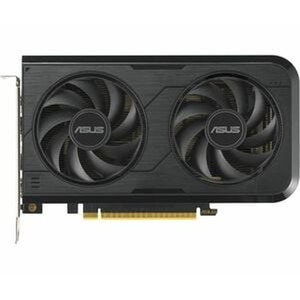
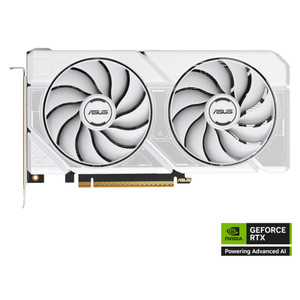
ASUS DUAL-RTX4070-12G-WHI Dual GeForce RTX 4070 12GB White Graphics Card
Overview
The ASUS DUAL-RTX4070-12G-WHI is a white-finish dual-fan GeForce RTX 4070 graphics card carrying 12GB of GDDR6X memory across a 192-bit bus — a practical choice for workstations and rendering nodes where you need Ada Lovelace performance without stepping into the power and thermal demands of the RTX 4080 class. The DUAL-RTX4070-12G-WHI (often searched as DUAL RTX4070 12G WHI) slots into any PCIe 4.0 x16 system and connects up to four displays simultaneously via its single HDMI 2.1 and three DisplayPort 1.4a outputs.
Key Features
- 5,888 CUDA Cores on Ada Lovelace: NVIDIA's Ada Lovelace architecture delivers the tensor and RT core density needed for hardware-accelerated ray tracing and AI workloads — useful in video analytics development environments or GPU-accelerated transcoding pipelines where you're pre-processing feeds before ingestion into a VMS.
- 12GB GDDR6X on a 192-bit Bus: 12GB of frame buffer keeps large inference models, multi-stream decode workloads, and 4K texture pipelines from thrashing system RAM. The 192-bit bus is narrower than the RTX 4080's 256-bit path, so memory-bandwidth-bound workloads will hit a ceiling — worth noting before deploying into heavy parallel inference.
- 2475 MHz Boost / 2505 MHz OC Mode: The factory OC mode pushes the boost clock to 2505 MHz versus the reference 2475 MHz — a modest ~1.2% lift. Useful if you're benchmarking throughput on a per-stream basis, but not a material differentiator for most deployments.
- PCIe 4.0 Interface: PCIe 4.0 x16 doubles the available bandwidth versus Gen 3, which matters when your host CPU is feeding the card high-resolution raw frame data continuously. Compatible with PCIe 3.0 slots at reduced bandwidth — verify your server or workstation platform before ordering.
- Four-Display Output (HDMI 2.1 + 3x DisplayPort 1.4a): Supports up to 7680×4320 (8K) maximum resolution and drives four independent displays. In a video wall or operator workstation context, three DisplayPort outputs plus one HDMI means you can run a quad-monitor layout from a single card without a hub or splitter.
- HDMI 2.1: The single HDMI port at version 2.1 supports 4K@120Hz and 8K@60Hz — relevant if you're feeding a high-refresh display for real-time playback review or connecting to a 4K monitor that only has HDMI input.
- DisplayPort 1.4a: All three DP outputs are version 1.4a, supporting DSC (Display Stream Compression) for high-resolution multi-monitor setups. If you're driving 4K monitors on all three DP ports simultaneously, DSC keeps the signal path clean without visible quality degradation.
- White Aesthetic (WHI Variant): The -WHI suffix identifies the white colorway versus the standard black DUAL-RTX4070-12G. Functionally identical — same cooler design, same PCB. Relevant only if the build aesthetic matters, as in a client-facing workstation or a white-themed system integration.
Integration and Compatibility
The DUAL-RTX4070-12G-WHI installs into any PCIe 4.0 (or backward-compatible PCIe 3.0) x16 slot. Verify your chassis has clearance for a dual-slot, dual-fan cooler before ordering — ASUS does not publish dimensional data in the known spec set for this SKU. Power connector requirements follow RTX 4070 reference spec; confirm your PSU has the appropriate 16-pin (12VHPWR) or adapter cable. No parallel processing technology (NVLink/SLI) is supported on this card — this is a single-GPU solution only.
For graphics cards in the ASUS product line, the DUAL series sits between the entry-level PHoenix and the higher-end TUF/ROG STRIX variants in terms of cooling mass and factory overclock. If you need the full ASUS ASUS GPU catalog for comparison, the TUF RTX 4070 carries a larger heatsink suited to sustained compute workloads in poorly ventilated enclosures.
Integrators deploying this card into a workstation for GPU-accelerated analytics or NVR transcoding offload should confirm CUDA toolkit compatibility with the software stack — the 5,888 CUDA cores are accessible via CUDA, but the evidence does not confirm OpenCL or specific SDK versions. Pair with a managed PoE switch infrastructure when deploying alongside IP camera systems that feed GPU-accelerated analytics engines.
Frequently Asked Questions
Q: What is the maximum resolution supported by the ASUS DUAL-RTX4070-12G-WHI?
A: The DUAL-RTX4070-12G-WHI supports a maximum resolution of 7680×4320 pixels (8K), output via HDMI 2.1 or DisplayPort 1.4a.
Q: How many monitors can I connect to the DUAL-RTX4070-12G-WHI simultaneously?
A: Up to four displays simultaneously — one via HDMI 2.1 and three via DisplayPort 1.4a. This makes it a practical single-card solution for quad-monitor operator workstations.
Q: Does the DUAL-RTX4070-12G-WHI support SLI or multi-GPU configurations?
A: No. Parallel processing technology (NVLink/SLI) is not supported on this card. It is a single-GPU solution only.
Q: What PCIe interface does the ASUS DUAL-RTX4070-12G-WHI use?
A: The card uses PCI Express 4.0. It is backward compatible with PCIe 3.0 slots at reduced bandwidth — confirm your platform supports the card's power and physical requirements before deploying.
Q: What is the difference between the DUAL-RTX4070-12G-WHI and the standard DUAL-RTX4070-12G?
A: The -WHI suffix denotes the white colorway. Functionally, both cards share the same GPU, memory configuration, cooling design, and clock speeds. The distinction is purely aesthetic.
Q: Does the DUAL-RTX4070-12G-WHI support CUDA?
A: Yes. The card includes 5,888 CUDA cores on NVIDIA's Ada Lovelace architecture, supporting CUDA-based compute workloads including GPU-accelerated inference, transcoding, and rendering pipelines.
The DUAL-RTX4070-12G-WHI hits a useful middle ground for integrators building GPU-accelerated analytics workstations around NVIDIA's Ada Lovelace platform — specifically, the 5,888 CUDA cores and 12GB of GDDR6X memory position it well for multi-stream inference pipelines without the power draw and cost of RTX 4080 or above. Where I've found it relevant is in edge analytics nodes that need to process decoded video frames through a detection model in near-real-time, where 12GB of VRAM keeps model weights resident without constant swapping.
Technical Highlights:
- 12GB GDDR6X / 192-bit bus: Sufficient VRAM for most mid-scale inference models, but the 192-bit bus limits peak memory bandwidth versus wider-bus peers — at sustained throughput, you'll see this card plateau earlier than a higher-tier option.
- 2505 MHz OC mode: Factory OC adds roughly 30 MHz over the reference boost — useful to validate in your thermal environment before relying on it in a sealed chassis or poorly ventilated rack shelf.
- 4-display output via HDMI 2.1 + 3x DP 1.4a: Drives a full quad-monitor operator console from a single card at up to 8K maximum resolution — eliminates the need for a secondary display card in dense workstation builds.
Deployment Considerations:
- PCIe 4.0 is the native interface; if your workstation or server platform is PCIe 3.0, bandwidth is halved — for high-resolution raw frame ingest, confirm Gen 4 platform support before speccing this card.
- No NVLink/SLI support means if your inference pipeline scales beyond what a single RTX 4070 can handle, you'll need a second discrete slot with a second card — not a bridged dual-GPU config — so plan your chassis slot count accordingly.
Best fit for a quad-display analytics workstation or a compact edge server running CUDA-based video analytics where 12GB VRAM is sufficient for the model set and the white finish either doesn't matter or is a deliberate build requirement.