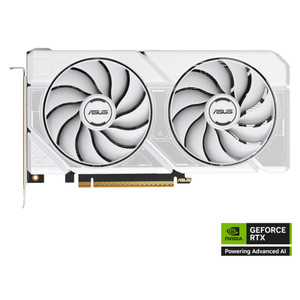
ASUS DUAL-RTX5060TI-O16G-WHITE GeForce RTX 5060 Ti 16GB White OC Edition Graphics Card
Overview
The ASUS DUAL-RTX5060TI-O16G-WHITE is a factory-overclocked GeForce RTX 5060 Ti graphics card carrying 16 GB of GDDR7 memory — a meaningful step up from the 8 GB configs that dominated the previous generation. Built on NVIDIA's Ada-successor Blackwell architecture, it targets professional AI inference workloads, video analytics acceleration, and demanding rendering pipelines where you need full PCIe 5.0 bandwidth and a VRAM headroom that won't bottleneck large model batches. The dual-fan Axial-tech cooling system draws thermal design DNA from ASUS's flagship ROG line, keeping thermals in check without the bulk of a triple-slot card.
If you've been evaluating GPU-accelerated video analytics servers — running object detection, license plate recognition, or edge AI inference at scale — the DUAL-RTX5060TI-O16G-WHITE (often searched as DUAL RTX5060TI O16G WHITE) represents a point where GDDR7 memory bandwidth and 4,608 CUDA cores intersect at a mainstream price tier.
Key Features
- 16 GB GDDR7 on a 128-bit Bus at 28 Gbit/s: GDDR7 delivers roughly 2× the bandwidth-per-pin of GDDR6, so even though this is a 128-bit bus, real-world throughput is competitive with wider GDDR6X implementations. For AI inference workloads — running multiple concurrent neural network models for video analytics — 16 GB means you're not swapping model weights in and out of VRAM mid-batch. That directly translates to lower inference latency and higher channel throughput on GPU-accelerated VMS platforms.
- 4,608 CUDA Cores at 2,632 MHz (OC Mode): The factory overclock pushes the boost clock 30 MHz above the reference 2,602 MHz spec. In sustained compute tasks like frame-by-frame analytics or parallel transcoding, the higher sustained clock floor reduces the performance variance you'd otherwise tune around. The 4,608-core count also gives you meaningful parallelism headroom versus the trimmed-down 5060 (non-Ti) die.
- PCIe 5.0 Interface: The card slots into any PCIe 5.0 x16 slot and remains backward compatible with PCIe 4.0 and 3.0 motherboards. In a workstation or server build where you're pairing this with a current-gen Xeon or Ryzen Threadpro platform, PCIe 5.0 eliminates the bus as a bottleneck for large texture streaming or high-bandwidth GPU-to-CPU data transfers in inference pipelines.
- Four Simultaneous Display Outputs (1x HDMI 2.1b + 3x DisplayPort 2.1b): HDMI 2.1b and DisplayPort 2.1b both support up to 7,680 × 4,320 (8K) at high refresh rates — relevant if you're driving a multi-monitor security operations center wall or a 4K × 4 video wall from a single workstation. Four outputs means a single card handles a full operator console without a display hub or secondary card.
- 8K Maximum Resolution (7,680 × 4,320): Ceiling resolution matters less for typical deployments than it does for future-proofing a console build. If your operations center is moving to 4K per-monitor, this card drives all four displays at native 4K with headroom to spare — no compromises on playback quality when reviewing high-resolution forensic footage.
- Dual Axial-Tech Fan Cooling: ASUS's Axial-tech fans use a smaller hub and longer blade design to increase airflow at lower RPM compared to conventional axial fans. In always-on analytics server builds — where the GPU runs at sustained load 24/7 — lower fan RPM at equivalent thermal dissipation means lower acoustic output and reduced bearing wear over multi-year deployment cycles.
- White Aesthetic with OC Edition Binning: The White OC Edition uses factory-selected GPU dies binned for sustained higher clocks. For integrators building security operations center workstations where the tower or chassis is customer-visible, the white colorway addresses aesthetic requirements without sacrificing the OC firmware that gives you the 2,632 MHz ceiling.
Integration and Compatibility
The DUAL-RTX5060TI-O16G-WHITE connects via PCIe 5.0, compatible with any standard x16 PCIe slot on current and recent-generation platforms. NVIDIA CUDA support — confirmed present — means the card integrates directly with GPU-accelerated analytics platforms that call CUDA APIs: Milestone XProtect with DeepLens acceleration, Genetec with GPU-offload plugins, and standalone deep-learning inference runtimes (TensorRT, ONNX Runtime with CUDA execution provider). GDDR7's bandwidth profile also benefits network video recorder appliances and AI servers that pair this card with high-channel-count NVR software for real-time analytics across 32+ streams simultaneously.
With four display outputs driving up to four independent 8K-capable monitors simultaneously, this card is a practical choice for security hardware builds targeting multi-monitor SOC (Security Operations Center) workstations. The PCIe 5.0 interface ensures compatibility with server-grade motherboards used in rackmount AI inference nodes, while the standard dual-slot form factor fits most 4U or larger chassis without modification.
For organizations building GPU-accelerated analytics pipelines, pair this card with a PoE network switch infrastructure that feeds high-resolution camera streams to the analytics server — higher-resolution camera inputs push more pixels per second through the inference engine, and the 16 GB GDDR7 VRAM ensures the model weights stay resident even when stream count scales up. Consult a IP camera selection guide to match camera resolution and frame rate output to your GPU compute budget.
Frequently Asked Questions
Q: What is the GPU boost clock speed of the DUAL-RTX5060TI-O16G-WHITE in OC mode?
A: In OC mode, the ASUS DUAL-RTX5060TI-O16G-WHITE boosts to 2,632 MHz. The standard boost clock (non-OC) is 2,602 MHz. The OC mode frequency is enabled via ASUS GPU Tweak software or the factory BIOS profile.
Q: Does the DUAL-RTX5060TI-O16G-WHITE support CUDA for AI and analytics acceleration?
A: Yes. The card includes 4,608 CUDA cores on the GeForce RTX 5060 Ti GPU. CUDA support means it is compatible with NVIDIA-CUDA-based AI inference runtimes including TensorRT and ONNX Runtime (CUDA execution provider), which are used by GPU-accelerated video analytics platforms.
Q: How many monitors can the DUAL-RTX5060TI-O16G-WHITE drive simultaneously?
A: Up to four displays simultaneously — one via HDMI 2.1b and three via DisplayPort 2.1b. All four outputs support up to 7,680 × 4,320 (8K) resolution.
Q: Is the DUAL-RTX5060TI-O16G-WHITE compatible with PCIe 4.0 motherboards?
A: Yes. The card uses a PCIe 5.0 interface which is backward compatible with PCIe 4.0 and PCIe 3.0 x16 slots. You will not see full PCIe 5.0 bandwidth on older platforms, but the card will function correctly.
Q: How much VRAM does the DUAL-RTX5060TI-O16G-WHITE have, and what type?
A: 16 GB of GDDR7 memory on a 128-bit memory bus, running at 28 Gbit/s. GDDR7 offers substantially higher bandwidth per pin than GDDR6, making this configuration well-suited for large AI model inference and high-resolution video analytics workloads.
Q: Does the DUAL-RTX5060TI-O16G-WHITE support parallel processing (SLI/NVLink)?
A: No. Parallel processing technology (SLI/NVLink multi-GPU) is not supported on this card per the product specifications.
The DUAL-RTX5060TI-O16G-WHITE is the first card in the mainstream Ti tier I'd seriously consider for a dedicated GPU analytics node — primarily because of the 16 GB GDDR7 specification. Running a multi-model inference stack (object detection + license plate recognition + behavior analytics simultaneously) on an 8 GB card means constant VRAM eviction under load; 16 GB keeps all three model graphs resident at once, which matters when you're processing 32+ camera streams with sub-second latency requirements.
Technical Highlights:
- GDDR7 at 28 Gbit/s: On a 128-bit bus, this delivers an effective memory bandwidth that outpaces GDDR6X implementations on equivalent bus widths — directly reducing the memory-bound bottleneck in large batch inference operations common in multi-camera analytics pipelines.
- 2,632 MHz OC Boost Clock: The 30 MHz factory OC over the reference 2,602 MHz ceiling is consistent across the board bin — this isn't a software-only OC that collapses under thermal load. In sustained 24/7 analytics server operation, that clock floor stability matters more than peak burst numbers.
- 4,608 CUDA Cores: Compared to the base RTX 5060, the Ti die adds a meaningful core count delta. For parallelized inference workloads — where CUDA threads map directly to frame analysis operations — the additional cores reduce per-frame inference time at higher stream counts.
Deployment Considerations:
- PCIe 5.0 is the native interface, but backward compatibility with PCIe 4.0 slots means this card drops into existing workstation refreshes without a motherboard upgrade — confirm your chassis has adequate clearance for the dual-slot cooler before ordering.
- Multi-GPU (SLI/NVLink) is explicitly not supported — if your analytics workload requires more than 16 GB VRAM, you'll need to scale horizontally (multiple single-card nodes) rather than vertically with a second card in the same chassis.
Best fit: a GPU analytics server running CUDA-accelerated VMS plugins (Milestone, Genetec, or standalone TensorRT inference) in a security operations center build where 32–64 camera streams need simultaneous real-time analytics and the operator console is driven from the same card's four display outputs.