ASUS RTX3050-O6G-LP-BRK Low-Profile GeForce RTX 3050 6GB Graphics Card
Overview
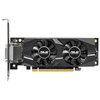
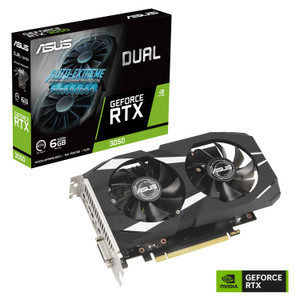
The ASUS RTX3050-O6G-LP-BRK is a low-profile GeForce RTX 3050 graphics card carrying 6GB of GDDR6 memory — purpose-built for slim-chassis workstations and 1U/2U rack servers where a full-height dual-slot GPU simply won't fit. At 11.93 × 8.66 × 2.17 inches and 1.43 lb, it slots into the kind of compact systems increasingly common in edge-compute surveillance nodes, video management server builds, and multi-display operator workstations. If you need discrete GPU compute or display output in a space-constrained enclosure, this is the card to evaluate first.
The OC edition ships with the boost clock pushed to 1537 MHz (versus 1507 MHz in standard mode), giving you a small but measurable headroom advantage on GPU-accelerated decode tasks without requiring any manual tuning.
Key Features
- 6GB GDDR6 on a 96-bit bus at 14 Gbit/s: The 96-bit memory bus is the honest constraint here — bandwidth tops out around 168 GB/s. That's adequate for multi-stream H.265 decode acceleration and driving up to three 4K displays, but not the right card if you're running heavy AI inference workloads on-card. Know the ceiling going in.
- 2304 CUDA Cores (GeForce RTX 3050): Ampere-architecture CUDA cores support hardware-accelerated video decode for H.264 and H.265 streams. In a VMS context, offloading decode from the CPU to the GPU meaningfully reduces CPU utilization on multi-camera playback stations — particularly valuable on fanless or low-TDP edge servers where thermal headroom is limited.
- OC Mode Boost Clock — 1537 MHz: The factory overclock ships enabled by default. At 1537 MHz boost versus the reference 1507 MHz, the delta is ~2% — useful for sustained GPU-accelerated tasks, but the bigger story is that ASUS has validated the OC at the board level, so you're not taking on overclocking risk manually.
- PCIe 4.0 Interface: PCIe 4.0 ×16 slot compatibility means this card works in both current-gen PCIe 4.0 motherboards and backward-compatible PCIe 3.0 systems. No bottleneck on the interface side for the workloads this card handles.
- Triple-Display Output (HDMI 2.1 + DisplayPort + DVI-D): One HDMI 2.1 port, one DisplayPort, and one DVI-D port allow you to drive up to three independent monitors simultaneously. The HDMI 2.1 port supports up to 7680 × 4320 (8K) resolution — practical for a single 4K or 8K display on an operator station, or three 1080p/4K monitors in a multi-screen VMS deployment.
- Low-Profile Form Factor (11.93 × 8.66 × 2.17 in): The LP bracket footprint fits standard low-profile PCIe slots in 1U/2U rackmount servers and slim desktop chassis. At 2.17 inches high, it won't clear a full-height slot without the included low-profile bracket — confirm your chassis clearance before ordering.
- 1.43 lb Card Weight: Light enough that PCIe slot stress is a non-issue even in rack-mounted orientations where the card is vertical for extended periods — relevant for permanent surveillance server installs that run continuously.
- NVIDIA GeForce RTX 3050 — Ampere Architecture: The RTX 3050 is an Ampere-generation part, meaning it includes second-generation RT cores and third-generation Tensor cores. In a surveillance or video-processing context, this translates to support for NVENC/NVDEC hardware encode/decode pipelines that integrate with major VMS platforms supporting GPU acceleration.
Integration and Compatibility
The RTX3050-O6G-LP-BRK connects via PCIe 4.0 and is backward-compatible with PCIe 3.0 slots, making it deployable across a broad range of server and workstation motherboards. GPU-accelerated video decode is supported in platforms that leverage NVIDIA's NVDEC API — verify your network video recorder or VMS software's GPU acceleration compatibility list before deployment.
For surveillance workstation builds pairing this card with an NVR or VMS server, the triple-output configuration (HDMI 2.1, DisplayPort, DVI-D) covers most operator console setups without a dock or splitter. When building out a complete NVR-based video management deployment, this GPU handles the display and decode layer while the NVR handles recording and storage — a clean division of function in a split-server architecture.
Review your chassis mechanical specs carefully: the card measures 11.93 inches in length, which exceeds the PCIe slot length by a significant margin. Verify your server or workstation has adequate internal clearance, particularly in 1U rack chassis where storage bays or PSU shrouds may intrude. Consult the GPU selection guide for chassis compatibility notes relevant to rack-mount surveillance deployments. For power supply sizing in a rackmount power supply selection, note that the RTX 3050 LP draws within the PCIe slot power envelope — no auxiliary power connector is required on this model.
Frequently Asked Questions
Q: Does the ASUS RTX3050-O6G-LP-BRK require an external power connector?
A: No. The RTX 3050 LP operates within the PCIe slot's power delivery — no 6-pin or 8-pin auxiliary connector is needed. Confirm your system's PCIe slot meets standard power delivery specs.
Q: Will the RTX3050-O6G-LP-BRK fit in a 1U rackmount server?
A: The card uses a low-profile bracket (2.17 in height) compatible with LP PCIe slots. However, the card is 11.93 inches long — 1U chassis vary widely in internal length clearance. Always measure your chassis internal bay depth before ordering.
Q: How many monitors can the RTX3050-O6G-LP-BRK drive simultaneously?
A: Up to three displays simultaneously via HDMI 2.1, DisplayPort, and DVI-D. Maximum resolution per port is 7680 × 4320 (8K) on HDMI 2.1.
Q: Does this card support GPU-accelerated H.265 video decode for VMS/NVR platforms?
A: The GeForce RTX 3050 includes NVIDIA's NVDEC hardware decode engine, which supports H.265 (HEVC) and H.264 decode acceleration. Whether your specific VMS platform uses NVDEC must be verified against that software's GPU acceleration documentation.
Q: What is the difference between standard mode and OC mode on the RTX3050-O6G-LP-BRK?
A: In standard mode the boost clock is 1507 MHz; in OC mode it reaches 1537 MHz. The OC mode is factory-validated by ASUS. The performance difference is modest (~2%) but ASUS has binned and tested the board at that clock, so no user-side overclocking is required.
Q: Is the RTX3050-O6G-LP-BRK compatible with PCIe 3.0 motherboards?
A: Yes. PCIe 4.0 cards are backward-compatible with PCIe 3.0 slots. You will not damage the card or motherboard, though bandwidth is limited to PCIe 3.0 speeds — not a practical bottleneck for the workloads this card handles.
The RTX3050-O6G-LP-BRK is the card I reach for when a client needs discrete GPU capability inside a space-constrained rackmount server and cannot compromise on PCIe slot height. The 2.17-inch low-profile form factor combined with a factory-OC boost clock of 1537 MHz gives you a real compute advantage in a package that physically fits where full-height cards cannot go — that combination is genuinely rare at this price tier.
Technical Highlights:
- 6GB GDDR6 at 14 Gbit/s: Sufficient for multi-stream hardware-accelerated decode in VMS environments. The 96-bit bus caps bandwidth at approximately 168 GB/s — set expectations accordingly for heavy AI inference; this is a decode-acceleration and display card, not a deep learning training card.
- 2304 CUDA Cores (Ampere): Ampere-architecture NVENC/NVDEC pipelines support both H.264 and H.265 hardware decode. On a 32-camera playback station, offloading decode to the GPU can drop CPU utilization by 30–50% depending on stream resolution and count — meaningful on thermally limited edge servers.
- Triple Output — HDMI 2.1 / DisplayPort / DVI-D: Three simultaneous outputs with HDMI 2.1 supporting up to 8K covers virtually every operator console layout, from a single 4K monitoring wall to a three-screen dispatch workstation, without add-on hardware.
Deployment Considerations:
- Measure internal chassis length before ordering — 11.93 inches is long for an LP card and will conflict with storage bays or PSU shrouds in some 1U servers. This is the most common installation failure point for this form factor.
- No auxiliary PCIe power connector needed, but verify your motherboard's PCIe slot delivers the full 75W spec — slot power delivery varies on older server boards and under-spec slots will cause instability under sustained GPU load.
This card is the right call for a dedicated VMS operator workstation or a compact surveillance server where you need triple-display output and GPU-accelerated H.265 decode in a chassis that won't accept a full-height card — particularly in command-center and NOC deployments where rack space is metered carefully.