ASUS GT730-SL-2GD5-BRK GeForce GT 730 2GB GDDR5 Silent Low-Profile Graphics Card
Overview
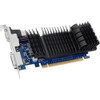
The ASUS GT730-SL-2GD5-BRK is a passively cooled discrete graphics card built around NVIDIA's GeForce GT 730 GPU — a practical choice when you need multi-display output, hardware video decode offload, or basic discrete graphics in a system where noise is unacceptable. The 0dB fanless thermal design means no moving parts, no acoustic signature, and no fan bearing to fail over time. At 1.10 lb and 9.00 x 6.50 x 2.10 inches, this card fits standard ATX builds and stays out of the way of adjacent slots.
This is not a gaming card. It is a workstation utility card — the kind of GPU you drop into a digital signage PC, a silent home-theater system, a surveillance decode station, or any headless box that needs three simultaneous display outputs without adding a loud cooler to the chassis.
Key Features
- Fanless 0dB Thermal Design: No spinning fan means zero acoustic output at idle or load — relevant for home-theater PCs, medical workstations, or any deployment where fan noise is a disqualifier. Fewer moving parts also reduces the primary failure mode in long-term fixed installs.
- 2GB GDDR5 Memory on a 64-Bit Bus: GDDR5 at 5010 MHz effective clock delivers substantially higher memory bandwidth than GDDR3 variants of the GT 730 despite the narrow 64-bit bus. For decode-heavy workloads like multi-stream surveillance playback or 1080p video looping, the bandwidth advantage over DDR3 equivalents matters more than raw capacity.
- 384 CUDA Cores at 902 MHz: Enough compute to hardware-accelerate H.264 decode, handle CUDA-based workloads in lightweight compute applications, and drive PhysX if needed. Do not expect this core count to handle real-time encoding or compute-intensive tasks — it's sized for display and decode, not production rendering.
- Triple Display Output (HDMI + DVI-D + VGA): One card covers HDMI 1.4, single-link DVI-D, and a legacy VGA (D-Sub) — useful when your install mixes modern and older displays without a separate adapter chain. Maximum resolution tops out at 2560 x 1600, which covers 1440p and below without issue.
- DirectX 11 and OpenGL 4.4: Covers the API requirements for most enterprise software, digital signage platforms, and surveillance VMS clients that rely on GPU-accelerated rendering. Not DirectX 12 — factor that in if your software stack has a hard DX12 requirement.
- PCI Express 2.0 Interface: Slots into any PCIe x16 slot on modern or legacy motherboards. PCIe 2.0 bandwidth is not a bottleneck for this GPU class — you can install it in PCIe 3.0 or 4.0 systems without compatibility concerns; the card runs at its own spec.
- HDCP Support: HDCP-compliant output means the card can pass protected content through HDMI — relevant for digital signage or home-theater builds where DRM-protected streams need to reach a display without a handshake failure.
- PhysX Hardware Support: NVIDIA PhysX acceleration is present, though at 384 cores this is secondary capability. Noted for completeness where software dependencies on PhysX exist.
Integration and Compatibility
The GT730-SL-2GD5-BRK connects via PCI Express 2.0, compatible with x16 slots across current-generation desktop platforms. The card draws power directly from the PCIe slot — no auxiliary power connector required — simplifying installation in compact or fanless chassis with limited PSU cabling. DirectX 11, OpenGL 4.4, and CUDA support align with driver requirements for most surveillance VMS clients, digital signage engines, and lightweight NVR decode workstations running Windows. NVIDIA driver support for the GT 730 is available through the NVIDIA legacy driver channel. Verify driver compatibility with your OS version before deployment in production systems. The triple-output configuration (HDMI, DVI-D, VGA) covers most commercial display combinations without adapters, though simultaneous use of all three outputs depends on resolution and refresh rate constraints of the GT 730 display engine. For builds requiring discrete GPU options with higher CUDA core counts or newer API support, evaluate current-generation alternatives in the ASUS GPU lineup. If your deployment is primarily a digital signage or silent HTPC build, the fanless design and HDCP output of this card remain its strongest arguments.
Frequently Asked Questions
Q: Does the GT730-SL-2GD5-BRK require an external power connector?
A: No. The card draws all required power from the PCIe x16 slot — no 6-pin or 8-pin power connector is needed. This simplifies installation in compact or small-form-factor chassis.
Q: Can the GT730-SL-2GD5-BRK drive three monitors simultaneously?
A: The card provides HDMI, DVI-D, and VGA outputs. Whether all three can be used simultaneously depends on your operating system and driver configuration. Check NVIDIA's driver documentation for multi-display limitations specific to the GT 730 display engine.
Q: What is the maximum resolution supported by the GT730-SL-2GD5-BRK?
A: 2560 x 1600 pixels — this covers 1440p and 1080p displays without issue. It does not support 4K (3840 x 2160) output.
Q: Is this card compatible with PCIe 3.0 or 4.0 motherboards?
A: Yes. PCIe is backward and forward compatible. The GT730-SL-2GD5-BRK (PCI Express 2.0) will operate in PCIe 3.0 or 4.0 slots at PCIe 2.0 speeds, which is not a performance bottleneck for this GPU class.
Q: What DirectX and OpenGL versions does the GT730-SL-2GD5-BRK support?
A: DirectX 11 and OpenGL 4.4. It does not support DirectX 12. Verify your software's API requirements before specifying this card for a new deployment.
Q: Is the GT730-SL-2GD5-BRK suitable for hardware-accelerated video decode in surveillance applications?
A: It supports NVIDIA CUDA and NVDEC hardware decode, which many VMS clients use to offload H.264 stream decoding from the CPU. At 384 CUDA cores, it is appropriate for light multi-stream decode (typically 4–8 streams at 1080p depending on the VMS). It is not sized for high-density decode stations.
The GT730-SL-2GD5-BRK earns its place in a very specific scenario: you need discrete GPU output and CUDA decode capability in a chassis where fan noise is not acceptable. The fanless 0dB design is the defining spec here — not the 384 CUDA cores or the 902 MHz clock. If silence is the constraint, this card solves it without compromise on the thermal side.
Technical Highlights:
- GDDR5 at 5010 MHz: Despite the 64-bit memory bus, GDDR5 memory gives this card meaningfully higher bandwidth than DDR3-equipped GT 730 variants — relevant when your VMS client is pulling multiple compressed streams through the decode pipeline simultaneously.
- Triple Output Configuration: HDMI + DVI-D + VGA on one card means you can cover a mixed-display environment — a newer HDMI monitor alongside a legacy DVI or VGA panel — without a separate active adapter. Max resolution of 2560 x 1600 handles any 1440p or 1080p display in the field.
- No Auxiliary Power Required: At this performance tier, the card runs entirely off the PCIe slot. In fanless mini-ITX or compact ATX builds where PSU cabling is already tight, eliminating the 6-pin connector requirement is a real installation simplification.
Deployment Considerations:
- This card runs NVIDIA legacy drivers — verify driver availability for your target OS (particularly if deploying on Windows Server or a non-standard Linux distribution) before committing it to a production workstation or decode station build.
- The 64-bit memory bus is the hard ceiling on bandwidth. At 2GB GDDR5 and 5010 MHz clock, you are near the top of what this bus width can deliver — adding more streams or higher-resolution decode will hit the bus before the CUDA cores saturate.
The GT730-SL-2GD5-BRK is the right call for a silent surveillance decode workstation or a fanless digital signage player where the acoustic environment rules out any active cooling. It is not the answer for high-density multi-stream decode or any workflow that requires DirectX 12 or modern encoder support.