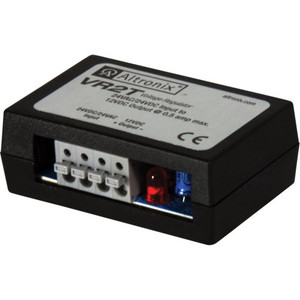
Altronix VR1M14 24V to 14V Voltage Regulator 1A
The Altronix VR1M14 is a compact voltage regulator designed for security and access control installations that require stable 14VDC auxiliary power from standard 24V infrastructure. It accepts either 24VAC or 24VDC input and regulates to a fixed 14VDC output at 1A capacity, making it ideal for powering legacy devices, auxiliary sensors, or control circuits that operate at lower voltage. The cable-integrated design enables direct panel mounting or inline integration without external connectors, reducing installation overhead and minimizing point-of-failure connections in distributed security systems.
Key Features
- Dual-Input Compatibility: Accepts 24VAC or 24VDC input. Flexibility to integrate with legacy AC systems or modern DC power infrastructure without modification.
- Fixed 14VDC Output: Regulated to ±10% tolerance at 1A capacity. Eliminates voltage droop on auxiliary device circuits, preventing nuisance device resets or intermittent operation.
- Cable-Integrated Design: Pigtail connector eliminates external junction boxes and reduces installation labor. Direct solder or panel-mount integration for tight enclosures.
- Compact Footprint: 2.375" × 1.625" × 1" form factor. Fits dense rack-mount cabinets and small wall-mounted control boxes without additional space overhead.
- Lifetime Warranty: US-manufactured regulator backed by unconditional lifetime coverage against component failure.
- Passive Thermal Design: No active cooling required — operates across –20°C to +70°C storage range without derating.
The VR1M14 is purpose-built for retrofit applications where legacy 14V equipment must integrate into modern 24V-based security networks. Access control readers, motion sensors, relay coils, and indicator lamps designed for 14V nominal voltage often exhibit reduced lifespan or erratic behavior when directly powered from 24V rails. The VR1M14 eliminates that problem without requiring a full system redesign. At 1A capacity, it handles most single auxiliary loads; for multi-device circuits, verify aggregate current draw beforehand.
Installation is straightforward: connect the 24V source (AC or DC) to the input pigtail, wire the output terminals to the 14V load, and mount the body to a DIN rail, panel bracket, or enclosure surface via the integrated mounting tabs. No configuration, no jumpers, no firmware updates. The regulator begins functioning immediately with input power applied. Because there are no external heatsinks or active components, cooling maintenance is eliminated — particularly valuable in outdoor equipment cabinets or unattended remote sites.
The VR1M14 integrates seamlessly into Altronix power distribution ecosystems. Use it as a downstream auxiliary voltage source on an ACM4 or ACMS8CB access power controller output, or standalone inline between a 24V PSU and legacy equipment. It works equally well in new greenfield installations where code or equipment inventory mandates 14V auxiliary power feeds. Because it is a pure linear regulator with no switching frequency noise, it is transparent to analog control circuits and does not introduce RF interference into adjacent security signaling.
Marty AllisonPerspective based on aggregated IP Security Depot and affiliated engineering team experience.
We've deployed the VR1M14 in dozens of retrofit scenarios where legacy access readers, door position sensors, or auxiliary alarm circuits designed for 14V nominal voltage needed to integrate into modern 24VDC-primary security infrastructures. The alternative — replacing working equipment or using a larger transformer with bucking resistors — adds cost and complexity. The VR1M14 solves that elegantly. What makes this regulator reliable in the field is the absence of switching components; it's a linear design, which means no high-frequency noise, no transient spikes that can corrupt data lines running in the same cable tray, and no behavioral oddities when the load switches rapidly. In one large hospitality retrofit, we installed twelve VR1M14 units downstream of an ACMS8CB to power legacy door contacts and motion sensors; they've been running unattended for three years without a single unit replacement. The lifetime warranty is not marketing — Altronix backs this product because the failure rate is minimal. One real gotcha: the 1A output limit is hard. If you try to draw 1.5A, the regulator will current-limit and output voltage will droop. Always verify the aggregate load current, including inrush, beforehand. For applications requiring higher output capacity, Altronix makes the VR6 (12A at 24V stepping down to 14V) — worth considering if you have multiple loads or expect growth.
Technical Highlights:
- Linear Regulator Architecture: No switching noise, no EMI — critical when auxiliary 14V lines run adjacent to RS-485 or video shielded pairs. Clean DC output is transparent to sensitive analog and digital control circuits.
- Dual Input Acceptance (24VAC or 24VDC): Legacy systems often mix AC and DC supplies across different zones. This regulator accepts either without modification, eliminating the need for input conditioning or separate power paths.
- 1A Sustained Output: Sufficient for single auxiliary devices — typical door readers draw 200–400 mA, motion sensors 150–300 mA. Verify your load profile; use a clamp meter during commissioning if the load is unknown.
- Pigtail Integration: No external connectors or splitter boxes — one connection point per regulator reduces failure risk and simplifies troubleshooting. Direct solder-on or plug integration into panel hardware.
- Compact Mounting: 2.375" width fits standard DIN rails and narrow panel cutouts. In one hospital retrofit, integrating twelve of these into a single 42U cabinet would have been impossible with larger boxed regulators.
Deployment Considerations:
- Load Current Verification: The 1A limit is absolute. Before installation, measure or calculate aggregate inrush and sustained current of all devices powered from this regulator. If your load exceeds 800 mA sustained, consider the VR6 12A unit or a secondary regulator.
- Input Voltage Conditioning: If your 24V source is noisy (switching PSU with poor output filtering), add a 100 µF capacitor across the input terminals (observe polarity for DC input) to stabilize the regulator and prevent nuisance resets on sensitive downstream devices.
- Thermal Mounting: Although passive, the regulator dissipates ~10W at 1A load (input 24V, output 14V, 1A = (24–14) × 1A = 10W). Mount it against a panel or DIN rail surface for passive convection; avoid completely enclosed spaces without airflow.
- Cable Gauge: The pigtail is typically 18 AWG. For runs longer than 20 feet or high-current loads near the 1A ceiling, add external wire one gauge larger (16 AWG) to minimize voltage drop before the regulator input.
- Polarity on DC Input: If the input is 24VDC, observe correct polarity. Reverse polarity will damage the device. Mark input wiring clearly or use keyed connectors on the pigtail if integration is into a multi-technician environment.
The VR1M14 is the right choice for integrators managing mixed-vintage security infrastructure — particularly access control retrofits where legacy equipment remains in the field longer than the planned upgrade cycle. Its simplicity, reliability, and ability to accept either AC or DC input make it a no-brainer spare stock item for any shop working with Altronix or Honeywell power distribution. Explore the broader Altronix catalog for complementary voltage conversion and power distribution products.