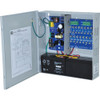
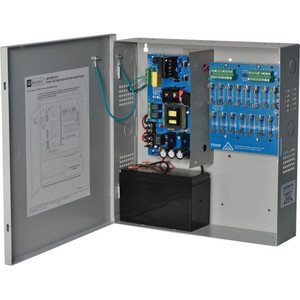
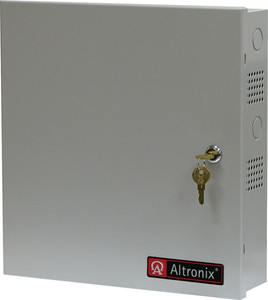
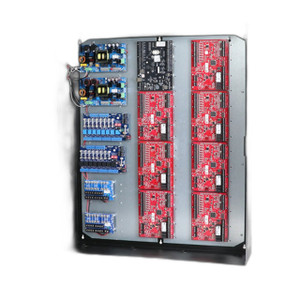
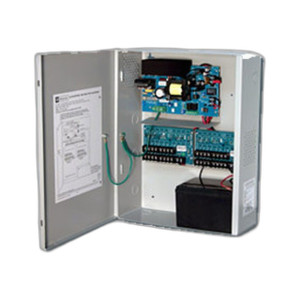
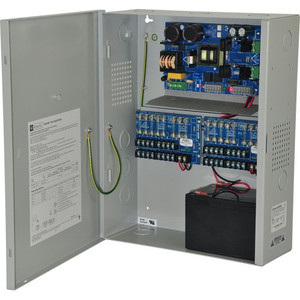
Altronix SMP3PMP16 16-Output Supervised Power Supply
The Altronix SMP3PMP16 is a supervised 12VDC power distribution board engineered for security and access control infrastructure where fault detection and failover capability matter. It accepts 16–28VAC input, regulates to 12VDC, and distributes power across 16 independently fused outputs. Built-in supervision circuitry monitors AC mains failure, low battery voltage, and battery presence — eliminating blind spots in your power chain and triggering alerts before systems go dark.
Key Features
- 16 independently fused outputs: Each output circuit breaks on fault, protecting downstream equipment and preventing one failed device from taking the entire distribution board offline. Granular control over which cameras, readers, or modules stay powered during incidents.
- AC failure supervision: Detects loss of mains supply and logs the event — critical for access control, where a missed power event can leave entry points unmonitored. Built-in relay output available for integration with alarm panels or NVRs.
- Low battery and battery presence monitoring: The board actively watches for weak battery voltage and missing battery connections, preventing silent failures where backup power has degraded or been accidentally disconnected.
- 12VDC regulated output: Delivers stable 12VDC across all 16 channels, supporting the voltage window required by most legacy and modern security cameras, access control readers, and door locks without additional regulators.
- Three output current ratings (0.5A, 4A, 6A per channel): Mix and match outputs based on device power draw — low-power IP camera encoders on 0.5A channels, mid-range analog modules on 4A, and heavier readers or lock controllers on 6A. No over-engineering individual circuits.
- Battery backup integration: Onboard connectors and circuitry support external 12VDC battery packs, allowing supervised failover to UPS power without external converters or relay logic. Supervision includes low-battery warning before reserves expire.
- Compact board form factor (7″L × 4″W × 1″H): Mounts in standard DIN rail enclosures or wall-mounted BC300 housings, fitting into tight spaces typical of security equipment rooms and access control closets without dedicated power cabinets.
- CE approved: Meets European safety and EMC standards, simplifying compliance documentation for integrators deploying across multiple jurisdictions.
Typical Deployment Scenarios
Multi-camera 12VDC infrastructure: Deploy the SMP3PMP16 as a centralized hub for a cluster of analog cameras, IP encoders, and edge storage modules in a warehouse, parking lot, or retail environment. Each camera circuit is independently fused, so a short at one location doesn't black out the entire site.
Access control with redundant power feeds: Wire reader circuits and electric strike controllers to separate fused outputs, then configure your access control panel to monitor the board's AC-fail and battery-low supervisory relays. When mains power drops, the panel alerts you and can trigger failsafe or failsecure modes depending on your security posture.
Alarm panel auxiliary power: Many legacy and modern security panels require supervised 12VDC rails for sirens, strobes, keypads, and RF modules. The SMP3PMP16's per-channel fusing and supervision align with panel requirements for isolated, monitored power distribution.
Integration & Compatibility
The SMP3PMP16 integrates with any supervised power infrastructure or access control system requiring 16–28VAC input and 12VDC distribution. Supervisory contacts (AC fail, low battery, battery present) are relay-isolated, compatible with hardwired alarm panels, contactless NVR integrations, and building management systems using simple NO/NC logic. Standard battery backup connectors support off-the-shelf 12V sealed lead-acid or lithium packs. No proprietary communication protocol — purely hardwired supervision.
Frequently Asked Questions
Q: Can I use the SMP3PMP16 for IP cameras requiring PoE?
A: No. The SMP3PMP16 is a 12VDC supply only. If your IP cameras are PoE-enabled, they receive power and data over a single Ethernet cable from a PoE switch or injector, not from a 12VDC board. However, the SMP3PMP16 works well for non-PoE analog cameras, IP encoders with separate 12VDC feeds, readers, locks, and auxiliary equipment in the same rack.
Q: What happens if the battery is disconnected or fails?
A: The SMP3PMP16 monitors battery presence and voltage continuously. If the battery is absent or voltage drops too low, the supervision circuit triggers a battery-low relay contact and (if configured) logs an event in your panel. AC mains power is still delivered to all 16 outputs as long as input power is present. Battery absence does not automatically cut output power — it only signals a loss of backup capability.
Q: Is the fusing user-replaceable?
A: Yes. Each of the 16 outputs has a replaceable fuse rated for its current class (0.5A, 4A, or 6A). Check the datasheet for specific fuse types and part numbers; field replacement requires only a screwdriver and compatible fuses.
Q: What input voltage range does the SMP3PMP16 accept?
A: The board accepts 16–28VAC input, a standard range for most commercial power transformers and UPS systems in North America and Europe. If your facility has a narrower supply (e.g., 24VAC ±10%), the SMP3PMP16 will regulate without issue.
Q: Can I daisy-chain multiple SMP3PMP16 boards for more outputs?
A: No. Each board is a standalone supervised supply requiring its own 16–28VAC input line. For distributed power across multiple buildings or zones, install separate boards, each with its own transformer or power feed, and cross-reference their supervisory relays in a central panel logic if needed.
Q: Does the SMP3PMP16 require external conditioning or surge protection?
A: Surge suppression at the input transformer or upstream UPS is recommended in lightning-prone regions; the board itself does not include MOV or gas-discharge protection. For long AC runs subject to noise, a ferrite core or line filter upstream improves stability. Consult the datasheet for grounding best practices.
Ted PerryPerspective based on aggregated IPSD and affiliated engineering team experience.
The Altronix SMP3PMP16 solves a real problem: distributed 12VDC power in security deployments where you need to know instantly when backup power fails or a circuit faults. If you're integrating access control readers, analog cameras, and auxiliary loads across a single site, this board's per-channel fusing and supervisory monitoring prevent cascading failures and reduce troubleshooting time when something goes wrong at 2 a.m.
Technical Highlights:
- 16 independently fused outputs with mixed current ratings (0.5A, 4A, 6A): Right-size each circuit to its load. A low-power encoder or wireless module doesn't force you to oversupply the entire board; a 6A reader circuit doesn't undersupply and fuse prematurely. This granularity cuts nuisance faults and simplifies BOM management across mixed-device deployments.
- AC mains failure supervision with relay output: The moment input power drops, the board triggers a relay contact — no polling, no network dependency. Integrates directly with hardwired alarm panels or contactless NVR trigger logic. In a real outage, your access control system knows within milliseconds, not minutes.
- Battery presence and low-voltage monitoring: Detects dead or missing backup batteries before they're needed. Many deployments fail silently because someone unplugs a battery for maintenance and forgets to reconnect it. The SMP3PMP16 catches that immediately and alerts your panel.
- 16–28VAC input window: Accepts transformer secondaries from 24VAC ±20%, the standard in most commercial buildings. Regulations are forgiving enough that you won't be chasing voltage drops across long runs unless your transformer is undersized — a less common problem.
Deployment Considerations:
- This board is NOT PoE; if half your cameras are PoE and half are 12VDC analog, you'll still need a separate PoE injector or switch. Mixing architectures is common in retrofit scenarios, but it complicates the design.
- Fuses are field-replaceable, but you must stock the correct types and ratings. A blown 4A fuse on a reader circuit means a service call if spares aren't on the truck. Verify the datasheet for exact fuse part numbers before deployment.
- The supervision relays are simple contact closures — they work with any alarm panel or logic module that reads dry contacts. No integration overhead, but also no remote diagnostics. If you need SNMP or syslog alerts, you'll stack a separate monitoring layer on top.
- Battery backup requires an external 12VDC pack; the board itself does not include batteries. Sizing the pack depends on your hold-up time and device draw — a reader and striker might need 5–10Ah, while a full camera cluster could need 20Ah or more. Calculate this separately and verify your enclosure has space.
The SMP3PMP16 is the right choice for warehouse, retail, or multi-building access control where analog camera feeds, door readers, strikes, and auxiliary modules converge on a single supervised 12VDC rail. It's also a solid backbone for backup power on legacy alarm panels that expect isolated, monitored 12VDC distribution and can't tolerate shared power rails. If your deployment is pure PoE or pure cloud-native, this board adds cost without benefit — but in hybrid environments or hardwired security infrastructure, it earns its place.