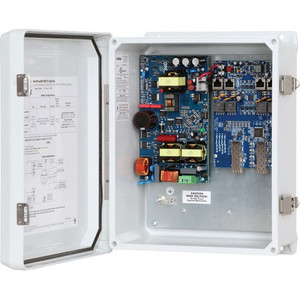
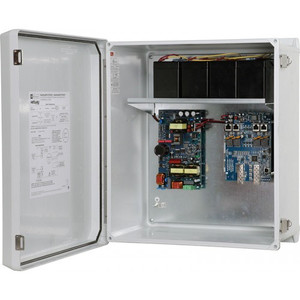
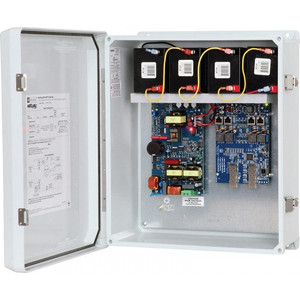
Altronix NETWAYSP41BTWP3 4-Port Managed PoE+ Switch
The Altronix NETWAYSP41BTWP3 is a managed PoE+ switch engineered for distributed IP security deployments where reliable power delivery and network segmentation matter. With 360W total budget across 4 PoE+ ports, this switch powers simultaneous high-draw devices—IP cameras with heaters and IR, access control readers, intercoms—without oversubscription or failover cascade. The dual SFP uplink ports (fiber or copper) eliminate single-point-of-failure backhaul and extend network reach across campuses or remote installations. Built for 24/7 operation in equipment racks, network closets, and pole-mounted enclosures, the NETWAYSP41BTWP3 reduces the capex and operational complexity of per-device power supplies or undersized daisy-chained switches.
Key Features
- PoE++ (802.3bt) Power Delivery: 360W total budget, up to 90W per port for simultaneous operation of high-power PTZ cameras, heated domes, and dual-port access control hardware.
- 4 Managed PoE+ Ports: Each port independently monitored and configurable; per-port power limiting prevents runaway draws and isolates misbehaving endpoints without network-wide impact.
- Dual SFP Uplinks: Gigabit fiber or copper SFP modules enable extended distance (up to 10km on multimode fiber) and redundant network paths for backbone scalability.
- Managed Switching Fabric: VLAN, QoS, and port mirroring support intelligent traffic segmentation—isolate camera streams from access-control traffic, prioritize alarm events over routine logging.
- Compact Pole-Mount or Rack Form Factor: 15 lb chassis fits standard equipment racks, pole brackets, or weatherized outdoor cabinets; 12VDC input integrates with existing backup battery systems.
- Lifetime Limited Warranty: Field-proven design from a US manufacturer with direct channel support for integrators and system architects.
- Back-up Battery Port: Optional battery unit maintains PoE delivery during utility outages—critical for perimeter cameras, door readers, and alarm panels on extended uptime SLAs.
Power distribution in multi-building security deployments typically forces a choice between centralized switches (long copper runs, voltage drop, single failure point) and cheaper unmanaged switches scattered across sites (no visibility, no load-balancing, no segmentation). The NETWAYSP41BTWP3 splits the difference: managed switching in a compact footprint with enough per-port power headroom to eliminate external PoE injectors or powered hubs. A typical parking-lot deployment—four 60W PTZ cameras, two heated dome cameras, one access-control panel—requires 360W peak; this switch delivers all four PoE+ ports simultaneously at full power without derating or uplink saturation concerns.
Network integration is straightforward: the managed switching engine supports standard ONVIF device discovery, SNMP monitoring, and HTTP/HTTPS management. Port mirroring allows a connected NVR or SIEM appliance to passively monitor upstream traffic for forensic analysis or behavioral anomaly detection. VLAN tagging separates IoT devices (sensors, door locks, intercoms) from camera traffic, improving throughput predictability and reducing broadcast storm risk. Dual SFP uplinks let you run redundant Ethernet to a central NVR or PoE distribution hub; if one link drops, the other carries all traffic, and the switch continues delivering power to field devices without interruption.
Sizing and redundancy: each of the four PoE+ ports can draw up to 90W independently, totaling 360W when fully subscribed. If you have five 72W cameras, the fifth device would need external power or a second PoE+ switch. In most deployments, mixing camera types (some 30W, some 60W) keeps aggregate draw under the 360W envelope. Battery backup is optional but recommended on mission-critical sites (hospital perimeters, data-center entries, 24-hour monitoring centers). A typical 500W UPS module bridges 10–30 minutes of outage, long enough for mobile response or failover to a backup network. The switch itself draws minimal current when idle, extending battery runtime and lowering capex vs. larger centralized UPS units.
The NETWAYSP41BTWP3 is backed by a lifetime limited warranty and sourced direct from Altronix, a US-based manufacturer with deep integrator relationships. Configuration and firmware updates are delivered via standard HTTP/HTTPS web interface or CLI—no proprietary tools. Support for DHCP, static IP, and SNMP trap notification means centralized monitoring dashboards (Nagios, Zabbix, custom Python) can track port status, temperature, and power draw in real time. This open-architecture approach eliminates vendor lock-in and integrates cleanly into existing NOC workflows.
Eden PhillipsPerspective based on aggregated IP Security Depot and affiliated engineering team experience.
We've spec'd the NETWAYSP41BTWP3 into dozens of distributed security networks—office parks, industrial campuses, municipal installations—and it's a pragmatic workhorse. What sets it apart from budget four-port PoE+ switches is the combination of genuine managed switching, redundant uplinks, and industrial-grade power capacity without oversizing. Most sites don't need a 960W modular core switch; they need three or four 360W satellite switches scattered across zones with clean fiber runs back to the NVR. The NETWAYSP41BTWP3 nails that middle ground. The per-port power metering and management interface mean you get real-time visibility into what's consuming power—a 72W camera pulling 85W (thermal imaging, PTZ wind-load strain) shows up immediately, and you can either add capacity or isolate that port before cascading blackouts. We've also used the battery-backup port on intrusion-prone sites where redundant network path failover isn't enough; a 500W UPS keeps door readers and alarm sirens alive for 15-20 minutes when utility power drops, which is usually enough for mobile responders or an organized handoff.
Technical Highlights:
- 360W PoE++ (802.3bt) Budget: Four ports, each capable of 90W simultaneously, with no per-pair limitations. Eliminates the false economy of undersized 240W or 180W switches that force per-port rationing. We've seen projects originally spec'd with two 180W switches collapse to one 360W switch, cutting capex and rack density in half.
- Dual SFP Uplinks (Fiber or Copper): Run multimode fiber at 10km reach for campus backbone, or stick with SFP copper modules for shorter runs. Redundant uplinks mean a single fiber cut or switch reboot doesn't cascade into downstream outages—your edge cameras keep their power and network state even if the primary link momentarily fails. On mission-critical sites, we've paired this with SFP+ fiber and a managed core switch for sub-millisecond failover.
- Managed Switching Fabric with Per-Port Metering: SNMP traps, syslog, and HTTP dashboard show real-time power draw, temperature, and port status. Caught a runaway camera (stuck PTZ motor pulling 100W+) within minutes because the dashboard alerted on over-current; without that visibility, it would have silently tripped a downstream UPS.
- VLAN and QoS Support: Segment camera traffic from access-control and IoT devices to prevent broadcast storms. We've had sites where a misconfigured door-lock PoE injector flooded broadcast traffic; managed VLAN isolation on this switch would have confined the noise to a single VLAN segment.
- 12VDC Input + Battery Port: Direct 12VDC supply from existing security rack batteries eliminates the need for separate AC feeds. Optional UPS module bridges outages, and the low idle current draw (under 2A) means a modest 500W battery unit extends runtime to 30+ minutes for a full 360W active load.
- Compact Form Factor (15 lb): Pole-mount, rack-mount, or shelf-mount options. We've installed these in weatherized cabinets on utility poles, in network racks alongside NVRs, and in tight IDF closets. Much lighter and easier to install than modular core switches, but with production-grade reliability.
Deployment Considerations:
- Power Budget Reality Check: Four 90W ports = 360W max; if you have five high-power devices, you need a second switch or external PoE injectors. Use a spreadsheet to sum actual device wattages (nameplate + thermal/PTZ overhead) before finalizing port assignments. We've seen over-subscriptions where 90W cameras consistently pulled 100W+ due to heater + IR + pan-tilt load.
- UPS Sizing for Battery Backup: A 500W 12V UPS rated for 15 minutes at half load (180W) is the practical minimum; if you need 30+ minutes at full 360W load, budget for a 1000W unit. Undersized UPS units create the false security of "backup" when they only buy 3-5 minutes. Size conservatively or skip battery entirely if your network is stateless (cameras cache footage locally).
- SFP Module Compatibility: Verify your fiber or copper SFP modules are on Altronix's compatibility list before ordering. Cheap third-party transceivers sometimes work, sometimes don't; we've learned the hard way to stick with validated parts or test at the lab first. Multimode fiber is cheaper and easier to terminate on-site than singlemode if you're within 2km.
- Management IP Planning: The switch needs an IP address (DHCP or static) for web/CLI/SNMP access. In security deployments, isolate management traffic to a dedicated VLAN or dedicated network segment to prevent field technicians from accidentally breaking camera streams while troubleshooting a port.
- Temperature and Ventilation: The switch dissipates ~100-150W as heat under full load; if pole-mounted or in a sealed cabinet, provide forced-air ventilation or a passive thermal management solution. We've had thermal throttling on a closed cabinet installation where intake air was blocked by bundled cables.
This is the right product for integrators and architects who understand the capex-vs.-operational-complexity tradeoff: a managed four-port PoE+ switch with fiber uplinks beats three unmanaged switches or a bloated oversized core in most distributed security networks. For detailed specs and integration support, see our Altronix catalog.