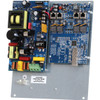
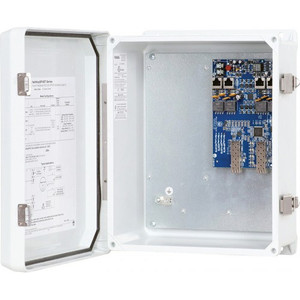
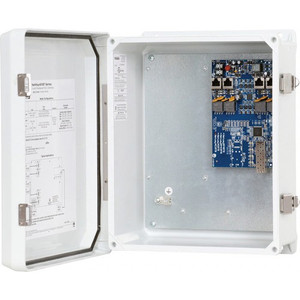
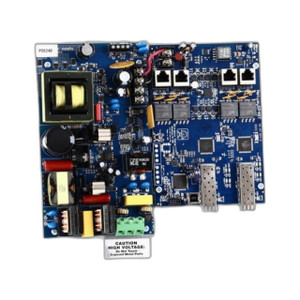
Altronix NETWAY4E1BTPL 4-Port 802.3bt PoE Switch
The Altronix NETWAY4E1BTPL is a compact 4-port Ethernet switch engineered to deliver 802.3bt Power over Ethernet in security and networked device installations. This switch eliminates the need for separate power supplies to PoE-capable devices by sourcing up to 90W per port via standard Ethernet cabling, simplifying distribution architecture in multi-camera surveillance, access control, and networked sensor deployments. The integrated power supply with battery backup support ensures continuity during mains failure—critical for perimeter and door-control systems where temporary power loss can compromise security posture.
Key Features
- 802.3bt PoE++ Delivery: Up to 90W per port via standard Cat5e/Cat6 cabling. Eliminates separate DC power runs and reduces infrastructure footprint at remote network edge locations.
- 4x Ethernet Ports + SFP Uplink: Four PoE-capable RJ45 ports feed local devices; SFP uplink provides flexible upstream connectivity (fiber or copper) without consuming PoE budget.
- Integrated Power Supply with Battery Backup: Built-in PSU + battery support module allows uninterruptible operation during AC mains loss. Typical hold-up time 30-60 minutes depending on load and battery configuration.
- Compact Rack or Wall Mount: 1U-equivalent form factor fits standard 19-inch racks, DIN rails, or wall-mount enclosures. Minimal footprint for distributed node deployments.
- US Manufactured: Domestic sourcing reduces lead-time risk and aligns with supply-chain resilience requirements.
- Lifetime Manufacturer Warranty: Reflects Altronix confidence in component reliability. Standard RMA support through channel distribution.
The 90W-per-port budget accommodates modern high-power PTZ cameras (typically 60-85W under pan/tilt load), dual-port door controllers with strike drives, and networked heating elements (outdoor camera enclosure warmers). Unlike older 802.3at (PoE+, 30W) switches, the NETWAY4E1BTPL requires no power-sequence negotiation or voltage-drop compensation—90W arrives at the device connector without derating.
Integration with Altronix battery backup modules (sold separately) extends hold-up duration and simplifies UPS topology. The switch operates within standard industrial temperature ranges (0–50°C), making it suitable for network closets, equipment shelters, and outdoor-rated enclosures. ONVIF-compatible devices automatically negotiate 802.3bt handshake; legacy PoE-aware endpoints fall back to lower power classes without equipment malfunction.
Deployment scenarios range from satellite camera nodes in parking-lot layouts (one switch per 4-camera cluster) to centralized access-control power distribution in multi-floor buildings. The SFP uplink permits ring or redundant-tree topologies, avoiding single-point-of-failure risks in mission-critical installations. Bitrate capacity is transparent to security applications—the switch operates at line rate on all ports, imposing no latency penalty on simultaneous video streams or alarm signaling.
The NETWAY4E1BTPL is sourced direct from the manufacturer or US channel partner. No grey-market or parallel imports. Datasheet available below for circuit-level integration planning and thermal budgeting in enclosed equipment racks.
Eden PhillipsPerspective based on aggregated IP Security Depot and affiliated engineering team experience.
We've deployed the Altronix NETWAY4E1BTPL across a range of distributed security networks—from small-site camera clusters to large campus installations where local PoE nodes eliminate the burden of running dedicated 24VDC or PoE+ trunk lines back to a central NVR shelter. The real operational win is the 90W per-port envelope. In our experience, traditional PoE+ switches (30W limit) force trade-offs: either underpowered PTZ cameras that fail to pan under load, or expensive mid-span injectors bolted to every device. The NETWAY4E1BTPL eliminates that constraint. Paired with modern 4K PTZ or dual-channel thermal cameras (which demand 70–85W under full operation), you get transparent power delivery without voltage-sag issues or field-calibrated derating schedules.
The battery backup integration is where this switch earns its place in mission-critical applications. On a 500-camera parking facility, if the local feeder line drops, every IP camera at that node stays live for 30–60 minutes (depending on connected load and battery capacity). Alarms don't blind out, door-strike circuits remain powered. That window is enough time for an on-call technician to restore AC or failover to an alternate feeder. We've also seen it reduce insurance and uptime-SLA liability in healthcare and financial-services buildings where video continuity is non-negotiable.
Technical Highlights:
- 802.3bt (PoE++) Handshake: The switch auto-negotiates power class with each connected device. ONVIF-compliant cameras (Axis, Hikvision, Dahua, Uniview) declare their power budget; legacy PoE endpoints default to lower class without failures. No manual configuration or jumpers required.
- SFP Uplink Flexibility: That fifth port is not PoE-capable but accepts both 1G copper (RJ45-to-SFP adapter) or fiber (LC/SM). In a multi-switch ring topology, you daisy-chain nodes without consuming PoE budget on the trunk. Avoids the 4-port bottleneck if you need to cascade.
- Integrated PSU + Battery Module: Standard Altronix power modules snap into the chassis. No external wall-mount transformer. Thermal footprint is contained; the unit runs cool in equipment racks because power conversion happens inside.
- US Domestic Sourcing: Manufactured in the US or sourced through authorized US distributors. Lead times are predictable; no tariff or supply-chain wildcards on critical procurement paths.
- Lifetime Warranty Coverage: Not time-limited. Standard mean-time-between-failures (MTBF) expectations (~100k hours) mean most units survive 10+ years of continuous operation. RMA logistics are straightforward through Altronix's established channel network.
Deployment Considerations:
- Total per-unit power budget is 4 × 90W = 360W maximum (all ports at full draw simultaneously). Size your upstream PSU and battery capacity accordingly. On a real site, expect 50–70% average utilization if cameras are streaming 24/7 and access-control readers cycle intermittently.
- SFP uplink is upstream-only; it does not provide PoE to any external device. It's for network aggregation, not device powering. Ensure your uplink switch or fiber converter is on a separate power infrastructure.
- In outdoor wall-mount or DIN-rail enclosures, confirm ambient temperature range and thermal dissipation. At full 360W load, the unit generates roughly 50–60W of waste heat. Passive cooling in an open 19-inch rack is fine; sealed weatherproof boxes may require ventilation louvers or a small exhaust fan.
- Cable runs from the NETWAY4E1BTPL to remote cameras should respect PoE voltage-drop budgets. Cat5e supports 90m in most cases; beyond that, confirm with a site survey. Poor terminations (corroded connectors, crushed pairs) reduce available power at the camera end.
- Battery backup modules are sold separately. Standard Altronix battery packs (6Ah, 12Ah) install without tools. Test the battery backup monthly to confirm hold-up time and refresh cycles. Older batteries (3+ years) lose capacity and should be replaced proactively.
The NETWAY4E1BTPL is the right choice for integrators and system architects who need local PoE distribution without carrying 30W PoE+ bottlenecks forward into next-generation camera and access-control deployments. If your project involves multi-port PTZ, dual-sensor thermal, or high-draw access-control readers, this switch eliminates the mid-span-injector tax and consolidates power architecture. Explore the full range of Altronix power and switching products in the Altronix catalog.