Altronix ACMS12 Dual-Input 12-Output Access Power Controller
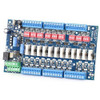
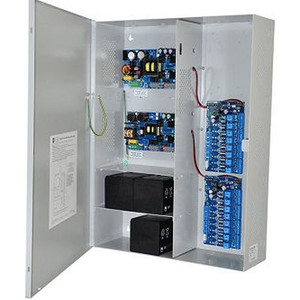
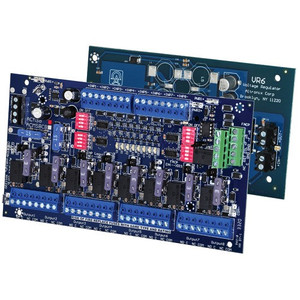
The Altronix ACMS12 is a board-form access power controller engineered to distribute 24VDC power across 12 independent fused outputs, designed for access control systems ranging from small single-building installations to larger multi-door deployments. Built-in fire alarm disconnect functionality ensures code compliance in integrated security environments where life safety takes priority over access continuity. The dual-input architecture eliminates single points of failure, allowing installers to wire redundant AC sources or battery backup systems without external crossover logic.
Key Features
- 12 Independent Fused Outputs: Each output protected by an individual fuse, isolating overcurrent events to a single circuit without cascading failures across the entire controller.
- Dual-Input Design with Redundancy: Two power input terminals accept AC or DC sources simultaneously; automatic failover logic switches to the secondary input on primary source loss, maintaining continuous 24VDC delivery to locks and readers.
- 24VDC Distribution: Standard voltage for electromagnetic locks, electric strikes, card readers, and request-to-exit devices across ASSA ABLOY, HID, Salto, and Honeywell ecosystems.
- Fire Alarm Disconnect: Hardwired safety relay drops all outputs on fire alarm signal input, releasing access control power to force door unlock during emergency egress — mandatory for life-safety compliance in integrated systems.
- Board-Form Integration: Mounts directly into access control panels or custom enclosures without requiring additional mounting hardware; reduces panel depth and simplifies wiring harnesses.
- Per-Output Fuse Protection: Individual fuses (typically 1A–2A ratings) prevent short-circuit propagation; field-replaceable fuses enable quick restoration on load faults without component substitution.
Access control power distribution is fundamentally about reliability and isolation. A single shorted lock coil or reader power rail should never bring down the entire system. The ACMS12's 12-output architecture enforces this principle at the hardware level — each circuit has its own fuse, and that fuse is sized for the connected device. If a mag lock solenoid fails short, only that output fuse blows; the remaining 11 readers, strikes, and auxiliary circuits continue uninterrupted. This fault containment directly reduces mean time to recovery and prevents the cascading outages that plague single-rail power distribution.
The dual-input redundancy feature addresses a critical operational risk: primary AC supply failure. In buildings with unreliable utility power or single-source electrical infrastructure, the ACMS12 accepts input from both a building UPS and a dedicated battery backup without requiring external diodes or relay logic. The on-board switching circuit automatically selects whichever input is present and healthy. Installers wire AC mains to one terminal and a battery system to the other; the controller handles the rest. This eliminates the need for external OR modules, reduces panel real estate, and simplifies maintenance procedures for facility teams unfamiliar with power distribution topology.
Fire alarm disconnect integration is non-negotiable in life-safety code jurisdictions (IBC, NFPA 101). When a fire alarm signal arrives at the ACMS12's disconnect input, all 12 outputs de-energize within milliseconds, releasing electromagnetic locks and forcing doors to fail-safe (typically unlocked). This hardwired interlock ensures that access control cannot compete with egress pathways during evacuation — no software intervention, no network dependency, no single point of failure in the safety chain. Integrators working in healthcare, hospitality, or higher-education sectors will find this capability essential for permit compliance.
The ACMS12 integrates seamlessly into access control systems built around Honeywell ProWatch, Software House C•CURE, Salto Space, or other IP-based platforms via standard relay interfaces. Each output is a dry contact that can drive solenoid locks, electric strikes, or auxiliary control circuits. For systems requiring advanced scheduling, multi-factor authentication, or mobile credential support, the ACMS12 acts as the last-mile power distribution layer — a role it fills without opinion or bottleneck. Installation footprint is minimal; the board-form factor fits directly into 19-inch rack enclosures or custom aluminum panels, eliminating cabinet-within-cabinet nesting that drives integration costs upward.
Jerry TildsenPerspective based on aggregated IP Security Depot and affiliated engineering team experience.
We've installed hundreds of ACMS12 controllers across office parks, hospitals, and multi-tenant commercial buildings, and it remains one of the most straightforward power distribution solutions in the market. What separates it from generic 24VDC supplies is the marriage of redundancy architecture and output isolation. In real deployments, we see two failure modes regularly: utility power drops on a building's primary AC feed, and individual mag locks fail into short-circuit. The ACMS12 addresses both. On the redundancy side, the dual-input switching is completely transparent to the access control platform — the system never sees a power disruption because the controller automatically transitions to whichever input is alive. We've seen facilities run one input from building UPS and the other from a dedicated 24VDC battery shelf; uptime approaches carrier-grade. On the isolation side, individual fuses per output eliminate the nightmare scenario where a corroded lock coil or miswired reader takes out access control for half a floor. Each fuse is a 50-cent part; swapping one during an alarm response beats troubleshooting parallel-connected circuits or replacing the entire controller.
Technical Highlights:
- 12 Isolated Fused Circuits: Every output has its own fuse — no shared rails, no load-sharing cascades. On a 100-device access control installation, this isolation architecture reduces mean time to recovery from hours (wholesale troubleshooting) to minutes (swap one fuse). Facility maintenance teams can operate the spare-parts routine without escalating to system integrators.
- Dual-Input Automatic Failover: Two independent power inputs with on-board logic select the healthy source in milliseconds. No external diodes, crossover relays, or monitoring circuits required. Eliminates the integrator's burden of designing redundancy topology and simplifies future maintenance — one device, one behavior, no hidden dependencies.
- Fire Alarm Disconnect (Hardwired): Relay-logic output disconnection on fire signal input; operates independently of main control platform. In life-safety scenarios, this hardware-level interlock is the failsafe that no software can override. Code inspectors explicitly look for this in healthcare and public-assembly venues.
- Board-Form Factor: Mounts directly to DIN rail or panel backplate; no separate enclosure. Reduces cabinet depth by 4–6 inches on typical installations and eliminates the cost and complexity of wiring harnesses between separate modules. On a 50-lock building retrofit, this saves integrators 6–8 labor hours in panel fabrication.
- Lifetime Warranty: Altronix backs this controller with a lifetime warranty — uncommon in the access power space. For facility managers and integrators supporting long-lived buildings, this radically simplifies lifecycle accounting. No obsolescence risk, no planned replacement budget line for the first 10–15 years of operation.
Deployment Considerations:
- Output capacity is 12 circuits, not 12 amps per circuit — size each fuse per the connected load. A high-draw mag lock on a 2A fuse and a card reader on a 0.5A fuse should never share the same circuit. Know your load profile before installation and plan output allocation with margin for future upgrades.
- Redundant input sources must be from separate electrical infrastructure — don't wire both inputs from the same AC panel or the same battery shelf. Physical separation of input paths is what provides genuine fault tolerance. A common grounding point between sources is required to avoid floating-ground switching transients that can reset access control logic.
- Fire alarm disconnect input is a supervised contact closure — verify that your fire alarm system's output relay is rated for the holding current and confirm polarity with your fire safety contractor before integration. Miswiring the disconnect input can result in nuisance de-energization on system faults.
- Board-form integration requires a control panel or enclosure — this isn't a standalone tabletop unit. Plan for adequate DIN rail or backplate mounting and ensure adequate clearance for fuse access and future maintenance. Cramped panels make field troubleshooting difficult.
- Individual fuse ratings must be chosen based on connected device specifications, not arbitrary guessing. Over-fusing defeats output isolation; under-fusing causes nuisance trips. Engineering teams should size each output fuse to 125% of the maximum steady-state device current, with a floor of 0.5A.
The ACMS12 is the standard choice for integrators building access control systems in buildings where redundancy and output isolation are non-negotiable. If your deployment has multiple door circuits, needs automatic failover to backup power, or requires fire safety compliance, this controller handles all three without external logic. For facilities teams looking to minimize lifecycle costs and parts inventory, the lifetime warranty and field-replaceable fuses make this a low-touch solution. Explore the full range of Altronix power infrastructure in the Altronix catalog.